You are typing fast. You reach for a word. Is it “than” or “then”? You stop. You doubt yourself. You are not alone.
Every day, millions of people search for “than or then.” The two words look almost the same. They sound almost the same. But they do very different jobs. One small slip can make an email, a post, or a school paper look sloppy.
People search this keyword for one reason. They want a fast answer. They want to know which word fits their sentence right now. Some also want to know why English has two words that look so close. Others wonder if the answer changes in the US and the UK.
This guide solves all of that. You will get the quick answer first. Then you will learn where the words came from. You will see real examples, common mistakes, and easy tricks to remember the rule. You will also find answers to the questions people ask most.
By the end, you will never second-guess “than or then” again. Let’s start with the short answer.
Than or Then – Quick Answer
Here is the rule in one line:
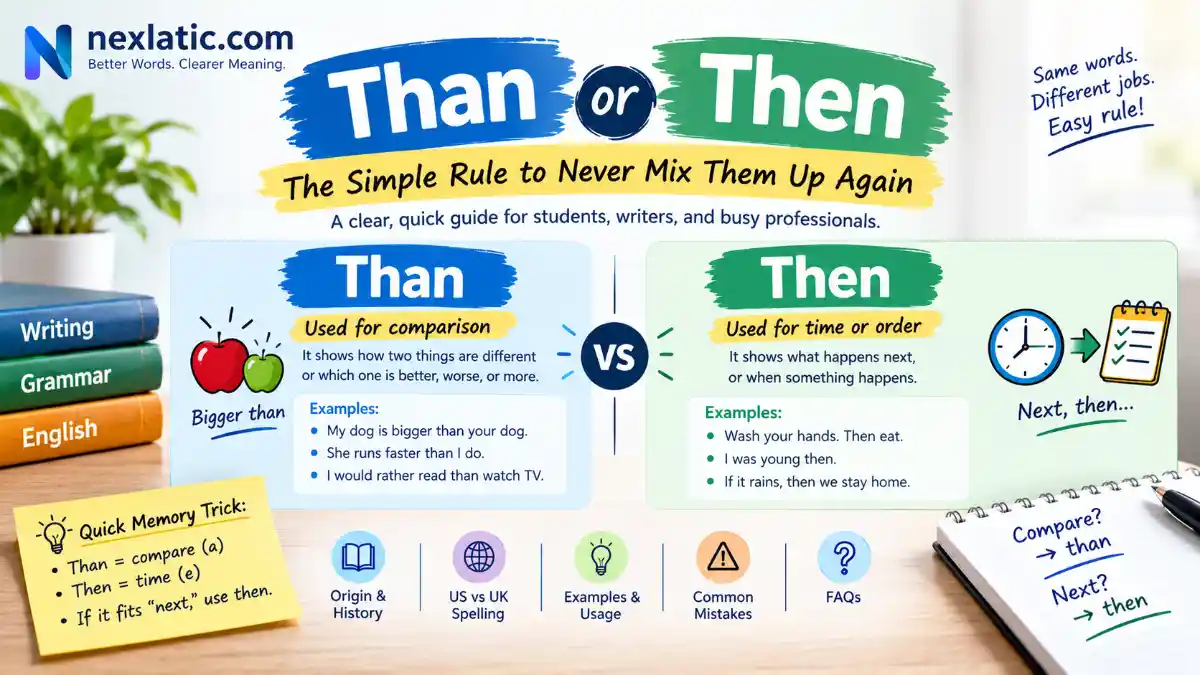
- Than is for comparing two things.
- Then is for time or order. It means “next” or “at that time.”
Examples with “than”:
- My dog is bigger than your dog.
- She runs faster than I do.
- I would rather read than watch TV.
Examples with “then”:
- Wash your hands. Then eat.
- I was young then.
- If it rains, then we stay home.
Easy memory tricks:
- Than and compare both have the letter a.
- Then and when both have the letter e. Both talk about time.
If you are comparing, use than. If you are talking about time or the next step, use then.
The Origin of Than or Then
These two words have the same roots. Long ago, in Old English, people used forms like thanne, thenne, and thonne. They meant both “at that time” and “compared to.”
For hundreds of years, writers used the words in a loose way. One spelling could do both jobs. Spelling was not fixed back then. There were no strict rules, and there were no big dictionaries.
Around the 1700s, things began to change. Printing spread. Dictionaries grew. Writers wanted clear rules. Slowly, English split the old word into two:
- Than took the job of comparing.
- Then kept the job of time.
So why do the spellings look so close? Because they are cousins. They came from the same word. Only one vowel changed. That one letter now carries a big difference in meaning.
This is also why the mix-up is so common. Your brain sees two words from one family. It is easy to grab the wrong one.
British English vs American English Spelling
Here is the good news. There is no spelling difference between British and American English for these words. Both use “than” for comparing. Both use “then” for time.
This is not like “color” and “colour,” or “center” and “centre.” The rules for “than or then” are the same everywhere.
Still, a few small habits differ. Some people mix up the words more in fast, casual writing. This happens in the US, the UK, Canada, Australia, and India alike.
| Feature | American English | British English |
| Spelling of “than” | than | than |
| Spelling of “then” | then | then |
| Meaning of “than” | Comparing | Comparing |
| Meaning of “then” | Time or next step | Time or next step |
| Example | She is taller than me. | She is taller than me. |
| Example | We ate, then we left. | We ate, then we left. |
| Common phrase | “Different than” is used often | “Different from” is used more often |
The last row is the one real difference. Many Americans say “different than.” Many British speakers prefer “different from” or “different to.” This is about style, not about “than” versus “then.”
Which Spelling Should You Use?
You do not need to pick a side. Use the rule the same way every time.
If your readers are in the US:
- Use “than” to compare and “then” for time.
- “Different than” is fine in casual writing. “Different from” is safer in formal writing.
If your readers are in the UK or Commonwealth countries:
- Use the same rule.
- Prefer “different from” in formal writing.
If your readers are global:
- Stick to the plain rule. Compare with “than.” Show time with “then.”
- Keep sentences short. Short sentences make mistakes easy to spot.
- Read your text out loud before you hit send.
Professional tip: Always proofread. A spell checker will not catch this error. Both words are real words, so the tool sees nothing wrong.
Common Mistakes with Than or Then
Here are the errors people make most often.
| Wrong | Right | Why |
| She is taller then me. | She is taller than me. | This is a comparison. |
| I would rather walk then drive. | I would rather walk than drive. | “Rather” signals a comparison. |
| More then ever. | More than ever. | “More” needs “than.” |
| First we eat, than we go. | First we eat, then we go. | This shows order. |
| If you study, than you pass. | If you study, then you pass. | This is an if-then idea. |
| Better then nothing. | Better than nothing. | This is a comparison. |
A fast test: Say “next” in place of the word. If the sentence still works, use then. If it does not, use than.
- “First we eat, next we go.” It works. Use then.
- “She is taller next me.” It fails. Use than.
Another sign: Words like more, less, better, worse, rather, other, and any word ending in -er are usually followed by than.
Than or Then in Everyday Examples
Seeing the words in real places helps the rule stick.
In emails:
- I can send the file sooner than planned.
- Please review the draft. Then send me your notes.
In news headlines:
- Prices rise faster than wages.
- Leaders met on Monday. Then they signed the deal.
On social media:
- Coffee is better than sleep. Fight me.
- Woke up late. Then missed the bus. What a day.
In formal writing:
- The results were higher than expected.
- The team tested the product. Then it was approved for sale.
In school essays:
- Dogs are more loyal than cats, some say.
- First, state your idea. Then give proof.
Notice the pattern. In every “than” sentence, two things are being compared. In every “then” sentence, something happens next, or a time is named.
Than or Then – Google Trends & Usage Data
People around the world search for this keyword. It is one of the most common grammar questions in English. Search interest tends to come from places where English is widely used in school and work, such as the United States, the United Kingdom, Canada, Australia, India, Pakistan, Nigeria, and the Philippines.
What drives the searches?
- School and exams. Students check the rule when they write essays.
- Work writing. People double-check emails, reports, and résumés.
- Social media. Public mistakes often start people searching.
- English learners. Many learners find the two words confusing.
Related searches often include:
- “than vs then”
- “then or than grammar”
- “more than or more then”
- “rather than or rather then”
- “different than or different from”
Search interest is usually steady all year. It often rises a little during school terms and exam seasons. For the latest numbers, open Google Trends, type “than or then,” and compare countries and dates yourself. Live data changes, so checking it fresh gives the best picture.
Comparison table: keyword variations side by side
| Phrase | Correct? | Notes |
| than | Yes | Used to compare |
| then | Yes | Used for time or next step |
| more than | Yes | Always use “than” after “more” |
| more then | No | Common typing mistake |
| rather than | Yes | Shows a choice or comparison |
| rather then | No | Wrong word |
| better than | Yes | Comparison |
| better then | No | Wrong word |
| and then | Yes | Shows next step |
| and than | No | Wrong word |
| if…then | Yes | Shows cause and result |
| if…than | No | Wrong word |
| different than | Yes (informal, mostly US) | “Different from” is safer |
Frequently Asked Questions
1. What is the difference between “than” and “then”?
“Than” compares two things. “Then” talks about time or what comes next. For example: “I am taller than you” and “I stood up, then I left.”
2. Is it “more than” or “more then”?
It is always “more than.” “More” is a comparison word, so it needs “than.”
3. Is it “rather than” or “rather then”?
It is “rather than.” You are choosing one thing over another. That is a comparison.
4. Is it “better than” or “better then”?
It is “better than.” “Better” compares things.
5. Does “than or then” change in British and American English?
No. The spelling and meaning are the same in both. Only phrases like “different than” and “different from” vary by habit.
6. Can I use “then” in an if-then sentence?
Yes. “If you call, then I will answer.” Here, “then” shows the result. You can also drop it: “If you call, I will answer.”
7. How can I remember the difference fast?
Think: than = compare (both have an a). Then = time (think when, both have an e). You can also swap in the word “next.” If it fits, use “then.”
8. Will spell check catch this mistake?
Usually not. Both are real words, so the tool may stay silent. Always read your work out loud or ask someone to proofread it.
Conclusion
The “than or then” question has a simple answer. Use than when you compare. Use then when you talk about time or the next step. That is the whole rule.
These two words come from the same old word. Over time, English split them in two. That is why they look so alike and why people mix them up. The good news is that the rule is the same in the US, the UK, and every other English-speaking place. No spelling change to worry about.
Remember the quick tricks. Than and compare share the letter a. Then and when share the letter e. You can also swap in “next.” If the sentence still works, pick then.
Watch for the common slips: “more then,” “rather then,” and “better then.” All three are wrong. The right forms are “more than,” “rather than,” and “better than.”

David Wilson is a writer and contributor at Nexlatic.com, where he writes about useful topics, everyday questions, and practical ideas. He enjoys turning information into simple, clear, and easy-to-read articles that readers can actually use. Through his work at Nexlatic, David aims to share helpful content that answers common questions, explains confusing topics, and gives readers something useful to take away from every article.