You are typing a sentence. You want to say someone is fake. Then you stop. Is it “phoney” or “phony”? You look at both words. They both look right. Now you are not sure.
You are not alone. Thousands of people search “phoney or phony” each month. The two spellings look almost the same. They sound the same too. But one feels more British and one feels more American. That is why people get stuck.
This guide clears up the confusion. You will get a quick answer first. Then you will learn where the word came from. You will see how British and American spelling differ. You will learn which spelling to use for your reader. We also share common mistakes, real examples, and answers to common questions.
By the end, you will know exactly which word to pick. You will not need to guess again. Whether you write emails, blog posts, school papers, or social media posts, you will feel sure about your choice.
Let’s start with the short answer.
Phoney or Phony – Quick Answer
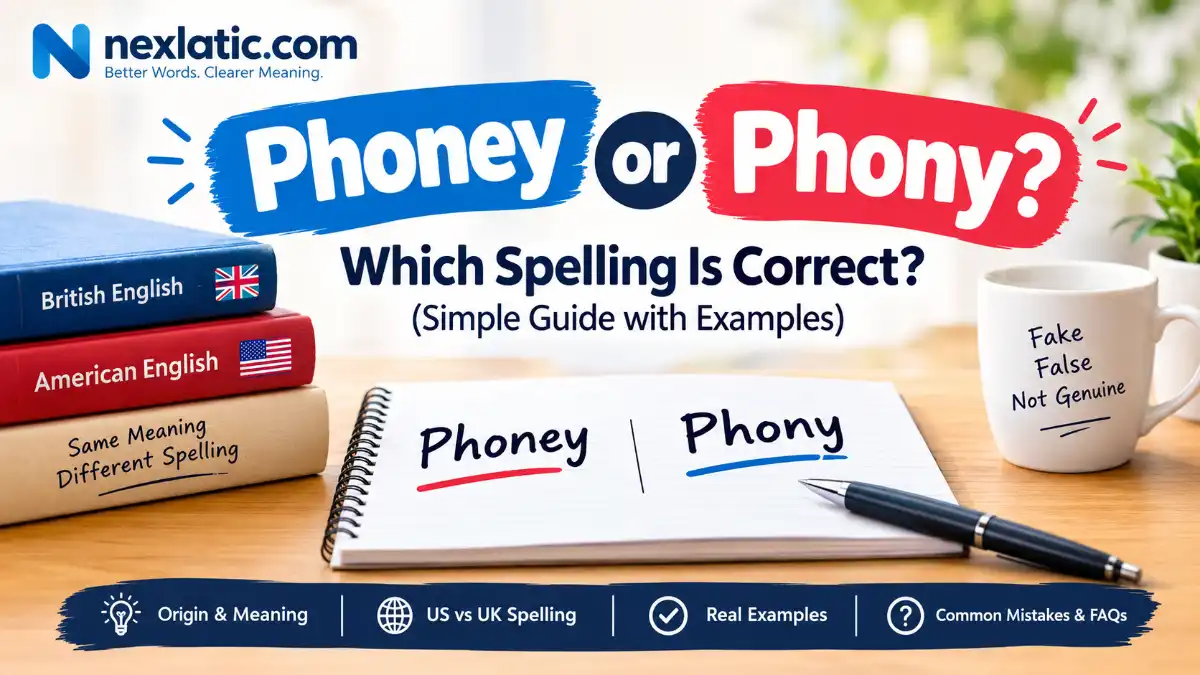
Both spellings are correct. They mean the same thing: fake, false, or not honest.
- Phony is the American English spelling.
- Phoney is the British English spelling.
That is the whole rule. The meaning does not change. Only the spelling changes.
Examples:
- American: “He gave me a phony smile.”
- British: “He gave me a phoney smile.”
- American: “That phony website stole my money.”
- British: “That phoney website stole my money.”
The word can be an adjective or a noun. As an adjective, it describes fake things: a phony accent. As a noun, it names a fake person: “He is a phony.”
Quick tip: Writing for the US? Use phony. Writing for the UK? Use phoney. Pick one and stay with it.
The Origin of Phoney or Phony
The word “phony” is not very old. It first showed up in American slang in the late 1800s. People used it to describe fake things and fake people.
Nobody knows its exact origin. But there is a popular idea. Many word experts link it to an old English slang word, fawney. A fawney was a gold-colored brass ring. Tricksters sold these rings as real gold. This con was called the “fawney rig.” The word may also connect to the Irish word fáinne, which means “ring.”
Some people think “phony” comes from the word “telephone.” This is a popular guess, but it is not proven. Most experts do not trust it.
Why are there two spellings?
The word was slang at first. Slang has no fixed spelling. Writers spelled it as they heard it. Over time, American writers settled on phony. British writers kept phoney.
The British form got a big boost in 1939. That year, the “Phoney War” began. This was the quiet early period of World War II, when little fighting took place. The name stuck in British writing, and it made phoney feel even more British.
British English vs American English Spelling
British and American English spell many words in different ways. Some changes are small. A single letter can be the only difference. The phoney/phony pair is a good example.
Here is a simple pattern. In many words, British English keeps extra letters. American English often makes words shorter.
| Word Type | American English | British English |
| Fake (adjective) | phony | phoney |
| Fake person (noun) | phony | phoney |
| Color | color | colour |
| Flavor | flavor | flavour |
| Center | center | centre |
| Theater | theater | theatre |
| Realize | realize | realise |
Notice the pattern? American spelling is often simpler. British spelling often keeps older forms.
One small point: the plural. In American English, you write phonies. In British English, you write phoneys. Both forms follow the same spelling split.
Which Spelling Should You Use?
Your reader decides the answer. Think about who will read your work.
Writing for a US audience? Use phony. This is the standard in American books, news, and schools.
Writing for a UK audience? Use phoney. The same goes for Ireland, Australia, New Zealand, India, South Africa, and other Commonwealth countries, where British-style spelling is common.
Writing for a global audience? Pick one spelling and use it every time. Phony is a safe choice because it is the shorter form and is widely seen online. But if your brand uses British English, use phoney everywhere.
Writing for school or work? Check the style guide first. Many schools and companies tell you which English to use.
The golden rule: be consistent. Do not write phony in one line and phoney in the next. Mixed spelling looks careless.
Common Mistakes with Phoney or Phony
Here are the mistakes people make most often.
1. Mixing both spellings in one text
- Wrong: “He is a phony. His phoney smile fooled us.”
- Right: “He is a phony. His phony smile fooled us.”
2. Using the wrong plural
- Wrong: “Those phonys are lying.”
- Right: “Those phonies are lying.” (US) or “Those phoneys are lying.” (UK)
3. Writing “fony” or “phonny”
- Wrong: “That was a fony excuse.”
- Right: “That was a phony excuse.”
4. Mixing it up with “phone”
- Wrong: “He is a phone.”
- Right: “He is a phony.”
5. Thinking one spelling is wrong
- Neither spelling is a typo. Both are real. Do not “correct” someone just because they use the other one.
6. Using it in a way that is too harsh
- “Phony” is a strong word when used for a person. In formal writing, “insincere” or “dishonest” may sound kinder.
Phoney or Phony in Everyday Examples
Seeing these words in real-life situations makes their meaning easier to remember. Both phony and phoney mean fake, false, or not genuine. However, phony is the standard American spelling, while phoney is commonly used in British English.
In emails
- (US) “We received a phony invoice. Please do not pay it.”
- (UK) “We received a phoney invoice. Please do not pay it.”
In news headlines
- (US) “Police stop phony charity scam.”
- (UK) “Police stop phoney charity scam.”
On social media
- (US) “Her fake laugh sounded so phony.”
- (UK) “His fake accent sounded so phoney.”
In formal writing
- (US) “The report found that the claims were phony.”
- (UK) “The report found that the claims were phoney.”
In books and movies
Writers often use these words to describe characters who pretend to be someone they are not. For example, a person who acts friendly only to gain something may be described as a phony or a phoney.
In daily speech
Both spellings appear in everyday conversations when people describe dishonest behavior or something that seems suspicious.
- “That deal sounds phony.” (It sounds fake.)
- “Don’t be a phoney.” (Don’t pretend to be someone you’re not.)
Although the spelling differs, the meaning remains the same. Choose phony for American English and phoney for British English to keep your writing consistent.
Phoney or Phony – Google Trends & Usage Data
Search tools like Google Trends show how often people search for words in each country. The exact numbers change over time, so check Google Trends for fresh data. But the general pattern is steady and easy to understand.
Popularity by country
- United States: Phony is the main spelling. Most searches and writing use this form.
- United Kingdom: Phoney is more common. Many UK writers prefer it.
- Canada: Canadians mix British and American habits. Phony is common, but phoney also appears.
- Australia, New Zealand, Ireland: These countries often lean toward the British form, phoney.
- India and South Africa: Usage varies, but British-style spelling is widely taught.
Why people search for it
- They want to check the right spelling before they publish.
- They want to know if one spelling is wrong.
- They are curious about the word’s history.
- They are learning English.
Usage by context
- Phony appears often in US news, books, and casual talk.
- Phoney appears often in UK news and in the phrase “Phoney War.”
Spelling variations side by side
| Variation | Region | Correct? | Example |
| phony | US | Yes | “A phony smile” |
| phoney | UK, Commonwealth | Yes | “A phoney smile” |
| phonies | US plural | Yes | “Many phonies” |
| phoneys | UK plural | Yes | “Many phoneys” |
| fony | None | No | Spelling error |
| phonny | None | No | Spelling error |
FAQs
1. Is it phoney or phony?
Both are correct. Phony is American. Phoney is British.
2. What does phony mean?
It means fake, false, or not real. It can describe a thing or a person.
3. Is phoney a real word?
Yes. It is the standard British spelling of phony. It is in major British dictionaries.
4. Which spelling is more common?
It depends on the country. Phony leads in the US. Phoney leads in the UK.
5. What is the plural of phony?
In American English, it is phonies. In British English, it is phoneys.
6. Where does the word come from?
It began as American slang in the late 1800s. Many experts link it to the old slang word fawney, a fake gold ring.
7. Is phony a rude word?
It can be. Calling a person a phony is a strong insult. Use it with care in formal or polite writing.
8. Can I use both spellings in one article?
No. Pick one and keep it the same all the way through.
Conclusion
So, which is right: phoney or phony? The answer is simple. Both are right.
Phony is the American spelling. Phoney is the British spelling. They mean the same thing: fake or not real. The word began as slang in the late 1800s. It may come from an old trick that used fake gold rings. Its spelling split over time, just like many other English words.
Here are the key points to remember:
- Use phony for US readers.
- Use phoney for UK and most Commonwealth readers.
- Always stay consistent in one piece of writing.
- Watch the plural: phonies (US) and phoneys (UK).
- Avoid spelling errors like “fony” and “phonny.”
When in doubt, think about your reader. Who are you writing for? Match your spelling to them. If you write for the whole world, choose one form and stick with it.
Now you can write with confidence. No more second-guessing. Pick your spelling, keep it steady, and move on to your next sentence.

Ali Bismal is the founder and writer behind Nexlatic.com, a growing online platform created to provide useful, informative, and easy-to-understand content for everyday readers. Through Nexlatic, Ali shares practical ideas, helpful guides, interesting topics, and engaging articles designed to make information simple and accessible. His goal is to create reliable, reader-focused content that helps people learn something new, find useful answers, and make everyday life a little easier.