Picture this. You are typing a message, and your phone, calendar, and laptop all need to match. You write, “I synced the files.” Then you stop. Is it synched? Or synced? Many people pause at this exact spot.
You are not alone. In fact, many people search “synched or synced” online. Either way, the word looks odd. For one, the “ch” in synched looks like it should sound like “church.” Meanwhile, the “c” in synced looks like it needs a “k.” As a result, both spellings feel half right.
This confusion makes sense. After all, the base word, “sync,” is short for “synchronize,” and it ends in a hard “k” sound. Because English has no clean rule for adding “-ed” to a word like that, writers simply guess.
This guide ends the guessing. Here, you will get a quick answer, the word’s history, spelling rules, and real examples. Moreover, you will learn which form to pick for your reader. Let’s start.
Synched or Synced – Quick Answer
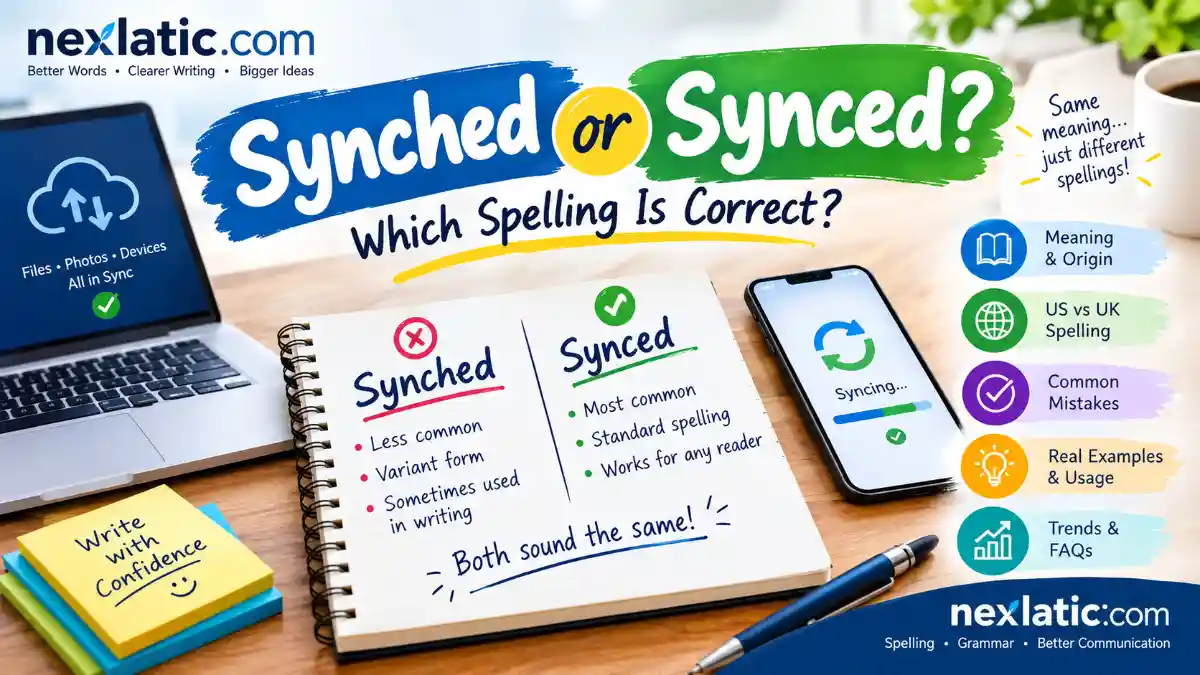
Use “synced.” It is the most common spelling, and most dictionaries list it first. Therefore, it is safe for any reader.
“Synched” is a variant. Although some dictionaries accept it as an alternative, it is rare, and some readers see it as a mistake.
Here are simple examples:
- Correct: “My phone synced with my laptop.”
- Correct: “We synced our calendars.”
- Less common: “My phone synched with my laptop.”
- Also correct: “I am syncing my files.”
Both words sound the same, and both rhyme with “linked.” Thus, the only difference is how you write them.
The Origin of Synced and Synched
“Sync” is a short form of “synchronize.” That longer word comes from Greek, where “syn” means “together” and “chronos” means “time.” In other words, to synchronize is to put things together in time.
People began to shorten the word in the early 1900s. Film makers used it first because they needed sound and picture to match. For example, they said a scene was “in sync” or “out of sync.”
Later, computers arrived. Soon, we began to sync files, phones, and apps, and “sync” became a daily verb.
Now the problem starts. A verb needs a past tense, and for most verbs, you simply add “-ed.” So “sync” plus “-ed” gives “synced.” That is simple enough.
However, some writers also used the spelling “synch.” This version keeps the “ch” from “synchronize.” When you add “-ed,” you get “synched.” In short, the two spellings come from two base forms: sync and synch.
There is a second reason for the mix-up. English has a habit with words ending in a hard “c.” Think of “picnic” and “picnicked.” Here, we add a “k” so the “c” stays hard. Because of this habit, some people expect “synct” or “syncked.” Since those look strange, most writers just use “synced.”
British English vs American English Spelling
Here is a surprise. This is not a classic UK and US split like “color” and “colour.” Instead, both countries use “synced” most of the time, and both have a few writers who use “synched.” Clearly, the real split is between the standard form and the variant form.
Still, British and American English do differ in other ways within this word family. Look at “synchronize” and “synchronise.”
| Word | American English | British English |
| Past tense of sync | synced | synced |
| Variant past tense | synched (rare) | synched (rare) |
| Present tense | syncing | syncing |
| Long verb | synchronize | synchronise (also synchronize) |
| Long verb, past tense | synchronized | synchronised (also synchronized) |
| Noun | synchronization | synchronisation (also synchronization) |
The rule is simple. Use “synced” in both. Only the long form changes: “-ize” in the US, and often “-ise” in the UK.
Which Spelling Should You Use?
Your choice depends on your reader. Here is easy advice.
- US readers: Use “synced.” Major US style guides and dictionaries favor it, so it looks clean and normal.
- UK and Commonwealth readers: Choose “synced” as well. It is the common form in the UK, Canada, Australia, and India. Meanwhile, keep “-ise” in “synchronise” if your style guide asks for it.
- Global readers: Go with “synced.” Many people read English as a second language, so the simplest form is the best form. Besides, tech tools and spell checkers also expect it.
- Brand or app names: Follow the brand. If a company writes “Synched,” copy it only when you name the product.
Final rule: when in doubt, write “synced.” Above all, pick one spelling and use it the same way in your whole text.
Common Mistakes with Synched or Synced
Here are errors people make often, along with fixes.
| Mistake | Fix | Why |
| “I synching my phone.” | “I am syncing my phone.” | Add “am.” Use “syncing.” |
| “We synct the files.” | “We synced the files.” | “Synct” is not a word. |
| “The files were syncked.” | “The files were synced.” | No extra “k.” |
| “They are out of synch.” | “They are out of sync.” | “Sync” is the standard noun. |
| “Sinced” or “sinked” | “Synced” | The word starts with “sy.” |
| Mixing both in one text | Pick one spelling | Be consistent. |
One more tip: “synced” and “since” are not the same. “Since” tells about time, whereas “synced” tells about matching.
Synched or Synced in Everyday Examples
Let’s see how the word works in real life. Each example uses the preferred spelling.
Emails
- “I synced the project folder. You can see the new files now.”
- “Our calendars are synced, so the meeting is set.”
News writing
- “The app synced user data across all devices.”
- “Lawmakers synced their plans before the vote.”
Social media
- “Finally synced my playlist to my new phone!”
- “We were so synced on that dance.”
Formal writing
- “The two systems were synced at midnight to avoid data loss.”
- “Researchers synced the clocks before the test began.”
Casual speech turned into text
- “Let’s sync up tomorrow.” (Here, “sync up” means “meet and share updates.”)
In every case, “synced” works. “Synched” would also be understood, but it may slow the reader.
Synched or Synced – Google Trends and Usage Data
Search data tells a clear story, though we should be careful with numbers. We did not pull live figures for this article. Instead, you can check current data yourself on Google Trends by typing in “synced” and “synched” and comparing them.
Here is the general pattern you will usually see:
- “Synced” is searched and used far more than “synched,” and the gap is large.
- “Synched” shows up in small amounts. Often, people search it when they doubt their spelling.
- Countries with many English speakers, such as the US, UK, Canada, India, and Australia, all lean toward “synced.”
- Tech contexts (phones, cloud apps, music, calendars) drive most of the use. In addition, spikes often follow new device or software launches.
- Film and audio contexts use “sync” and “synced” for sound that matches picture.
Tip: in Google Trends, try the filters for country and time range, then compare “synced vs synched” over five years. Alternatively, you can use Google Books Ngram Viewer to see written use over time.
Keyword Variations Side by Side
| Form | Part of speech | Usage level | Status |
| sync | verb, noun | Very common | Standard |
| synced | past tense | Very common | Standard, preferred |
| syncing | present participle | Very common | Standard |
| synch | verb, noun | Rare | Accepted variant |
| synched | past tense | Rare | Accepted variant |
| synching | present participle | Rare | Accepted variant |
| synchronized / synchronised | past tense | Common in formal writing | Standard (US / UK) |
| synct, syncked | none | Not used | Incorrect |
Frequently Asked Questions
1. Is it synched or synced?
Both appear in print. However, “synced” is the standard and preferred spelling, so use it unless a style guide says otherwise.
2. Is “synched” a real word?
Yes. Some dictionaries list it as a variant, and it comes from the spelling “synch.” Even so, it is much less common than “synced.”
3. Is “synched” wrong in British English?
Strictly speaking, it is not wrong. Still, British writers mostly use “synced,” so readers may think “synched” is a typo.
4. What is the present tense: syncing or synching?
“Syncing” is the standard form. For instance, say “I am syncing my phone.”
5. How do you say synced?
Say it like “sinkt,” which rhymes with “linked.” Likewise, “synched” is said the same way.
6. Is it “in sync” or “in synch”?
Write “in sync.” That is the common form, while “synch” is a rare variant.
7. Which spelling is best for SEO and web writing?
Use “synced,” since it matches what most people type and search. If you want to catch both searches, you can use the variant once in a short note. Even then, keep the main text consistent.
Conclusion
So, synched or synced? The answer is easy. Write “synced.” It is the standard spelling, and it works in the US, the UK, and everywhere else. Best of all, it matches what most people search and read.
“Synched” is a rare variant. It comes from the spelling “synch,” which keeps the “ch” from “synchronize.” Although some dictionaries allow it, many readers will see it as an error.
Remember these key points:
- “Sync” is short for “synchronize,” which means to match in time.
- Add “-ed” for “synced,” and add “-ing” for “syncing.”
- Both the UK and US use “synced.” Only the long form changes: “synchronize” vs “synchronise.”
- Avoid made-up forms like “synct” and “syncked.”
- Finally, stay consistent in every text you write.
If your boss, school, or brand has a style guide, follow it first. Otherwise, choose “synced” and move on with confidence. Now you can write that email, post, or report without that small pause.

David Wilson is a writer and contributor at Nexlatic.com, where he writes about useful topics, everyday questions, and practical ideas. He enjoys turning information into simple, clear, and easy-to-read articles that readers can actually use. Through his work at Nexlatic, David aims to share helpful content that answers common questions, explains confusing topics, and gives readers something useful to take away from every article.