You are writing an email. You type the word, and then you stop. Is it dialogue or dialog? Both look right. Both look wrong. You are not alone.
Thousands of people search for “dialogue or dialog” every month. Writers, students, teachers, and workers all hit the same wall. One spelling looks fancy. The other looks short and modern. You want to pick the right one and move on.
The confusion is easy to explain. English has two spellings for one word. They mean the same thing. They sound the same. But they do not show up in the same places. Some readers see one as correct and the other as a mistake.
This guide clears it up fast. You will get a quick answer first. Then you will learn where the word came from and why two spellings exist. You will see how British and American English treat it. You will also get simple tips, common mistakes, real examples, and a short FAQ.
By the end, you will know which spelling to use and when.
Dialogue or Dialog – Quick Answer
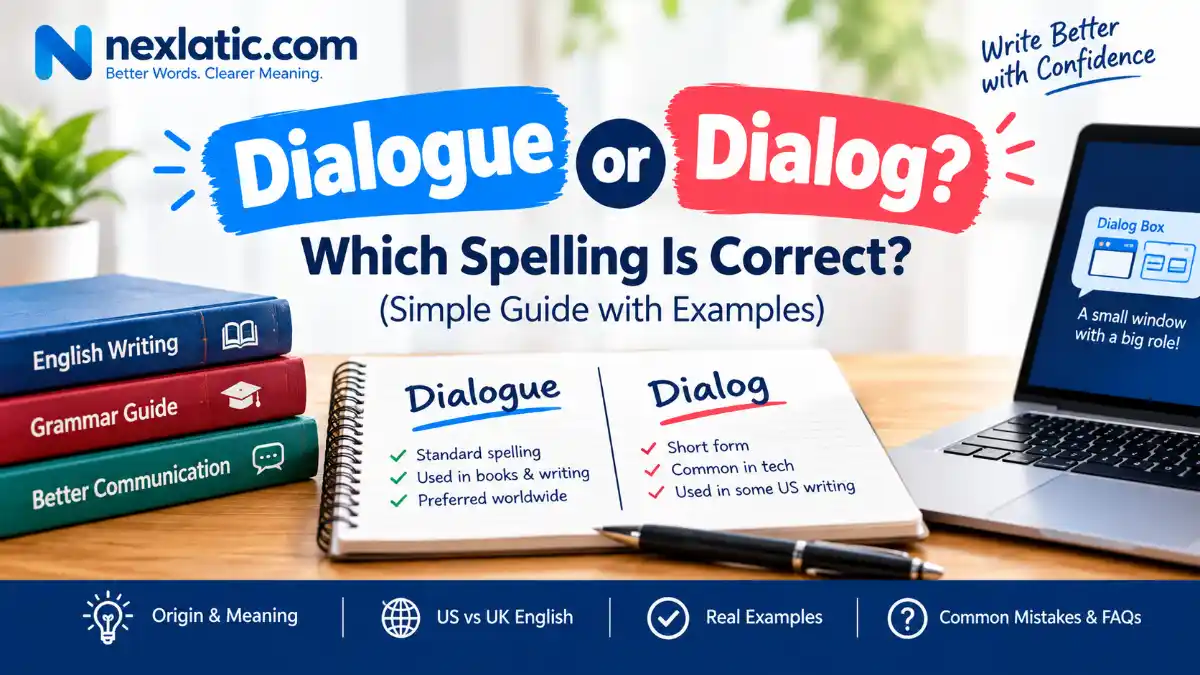
Both spellings are correct. They mean the same thing. But they are not used the same way.
- Dialogue is the standard spelling. Use it in books, essays, news, school work, and business writing. It is the safe choice in the US, the UK, and everywhere else.
- Dialog is a short form. It is common in computer terms, like “dialog box.” It is also found in some American writing.
Examples:
- “The dialogue in the movie felt real.” ✅
- “Click OK in the dialog box.” ✅
- “The two leaders began a dialogue about trade.” ✅
Simple rule: When in doubt, write dialogue.
The Origin of Dialogue or Dialog
The word is old. It comes from the Greek word dialogos. That word has two parts. Dia means “through” or “across.” Logos means “word” or “speech.” So the word means “talk that goes back and forth.”
Many people think dia means “two.” It does not. A dialogue can have two people, or it can have many.
The word passed from Greek into Latin. Then it moved into Old French. From there it entered English in the Middle Ages. Early English writers spelled it in many ways. Spelling was not fixed back then.
Why are there two spellings today?
- English spelling changed slowly over hundreds of years.
- In the 1800s, American writers pushed to make spelling shorter and simpler. Noah Webster led this push. Think of color instead of colour.
- The short form dialog fits that idea. It drops the silent ue at the end.
- In the 1900s, computer makers needed short words. They chose dialog for screens and menus. That gave the short spelling new life.
So dialog is not new or wrong. It is a short form that found a home in technology.
British English vs American English Spelling
British English and American English often split on spelling. But this word is a little different. Both countries use dialogue most of the time. The difference is in how much they accept dialog.
British English strongly prefers dialogue. The short form dialog looks odd to most British readers. It is mostly seen only in computer terms.
American English also prefers dialogue for general writing. But dialog is more accepted. Some American writers use it, and many dictionaries list it as a valid variant.
| Feature | British English | American English |
| Standard spelling | Dialogue | Dialogue |
| Short spelling (dialog) | Rare, mostly in computing | Accepted, but less common in books and news |
| In computing | Dialog box | Dialog box |
| Verb use (“to dialogue”) | Dialogue | Dialogue |
| Formal writing | Dialogue | Dialogue |
| Dictionary status | Dialog is a variant | Dialog is a variant |
Other words that follow the same pattern:
| Long form | Short form |
| catalogue | catalog |
| analogue | analog |
| monologue | monolog (rare) |
| epilogue | epilog (rare) |
You can see the pattern. Americans sometimes drop the ue. The British almost never do. Still, catalog has won in the US more than dialog has.
Which Spelling Should You Use?
Pick your spelling based on who will read your work.
Writing for a US audience Use dialogue for most writing. Use dialog only for computer screens, such as “dialog box.” Some US style guides allow dialog in general text. Check your guide first.
Writing for a UK or Commonwealth audience Use dialogue. This covers the UK, Australia, Canada, India, South Africa, and New Zealand. Use dialog only for software terms.
Writing for a global audience Use dialogue. It is the most widely accepted form. No reader will think it is a mistake.
Quick guide:
- Novels, scripts, and stories → dialogue
- News and school essays → dialogue
- Business emails and reports → dialogue
- Software, apps, and coding → dialog
- Not sure → dialogue
One more tip: be consistent. Do not use both spellings in one article. Pick one and stick with it.
Common Mistakes with Dialogue or Dialog
Here are the errors people make most often.
1. Mixing spellings in one piece ❌ “The dialogue was good, but the dialog needed work.” ✅ “The dialogue was good, but the dialogue needed work.”
2. Using dialog in formal writing for a UK reader A British editor may mark it as a mistake. Use dialogue instead.
3. Using dialogue for software windows This is not wrong. But tech writers prefer dialog box. Follow your style guide.
4. Misspelling the word ❌ dialouge, dialogu, dialoge ✅ dialogue
5. Mixing up dialogue and discussion in fiction In a story, dialogue means the words the characters speak. It is not the same as narration. Keep them apart.
6. Mixing up dialogue and monologue A dialogue has two or more speakers. A monologue has one.
7. Using “to dialogue” too much Some readers dislike dialogue as a verb. “We talked” or “We held talks” often sounds cleaner.
Dialogue or Dialog in Everyday Examples
In emails
- “Thank you for the open dialogue. I look forward to our next call.”
- “Please see the error in the dialog box and send a screenshot.”
In news
- “Leaders agreed to continue dialogue over the border dispute.”
- “The mayor called for a public dialogue on housing.”
On social media
- “The dialogue in this show is so sharp! 🔥”
- “Why does this app keep showing a dialog box?”
In formal writing
- “The essay explores the dialogue between science and faith.”
- “Plato wrote many of his ideas as a dialogue between two speakers.”
In fiction
- “Good dialogue shows how a character feels without saying it.”
- “The editor cut the long dialogue from chapter two.”
Notice the pattern. People use dialogue for human talk. They use dialog for screens.
Dialogue or Dialog – Google Trends & Usage Data
Search tools like Google Trends show a clear picture. People look up both spellings. But “dialogue” is searched and used far more than “dialog.” The short form is a small share of the total.
By country (general pattern):
- United States: Dialogue leads. Dialog gets a visible share, mostly from tech searches.
- United Kingdom, Australia, India, and other Commonwealth countries: Dialogue is the strong favorite. Dialog is rare outside software.
- Other countries: Most use dialogue, since it is the form taught in schools.
By context:
- Searches with words like movie, script, writing, and examples lean to dialogue.
- Searches with words like box, window, Windows, Android, and error lean to dialog.
So the data matches the rule. Dialogue is for people. Dialog is for screens.
Tip: Open Google Trends and compare the two terms yourself. Change the country and date range to see how the numbers shift over time.
Side-by-side comparison:
| Detail | Dialogue | Dialog |
| Status | Standard spelling | Variant spelling |
| Meaning | A talk between people, or lines in a story | Same meaning; also a screen window |
| Best for | Books, news, school, business | Software, apps, tech writing |
| Safe for UK readers? | Yes | Only in tech terms |
| Safe for US readers? | Yes | Yes, in most cases |
| Safe for global readers? | Yes | Not always |
| Common phrase | Open dialogue | Dialog box |
| Search popularity | Much higher | Much lower |
FAQs
1. Is it dialogue or dialog?
Both are correct. Dialogue is the standard spelling. Dialog is a short variant, often used in computing.
2. Is dialog wrong in American English?
No. It is accepted in American English. But dialogue is still the main choice for books, news, and school work.
3. Is dialog used in British English?
Rarely. British writers use dialogue. They use dialog mostly in computer terms, like “dialog box.”
4. Why do we say “dialog box”?
Early software makers liked short words. They chose dialog for the small window that asks a question. The name stuck.
5. Does “dialogue” mean only two people talking?
No. The Greek dia means “through,” not “two.” A dialogue can have two people or more.
6. What is the difference between dialogue and monologue?
A dialogue has two or more speakers. A monologue has one speaker.
7. Can “dialogue” be used as a verb?
Yes. “The two groups agreed to dialogue.” But many readers find it stiff. Words like talk or discuss are often clearer.
8. Which spelling is best for SEO and blogs?
Use dialogue in your main text. If your topic is software, use dialog box where it fits. Always stay consistent.
Conclusion
So, which is right: dialogue or dialog? The answer is simple. Both are correct, but they do different jobs.
Dialogue is the standard spelling. It works in the US, the UK, and around the world. Use it for stories, scripts, news, school work, emails, and reports. If you are ever unsure, choose dialogue. No reader will call it a mistake.
Dialog is the short form. It shines in tech writing. You will see it in terms like “dialog box.” It is also accepted in some American writing, but it is less common in books and news.
Here are the key points to remember:
- Dialogue is for people and stories.
- Dialog is for screens and software.
- British and Commonwealth readers strongly prefer dialogue.
- Never mix both spellings in one piece.
- Follow your style guide if you have one.
Now you can write with confidence. Pick your spelling, stay consistent, and keep the conversation going.

David Wilson is a writer and contributor at Nexlatic.com, where he writes about useful topics, everyday questions, and practical ideas. He enjoys turning information into simple, clear, and easy-to-read articles that readers can actually use. Through his work at Nexlatic, David aims to share helpful content that answers common questions, explains confusing topics, and gives readers something useful to take away from every article.