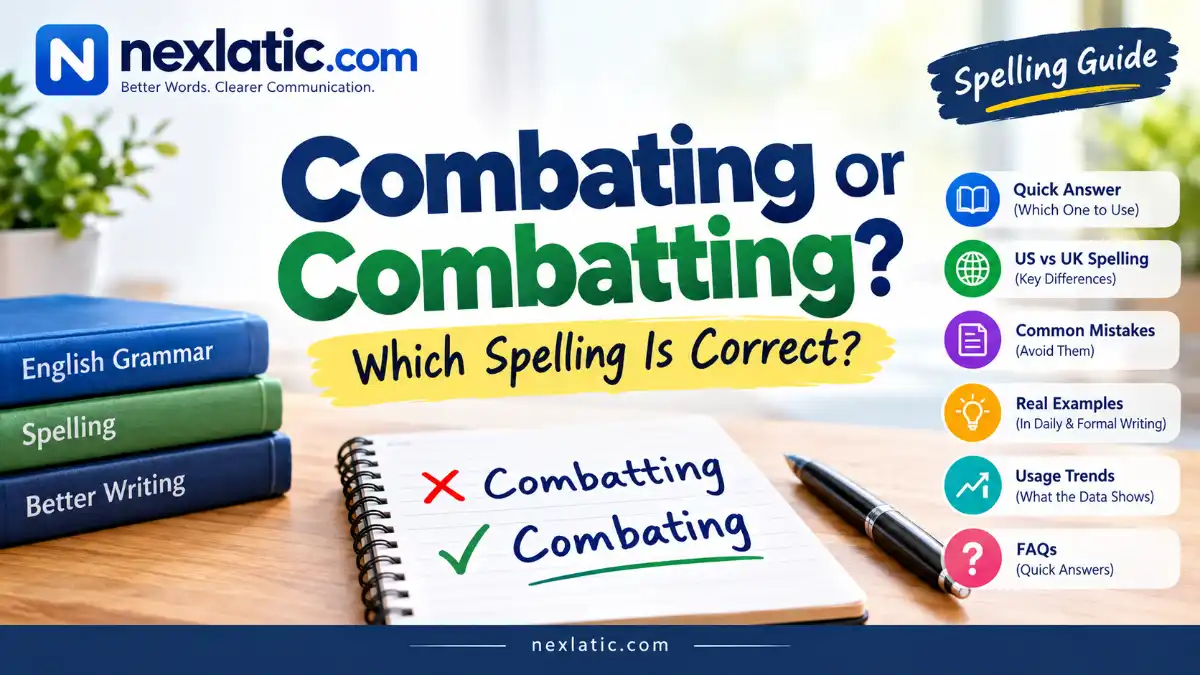
Which spelling is right when you want to say someone is fighting a problem? You type “combating.” Then you stop. Should it be “combatting” instead?
You are not alone. Many people search “combating or combatting” every month. Both words look right. Both show up in news stories, school papers, and business reports. That is why the choice feels so hard.
People search this keyword for one reason. They want a fast, safe answer. They do not want to look careless in an email, an essay, or a blog post.
This article clears up the confusion. You will get a quick answer first. Then you will learn where the word came from and how US and UK spelling differ. You will see which form to pick, common mistakes, real examples, usage trends, and a short FAQ.
By the end, you will know the right spelling and why it is right. You will never have to stop and wonder again.
Combating or Combatting – Quick Answer
Use “combating.” It is the main spelling in American English and British English.
“Combatting” is a variant. Some dictionaries list it as an accepted second option. But most writers, editors, and style guides prefer “combating.”
Here are some examples:
- The city is combating crime with new street lights.
- Doctors are combating the flu with early shots.
- We are combating climate change one step at a time.
The same rule works for the past tense. Write “combated,” not “combatted.”
The Origin of Combating or Combatting
The word starts with combat. It came into English from French. French took it from Latin. The Latin root joins two parts: com (with) and battuere (to beat). So the old meaning is “to beat with” or “to fight against.”
English first used “combat” as a verb in the 1500s. Later it also became a noun, as in “a fierce combat.”
So why do two spellings exist? It comes down to a spelling rule. When a word ends in a single consonant after a single vowel, writers often double the last letter before adding -ing. Think of “run” and “running.” But the rule only holds when the stress falls on the last syllable.
“Combat” is stressed on the first syllable: COM-bat. So the stress rule says do not double the T. That gives us “combating.”
But some writers copied the pattern of words like “bat” and “batting.” That is how “combatting” crept in. Dictionaries record it, but it is the weaker choice.
British English vs American English Spelling
Many spelling gaps exist between the US and UK. Think of “color” and “colour.” This case is different. Both regions mostly agree on “combating.”
The main difference is how much each side accepts the variant. American dictionaries tend to list “combating” first and “combatting” as a variant. British sources do much the same. Some UK dictionaries are a little more open to the double T.
| Feature | American English | British English |
| Main spelling | combating | combating |
| Variant spelling | combatting (less common) | combatting (less common) |
| Past tense | combated | combated |
| Stress rule | Stress on first syllable, so no doubling | Same rule, but doubling is more tolerated |
| Best choice | combating | combating |
Compare this with words where the stress is on the last syllable. “Begin” becomes “beginning,” and “occur” becomes “occurring.” The T in “combat” is different because the stress is up front.
Which Spelling Should You Use?
Pick “combating.” It is the safe choice for almost every reader.
Writing for a US audience: Use “combating.” Style guides and editors expect it.
Writing for a UK or Commonwealth audience: Use “combating.” “Combatting” will not be marked as a crime, but it may look odd to some editors.
Writing for a global audience: Use “combating.” It is the one form that works everywhere.
One exception: If your school, company, or publisher has a style guide that says otherwise, follow the guide. Be consistent. Do not use both spellings in the same piece.
Common Mistakes with Combating or Combatting
Mistake 1: Doubling the T in the past tense.
❌ The team combatted the problem.
✅ The team combated the problem.
Mistake 2: Mixing both spellings in one document.
❌ We are combating waste. Others are combatting it too.
✅ We are combating waste. Others are combating it too.
Mistake 3: Thinking “combating” is a typo.
It is not. Some people see it flagged by a spell checker that is set to the wrong rules. Check your settings.
Mistake 4: Using “combat” when you need a verb form.
❌ The group is combat hunger.
✅ The group is combating hunger.
Mistake 5: Confusing the noun and the verb.
“Combat” is both a noun and a verb. Use “combating” only for the action. For example: “He saw combat” (noun) and “He is combating fear” (verb).
Combating or Combatting in Everyday Examples
In an email:
“Our team is combating late shipments. I will send an update on Friday.”
In a news headline:
“Schools Combating Rising Absence Rates”
On social media:
“Combating burnout starts with sleep. Seriously. 😴 #wellness”
In formal writing:
“The report describes strategies for combating poverty in rural areas.”
In academic writing:
“Researchers are combating antibiotic resistance with new treatments.”
Notice that every example uses one T. That is what readers expect.
Combating or Combatting – Google Trends & Usage Data
Search data and book data tell the same story. “Combating” is used far more than “combatting.” This holds true in the United States, the United Kingdom, and other English-speaking countries.
Here is what usually shows up when you compare the two on Google Trends or Google Books:
- “Combating” appears much more often in news and formal writing.
- “Combatting” appears mostly in casual writing and in a few regional outlets.
- Searches for the pair spike when people are writing essays, reports, or articles.
- Interest is high in countries where English is a school or work language, such as the US, UK, India, Canada, Australia, Pakistan, and Nigeria.
You can check this yourself. Open Google Trends. Type both words. Pick “Worldwide” or a single country. Pick a time range. You will see “combating” stay on top.
Tip: Trend numbers change over time, so check the live data before you quote any figure.
Side-by-Side Comparison
| Form | Status | Past Tense | Frequency | Recommendation |
| combating | Standard | combated | Very common | ✅ Use this |
| combatting | Accepted variant | combatted | Much less common | ⚠️ Avoid unless required |
| combat (verb) | Base form | combated | Common | Use before “-ing” is added |
| combated | Standard past | — | Common | ✅ Use this |
| combatted | Variant past | — | Rare | ⚠️ Avoid |
Frequently Asked Questions
1. Is it combating or combatting?
Both exist, but “combating” is the preferred spelling. Use it in almost every case.
2. Is “combatting” wrong?
Not exactly. Many dictionaries list it as a variant. But it is less common, and some editors will change it.
3. What is the past tense of combat?
The best form is “combated.” The variant is “combatted.”
4. Why does “combat” not double the T?
The stress is on the first syllable (COM-bat). Doubling usually happens when the stress is on the last syllable.
5. Is “combating” British or American?
It is both. It is the standard form in the US, the UK, and other English-speaking countries.
6. Will a spell checker mark “combating” as an error?
It should not. If it does, your language setting may be wrong. Check that it is set to English.
7. Can I use “combatting” in a school essay?
It is better to use “combating.” If your teacher has a style guide, follow it.
8. Is “combat” a verb or a noun?
It is both. “A hard combat” is a noun. “They combat disease” is a verb.
Conclusion
The answer is simple. Write “combating” with one T.
Here are the key points to remember:
- “Combating” is the standard spelling in American English, British English, and global English.
- “Combatting” is a less common variant. Dictionaries may list it, but editors often avoid it.
- The past tense is “combated.”
- The word is stressed on the first syllable, so the T does not double.
- Use one spelling in each piece of writing. Do not mix.
- If a style guide tells you otherwise, follow it.
Your readers will not stop and wonder when they see “combating.” They will just read on. That is the goal of good writing.
So next time you type this word, do not stop. Write “combating,” hit send, and move on with confidence. You now know the rule, the reason, and the proof.

Ali Bismal is the founder and writer behind Nexlatic.com, a growing online platform created to provide useful, informative, and easy-to-understand content for everyday readers. Through Nexlatic, Ali shares practical ideas, helpful guides, interesting topics, and engaging articles designed to make information simple and accessible. His goal is to create reliable, reader-focused content that helps people learn something new, find useful answers, and make everyday life a little easier.