Your child is crying again. Your coworker will not stop complaining. You want one word to describe it, but then you freeze. Do you write whiny or whiney?
You are not alone. Many people search for this every month. The word looks simple, yet both spellings seem odd. One has an extra letter. The other looks cleaner. Which one is right?
This confusion is common with words that end in a silent “e.” Writers wonder if they should keep the “e” or drop it. Spell checkers sometimes flag one version and not the other, which makes things worse.
In this article, you will get a quick answer first. Then you will learn where the word comes from, how US and UK spelling compare, and which form to use in your own writing. You will also see real examples, common mistakes, and answers to popular questions.
By the end, you will never second-guess this word again. Let’s start with the short answer.
Whiny or Whiney – Quick Answer
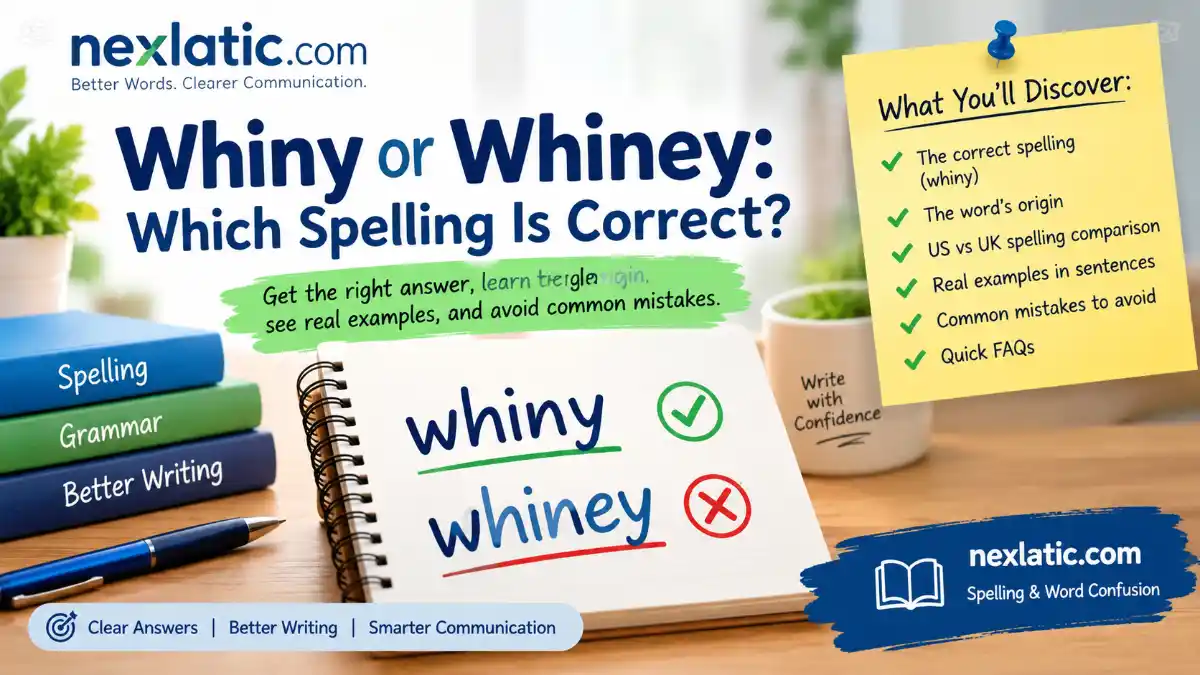
Use “whiny.” It is the standard spelling in American English and British English. Major dictionaries list it first.
“Whiney” is a rare variant. Some US dictionaries list it as an alternate form, but most editors treat it as a mistake. If you want to be safe, always pick “whiny.”
Examples:
- The toddler was whiny after his nap.
- I don’t want to sound whiny, but the soup is cold.
- She hates whiny voices on the phone.
Wrong:
- ~~The toddler was whiney after his nap.~~ (Not wrong in every dictionary, but risky.)
The Origin of Whiny or Whiney
The word starts with the verb whine. It comes from the Old English word hwīnan, which meant to make a high, thin sound, like wind or an arrow flying by. Over time, it came to mean a sad, complaining cry.
Later, English speakers added -y to make an adjective. This is a common trick. Add -y to a noun or verb, and you get a word that describes a quality. Think of rain → rainy and shine → shiny.
So why two spellings? There are two reasons.
- The silent “e” rule. Most words drop the final “e” before -y. That gives us shiny, spiny, bony, and whiny.
- Sound-based spelling. Some writers type what they hear. The word sounds like “WY-nee,” so they add an “e” before the “y.” They copy words like money and honey.
The rule-based spelling won in most dictionaries. The sound-based spelling stayed alive in casual writing.
British English vs American English Spelling
Good news: this is not a classic US vs UK spelling fight. You do not have two different correct answers like color and colour. Both countries prefer “whiny.”
British writers also have another word with a similar meaning: whingey or whingy, from the verb whinge. That is where some of the confusion comes from.
| Word | American English | British English | Notes |
| Whiny | Standard | Standard | Preferred everywhere |
| Whiney | Rare variant | Rare variant | Listed in some dictionaries, but not preferred |
| Whingey / Whingy | Rare | Common in casual speech | From “whinge,” a British word for complain |
| Whine (verb) | Same | Same | Base word |
| Whining | Same | Same | Drop the “e” before -ing |
The simple rule: When a word ends in a silent “e,” drop the “e” before adding -y. Exceptions exist, but “whiny” follows the main rule.
Which Spelling Should You Use?
Here is advice for each type of reader.
US readers: Use whiny. It is the first form in most American dictionaries and style guides.
UK and Commonwealth readers (Australia, Canada, India, and others): Use whiny. If you want a very British feel, you can also use whingy, but only in casual writing.
Global or business audiences: Use whiny. It is the safest choice for websites, emails, and reports. It will not look like an error to anyone.
Students and exam writers: Use whiny. Teachers and graders expect the standard form.
SEO writers: Use “whiny” in your main text. You can mention “whiney” once, as in this article, to catch people who search for it.
Common Mistakes with Whiny or Whiney
| Mistake | Why it happens | Fix |
| Writing whiney in formal work | Copying the sound of the word | Use whiny |
| Writing whinny | Mixing it up with whinny, the sound a horse makes | Use whiny for complaining |
| Writing whinie | Typing by ear | Use whiny |
| Writing whining as an adjective only | Mixing verb forms | Whining is fine, but whiny describes a person or tone |
| Using whiny for the verb | Confusing word types | The verb is whine |
Watch out for “whinny.” It looks almost the same, but it means the soft cry of a horse. “The horse let out a whinny” is correct. “The whinny child” is not.
Whiny or Whiney in Everyday Examples
Email:
- “Sorry if I sound whiny, but I have asked for this report three times.”
News:
- “Critics called the speech whiny and unfocused.”
Social media:
- “I was so whiny today. Coffee, please.”
- “Why is my cat so whiny at 5 a.m.?”
Formal writing:
- “The study found that tired children are more irritable and whiny.”
Parenting blog:
- “Hunger is often the reason behind a whiny mood.”
Review writing:
- “The lead character felt whiny, which made the story hard to enjoy.”
In every case, “whiny” fits cleanly and reads smoothly.
Whiny or Whiney – Google Trends and Usage Data
I can’t pull live Google Trends numbers here, so I won’t invent them. Here is what you can expect to see when you check the data yourself.
- “Whiny” is searched far more than “whiney.” Most people who type the word are looking for the standard form.
- The “whiney” searches usually come from people who are unsure. They want to confirm the spelling.
- Interest is strongest in English-speaking countries like the US, UK, Canada, Australia, and India.
- Context matters. People search it around parenting topics, workplace complaints, movie and TV reviews, and social media slang.
To see the numbers yourself: Open Google Trends, enter “whiny” and “whiney” as two terms, and compare them by country and by time. You can also check Google Books Ngram Viewer to see how often each form appears in printed books.
Keyword Variations Side by Side
| Variation | Correct? | Best use | Example |
| Whiny | Yes, preferred | All writing | “He felt whiny and tired.” |
| Whiney | Rare variant | Avoid in formal writing | “He felt whiney.” |
| Whinny | Different word | Horse sounds | “The horse gave a whinny.” |
| Whingy / Whingey | Informal UK/AU | Casual speech | “Stop being so whingy.” |
| Whine | Verb/noun | Complaining sound | “Stop whining.” |
| Whining | Adjective/verb form | Ongoing complaint | “A whining child.” |
FAQs
1. Is it whiny or whiney?
Use whiny. It is the standard spelling in both American and British English.
2. Is “whiney” a real word?
Some dictionaries list it as a variant. But most editors and teachers treat it as a spelling error, so avoid it.
3. Why do people write “whiney”?
They type what they hear, or they copy words like money and honey. They may also forget the rule about dropping the silent “e.”
4. What does whiny mean?
It means complaining in a high, annoying voice. It can describe a child, an adult, or even a tone of writing.
5. What is the difference between whiny and whinny?
“Whiny” means complaining. “Whinny” is the soft cry a horse makes.
6. Is “whinge” the same as “whine”?
They mean almost the same. “Whinge” is more common in British, Australian, and New Zealand English. “Whine” is more common in the US.
7. What is a good synonym for whiny?
You can use fussy, cranky, grumpy, complaining, or tearful.
8. Does the spelling change in the US and UK?
No. Both use “whiny” as the main form.
Conclusion
So, whiny or whiney? The answer is simple. Whiny is the correct and safest spelling. It works in American English, British English, and global writing.
Here are the key points to remember:
- “Whiny” comes from the verb whine, with the silent “e” dropped before -y.
- “Whiney” is a rare variant. Most editors see it as a mistake.
- “Whinny” is a different word. It describes a horse’s sound.
- “Whingy” is a casual British and Australian option.
- When in doubt, use “whiny” in emails, essays, articles, and social posts.
If you ever feel unsure about a word that ends in a silent “e,” think of shiny and bony. They follow the same rule. Drop the “e,” add the “y,” and you are done.
Clear spelling builds trust with your readers. Pick “whiny,” and your writing will look clean and professional every time.

Ali Bismal is the founder and writer behind Nexlatic.com, a growing online platform created to provide useful, informative, and easy-to-understand content for everyday readers. Through Nexlatic, Ali shares practical ideas, helpful guides, interesting topics, and engaging articles designed to make information simple and accessible. His goal is to create reliable, reader-focused content that helps people learn something new, find useful answers, and make everyday life a little easier.