Picture this. An email is open on your screen, and you want to say a teacher showed you something. Your fingers type “tought.” Then you pause. Does that look right?
Many people feel the same doubt. English spelling is tricky, and “taught” is a good example. It sounds like “tawt,” but the letters do not match the sound. So the brain guesses, and “tought” is a common guess. That is why so many people search “tought or taught” every day.
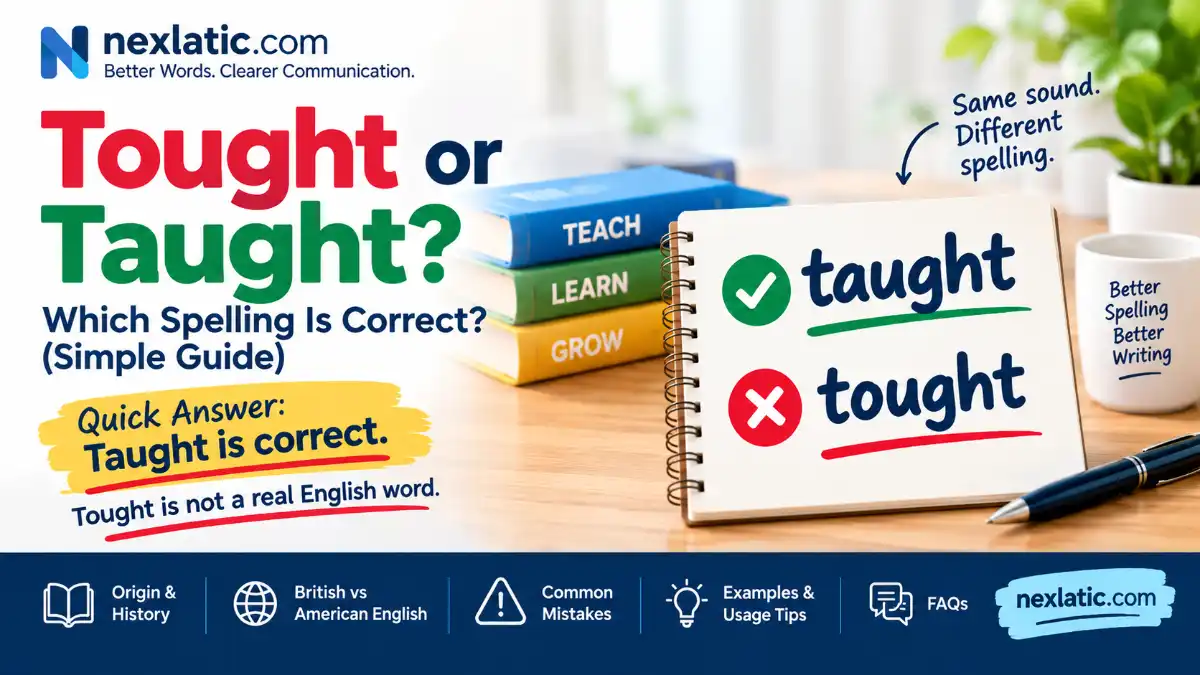
Here is the short answer: “taught” is correct. “Tought” is not a real English word. It is just a spelling mistake.
This article clears up the confusion. Inside, you will learn why the mix-up happens, where “taught” comes from, and how to remember it. Real examples from emails, news, and social posts show the word in action. Answers to common questions come at the end. For school, work, or the web, this guide helps you spell it right every time. Let’s fix it for good.
Tought or Taught – Quick Answer
Taught is the only correct spelling. It is the past tense of “teach.” It is also the past participle.
- Today I teach. Yesterday I taught.
- She taught me how to swim.
- He has taught math for ten years.
Tought is wrong. You will not find it in any standard dictionary.
Memory trick: “Taught” has the letters “aught,” just like “caught.” If you can spell “caught,” you can spell “taught.”
The Origin of Taught
“Taught” comes from Old English. The old verb was tǣcan, which meant “to show” or “to teach.” Its past form was tǣhte. Over the years, that became taughte in Middle English, and later “taught.”
So why the odd “augh” letters? Long ago, the “gh” stood for a throaty sound, a bit like the “ch” in Scottish “loch.” Over time, English speakers stopped saying that sound. But the spelling stayed the same. This is why we have so many strange words today.
Here are other words with the same pattern:
- caught
- bought
- fought
- thought
- brought
“Tought” likely comes from these look-alikes. Words like “ought,” “bought,” and “thought” end in “ought.” The brain sees that pattern and applies it to “taught.” Add the fact that “tough” is a common word, and the mix-up makes sense.
British English vs American English Spelling
Here is the key point: there is no British or American difference for this word. Both use “taught.” Neither uses “tought.”
Many spelling pairs do differ between the two (like “color” and “colour”). This is not one of them.
| Word | American English | British English | Correct? |
| Past tense of teach | taught | taught | Yes, everywhere |
| Past participle of teach | taught | taught | Yes, everywhere |
| Tought | – | – | No, in all English |
| Teached | – | – | No, in all English |
For comparison, here are words that do change:
| American | British |
| color | colour |
| center | centre |
| realize | realise |
Remember: if a spelling is wrong in the US, it is wrong in the UK too. “Tought” fails in both.
Which Spelling Should You Use?
The answer is easy. Use “taught” every time.
- US readers: Use “taught.”
- UK and Commonwealth readers (Canada, Australia, India, Pakistan, South Africa and more): Use “taught.”
- Global readers: Use “taught.”
Writing for work? A wrong spelling can hurt trust. Writing for school? It can cost marks. Writing a blog? It can hurt your search ranking and your credibility.
One more tip: if you are not sure, say the word “teach” first. Then switch to the past. “Teach” becomes “taught.”
Common Mistakes with Tought or Taught
| Mistake | Correction | Why |
| She tought me. | She taught me. | “Tought” is not a word. |
| He teached us. | He taught us. | “Teach” is irregular. |
| It was a taught exam. | It was a tough exam. | “Tough” means hard. |
| I taught about it. | I thought about it. | “Thought” is about thinking. |
| The rope was taught. | The rope was taut. | “Taut” means tight. |
Main error types:
- Wrong spelling. Writing “tought” instead of “taught.”
- Adding -ed. Writing “teached.” Irregular verbs do not follow the usual rule.
- Mixing look-alikes. “Taught,” “thought,” “tough,” and “taut” look close but mean different things.
Taught in Everyday Examples
Emails
- “Thank you for the training. I taught my team what I learned.”
- “As I taught in last week’s class, please review the notes.”
News
- “The teacher taught for 30 years before she retired.”
- “Children were taught online during the storm.”
Social media
- “My mom taught me how to cook. Best lessons ever! 🍳”
- “Life taught me to stay calm.”
Formal writing
- “The method was taught to all new staff.”
- “Students were taught basic research skills in the first term.”
In all four settings, the spelling stays the same.
Tought or Taught – Google Trends & Usage Data
I do not have live Google Trends numbers, and I will not invent them. Here is what is safe to say, and how to check the real data yourself.
What we can say in general:
- “Taught” is a very common word. “Tought” shows up mostly as a typo.
- Searches like “tought or taught” usually come from people checking a spelling before they write.
- Spelling checks tend to rise in school and exam seasons and in countries where many people use English as a second language.
How to see real data:
- Go to Google Trends.
- Type “tought or taught.”
- Pick a country and a time range.
- Compare it with “taught meaning” or “past tense of teach.”
- Check the “Related queries” box for ideas.
Tip for writers: use a key phrase like “tought or taught” in your title, but always spell the word correctly in your body text.
Spelling variations side by side:
| Variation | Real word? | Meaning | Use it? |
| taught | Yes | Past of “teach” | Yes |
| tought | No | None | Never |
| teached | No | None | Never |
| thought | Yes | Past of “think” | Only for thinking |
| tough | Yes | Hard or strong | Only for hard things |
| taut | Yes | Tight | Only for tight things |
FAQs
1. Is it tought or taught?
It is “taught.” “Tought” is a spelling mistake.
2. Is “tought” ever correct?
No. It is not in standard English dictionaries, in the US, UK, or anywhere else.
3. What is the past tense of “teach”?
The past tense is “taught.” The past participle is also “taught.”
4. Is “teached” a word?
No. “Teach” is an irregular verb. Use “taught.”
5. Is there a British and American difference?
No. Both use “taught.”
6. How do I remember the spelling?
Link it to “caught.” Both end in “aught.” Also, “taught” has “aught” in “taught,” and a teacher does just that.
7. What is the difference between taught, thought, and tough?
“Taught” is about teaching. “Thought” is about thinking. “Tough” means hard or strong.
8. Will spell check catch “tought”?
Usually yes. But it may not catch “thought” or “taut” used in the wrong place. Always re-read your text.
Conclusion
The answer to “tought or taught” is simple: use “taught.” It is the past tense and past participle of “teach,” and it is the same in the US, the UK, Canada, and Australia. “Tought” is not a real word in any form of English. It is only a spelling mistake.
To remember it, think of “caught” and “bought.” All three end in “aught,” so if you can spell one, you can spell them all. You can also start with “teach” and switch to the past: “teach” becomes “taught,” never “teached.” Watch for look-alikes too. “Thought” is about thinking, “tough” means hard or strong, and “taut” means tight. Each word has its own job.
Before you hit send, take two seconds to re-read your text. Spell check will usually catch “tought,” but it will not catch “thought” or “taut” in the wrong place. Good spelling builds trust, and readers notice small errors. Now you know the right word, so write it with confidence.

David Wilson is a writer and contributor at Nexlatic.com, where he writes about useful topics, everyday questions, and practical ideas. He enjoys turning information into simple, clear, and easy-to-read articles that readers can actually use. Through his work at Nexlatic, David aims to share helpful content that answers common questions, explains confusing topics, and gives readers something useful to take away from every article.