Picture a simple sentence about a very thin dog. You type “boney.” Then you stop. Something looks off. Is it boney or bony?
You are not alone. Many people search for this exact question. English spelling can be tricky. Lots of words end in -y. Some keep the silent e. Some drop it. So people guess.
The word “bone” ends in e. That is why “boney” looks right to many eyes. But “bony” looks right too. Which one is correct?
This article clears up the confusion. You will get a quick answer first. Then you will learn where the word comes from. You will see how US and UK spelling compare. You will also find common mistakes, real examples, and simple tips.
By the end, you will know which spelling to use at work, at school, and online. You will never need to stop and wonder again. Let’s start.
Boney or Bony – Quick Answer
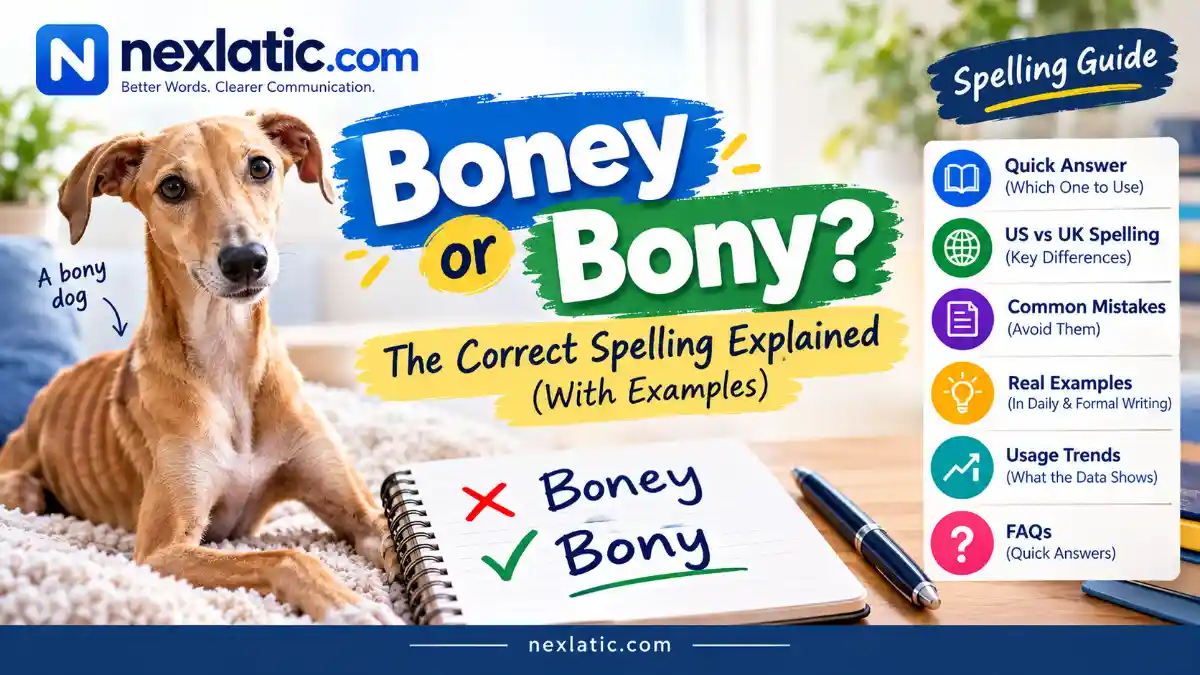
Use “bony.” It is the standard spelling in American English and British English.
“Boney” is a rare variant. Most style guides and teachers mark it as a mistake. It is also used as a name or nickname, like the band Boney M.
Here are simple examples:
- The cat had a bony back.
- He has bony knees.
- The fish was full of bony parts.
- She gave him a bony hug.
Easy rule: Take the word bone. Drop the e. Add -y. You get bony.
The Origin of Boney or Bony
The word starts with bone. In Old English, it was bān. It meant the hard part inside a body.
Later, English speakers added -y to the end of nouns. This -y turns a noun into a describing word. Think of these:
- Rock becomes rocky.
- Salt becomes salty.
- Bone becomes bony.
Now here is the key. When a word ends in a silent e, writers often drop the e before adding -y. This is why we write shiny, stony, noisy, and bony.
So why does “boney” exist at all? There are three reasons:
- Habit. Some writers keep the e to show the long “o” sound.
- Old spelling rules were loose. Before dictionaries, spelling changed a lot from writer to writer.
- Names. People and brands use “Boney” on purpose. In Britain, “Boney” was even a nickname for Napoleon Bonaparte.
Over time, dictionaries chose “bony” as the main spelling. That choice stuck.
British English vs American English Spelling
Here is good news. British and American English use the same spelling here. Both say “bony.”
So this is not like color and colour. You do not need to switch the spelling for your reader’s country.
The -y rule is the same in both. Look at the table.
| Word | American English | British English | Note |
| Thin, like bone | bony | bony | Same in both |
| Like stone | stony | stony | Same in both |
| Shining | shiny | shiny | Same in both |
| Full of noise | noisy | noisy | Same in both |
| Able to be liked | likable | likeable | Differs |
| Getting older | aging | ageing | Differs |
The last two rows show that the silent e rule does change in a few words. But “bony” is not one of them.
Also, a few words keep the e before -y. Examples are pricey, dicey, and homey. These are special cases. They do not change the rule for “bony.”
Which Spelling Should You Use?
The answer is simple. Use bony for almost everyone.
If your readers are in the US: Use “bony.” It is the standard form in American dictionaries.
If your readers are in the UK, Australia, Canada, India, or other Commonwealth places: Use “bony.” It is standard there too.
If your readers are around the world: Use “bony.” It is safe and clear.
When can you use “Boney”?
- A person’s name, like Boney James.
- A band or brand name, like Boney M.
- A quote from an old text that used it.
In all other cases, pick “bony.” This keeps your writing clean and trusted.
Common Mistakes with Boney or Bony
Here are the errors people make most often, and the fixes.
1 Mistake : Writing “boney” for a describing word.
- Wrong: She has boney fingers.
- Right: She has bony fingers.
2 Mistake : Thinking UK English needs the e.
- Many people think British spelling keeps the e. It does not. UK English also says “bony.”
3 Mistake : Mixing up “bony” and “bone-y.”
- Do not add a hyphen. Write “bony.”
4 Mistake : Confusing “bony” with “bonny.”
- Bonny means pretty or healthy. It is used in Scotland and northern England.
- Wrong: a bonny fish skeleton
- Right: a bony fish
5 Mistake : Using “bony” for something it does not describe.
- “Bony” means full of bones or very thin. It does not mean “strong.”
6 Mistake : Trusting spell check blindly.
- Some tools may not flag “boney.” Always double-check.
Boney or Bony in Everyday Examples
See how “bony” works in real life.
In an email:
- “The chicken I ordered was too bony. Can I get a refund?”
In the news:
- “The vet said the rescued horse was bony but healthy.”
- “Scientists found a bony fish that lived millions of years ago.”
On social media:
- “My bony knees hurt after the run. 😩”
- “Why are my elbows so bony?”
In formal writing:
- “The patient had a bony growth on the left foot.”
- “Bony fish make up most of the fish in the sea.”
In a story:
- “The old man pointed a bony finger at the door.”
The spelling stays the same each time. That is why it is easy to remember.
Boney or Bony – Google Trends & Usage Data
People search for this keyword because they are unsure. The word looks like it needs an e.
Here is what usually happens in search data and in books:
- “Bony” is far more common than “boney” in published writing. This includes news, books, and science papers.
- “Boney” gets searches mostly from people checking spelling. Other searches come from names, like Boney M or Boney James.
- Interest is global. People in the US, UK, India, Pakistan, Australia, Canada, and Nigeria search for spelling help like this.
- Context matters. Cooking and food writers use “bony” for fish and meat. Health writers use it for bones and joints. Casual writers use it for thin people or pets.
Want to see the exact numbers? Open Google Trends. Type “bony” and “boney” side by side. Pick your country and date range. You will see which spelling wins in your area.
Here is a side-by-side look at the two spellings.
| Feature | Bony | Boney |
| Standard spelling | Yes | No |
| Used in US English | Yes | Rare |
| Used in UK English | Yes | Rare |
| Found in most dictionaries | Yes | Only as a rare variant, if at all |
| Good for school and work | Yes | No |
| Used in names and brands | Sometimes | Often |
| Follows the drop-the-e rule | Yes | No |
FAQs
1. Is it boney or bony?
It is “bony.” This is the correct spelling in both US and UK English.
2. Is “boney” a real word?
It is not standard. Some people use it, but most dictionaries and teachers prefer “bony.” It is fine as a name, like Boney M.
3. What does “bony” mean?
It means made of bone, full of bones, or very thin so the bones show.
4. Is “bony” spelled differently in British English?
No. British and American English both spell it “bony.”
5. Why do we drop the e in “bony”?
In English, we often drop a silent e before adding -y. The same happens in shiny, stony, and noisy.
6. What is the difference between “bony” and “bonny”?
“Bony” is about bones. “Bonny” means pretty or lovely, mostly in Scottish and northern English use.
7. Can I use “boney” in a name?
Yes. Names and brands can use any spelling. Just copy it as the owner writes it.
8. What is the opposite of bony?
Common opposites are plump, fleshy, and well-fed.
Conclusion
So, boney or bony? The answer is clear. Bony is correct. It works in American English, British English, and every other kind of English.
Here are the key points to remember:
- “Bony” comes from bone plus -y. We drop the silent e.
- “Boney” is not standard. It shows up mostly in names, like Boney M.
- US and UK writers spell the word the same way.
- Watch out for “bonny.” It means something else.
- Use “bony” in emails, school work, news, and posts.
Here is a trick to help you remember. Think of shiny. Nobody writes “shineey.” The same goes for “bony.” Drop the e and you are done.

David Wilson is a writer and contributor at Nexlatic.com, where he writes about useful topics, everyday questions, and practical ideas. He enjoys turning information into simple, clear, and easy-to-read articles that readers can actually use. Through his work at Nexlatic, David aims to share helpful content that answers common questions, explains confusing topics, and gives readers something useful to take away from every article.