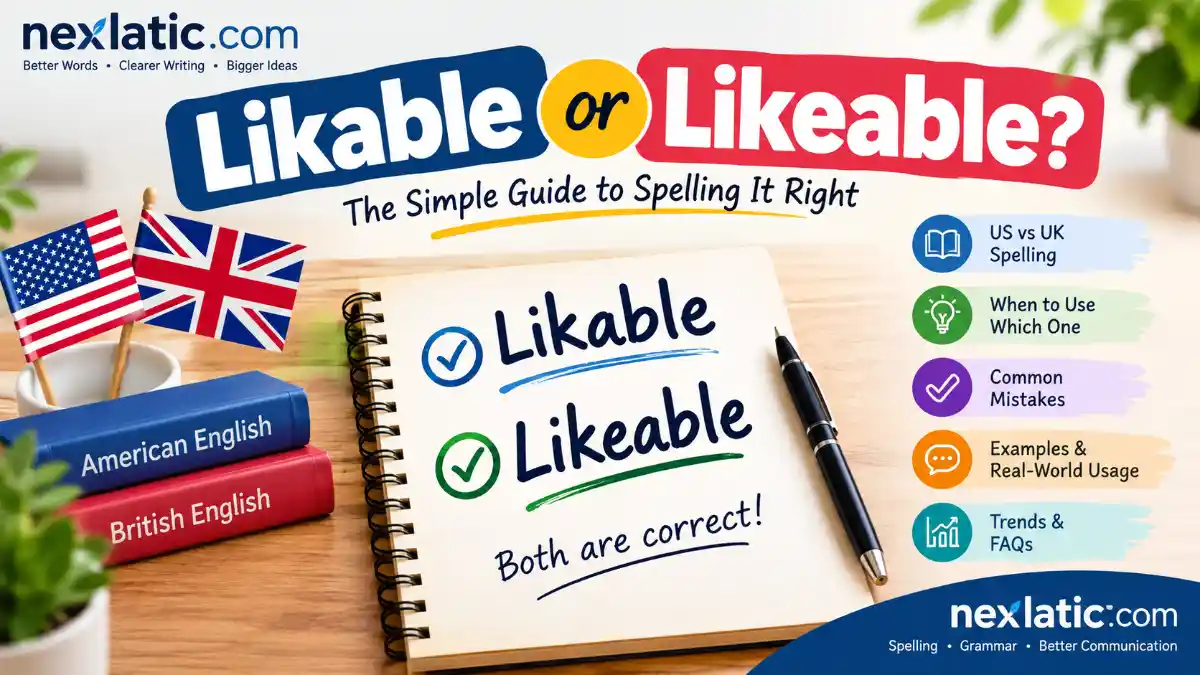
Have you ever stopped mid-sentence and asked, “Is it likable or likeable?” You are not alone. Many people search this question every month. The word looks easy, but the spelling is tricky. Spell-check may not even flag either one, so it is hard to know which is right.
People search this keyword for a few reasons. Some are writing a resume or cover letter. Some are writing a school essay. Others are writing a blog post or a work email. They all want to look sharp and avoid a silly mistake.
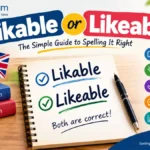
Here is the good news: both spellings are correct. The difference is about place and style, not right and wrong.
In this guide, you will get a quick answer first. Then you will learn where the word comes from and how US and UK spelling differ. You will also see which one to pick for your reader, common mistakes, real examples, usage trends, and a short FAQ. By the end, you will know exactly what to write.
Likable or Likeable – Quick Answer
Both are correct.
- Likable is more common in American English.
- Likeable is more common in British English.
Both words mean “easy to like” or “pleasant.”
Examples:
- She is a likable boss. (US style)
- He is a likeable guy. (UK style)
- The hero of the book is warm and likable.
- Everyone finds the new teacher likeable.
Rule of thumb: Pick one spelling and use it every time in the same piece.
The Origin of Likable and Likeable
The word starts with the verb “like.” It comes from an Old English word that meant “to please.” Over time, “like” came to mean “to enjoy” or “to be fond of.”
Then English added the ending “-able.” This ending means “can be” or “worthy of.” So “likable” means “can be liked.”
Here is where the trouble starts. When you add “-able” to a word that ends in a silent “e,” you have two choices:
- Drop the “e” → likable
- Keep the “e” → likeable
English never picked just one. Writers used both for many years. In the early 1800s, American writer Noah Webster pushed for simpler spelling. His dictionaries helped Americans drop extra letters. British writers kept more of the old forms.
That is why you see the same split in other words:
- lovable / loveable
- movable / moveable
- sizable / sizeable
- rateable / ratable
The spelling is not a mistake. It is a habit that grew in two places.
British English vs American English Spelling
American spelling often drops the silent “e” before “-able.” British spelling often keeps it. But this is a habit, not a strict law. Many British writers use “likable” too, and some Americans use “likeable.”
| Word | American English | British English |
| Easy to like | likable | likeable |
| Easy to love | lovable | loveable |
| Able to move | movable | moveable |
| Large in size | sizable | sizeable |
| Able to be rated | ratable | rateable |
| Able to be shared | shareable | shareable |
Notice the last row. Some words keep the “e” in both. When the “e” is needed to keep a soft sound (like in “noticeable” or “manageable”), everyone keeps it.
Simple tip: In the US, lean toward dropping the “e.” In the UK, lean toward keeping it.
Which Spelling Should You Use?
Think about who will read your writing.
Writing for a US audience?
Use likable. Most US style guides and dictionaries list it first.
Writing for a UK, Australian, Canadian, or other Commonwealth audience?
Use likeable. It is the more common choice there. Canadian writers sometimes use both.
Writing for a global audience?
Pick one and stay steady. Either one is fine. Many global brands choose “likable” because it is shorter. Match the spelling of the rest of your text, such as “color” vs “colour.”
Writing for a school, job, or publisher?
Check their style guide. If there is none, follow the spelling of the country where you are sending it.
The golden rule: Be consistent. Do not use “likable” in one paragraph and “likeable” in the next.
Common Mistakes with Likable and Likeable
1. Mixing spellings in one document
- Wrong: “She is likable. He is also likeable.”
- Right: “She is likable. He is also likable.”
2. Writing “likeble” or “likible”
- Wrong: “A very likible person.”
- Right: “A very likable person.”
3. Using the wrong form for the noun
- Wrong: “Her likeableness is her best trait.” (Awkward but not wrong; “likability” is smoother.)
- Better: “Her likability is her best trait.”
4. Spelling the opposite wrong
- Wrong: “unlikeble”
- Right: “unlikable” or “unlikeable”
5. Mixing “like” and “liked”
- Wrong: “He is a liked person” when you mean “He is a likable person.”
- “Liked” means people do like him. “Likable” means he is easy to like.
6. Thinking one spelling is a typo
Neither one is a typo. Do not “fix” it in someone else’s work unless you are matching a style guide.
Likable and Likeable in Everyday Examples
In an email:
“Thank you for the interview. Your team seems friendly and likable.”
In a job reference:
“Maria is a hard worker and a very likeable colleague.”
In the news:
“The new mayor has a likable style that voters enjoy.”
On social media:
“Honestly, he’s the most likeable character in the show. 😄”
In formal writing:
“Studies show that likability can affect hiring choices. Likable candidates often earn higher trust.”
In a book review:
“The hero is flawed, but still deeply likable.”
Likable and Likeable – Google Trends & Usage Data
Search data tells a clear story. Both spellings are searched all the time. Neither one has disappeared.
Here is the general pattern you will see in Google Trends:
- United States and Canada: “likable” gets more searches and more use in print.
- United Kingdom, Ireland, Australia, and New Zealand: “likeable” is the usual choice.
- India, Pakistan, and other places: Both appear. People often follow British spelling, but many follow US spelling because of online media.
Context matters too:
- Marketing and business writing often use “likability” and “likable.”
- News and fiction writing in the UK lean on “likeable.”
- Social media uses both, and some posts use either one by habit.
Want fresh numbers? Open Google Trends, type both words, and compare them. You can filter by country and time range. Trends change, so check the latest data before you quote any numbers.
Keyword Variations Side by Side
| Word | Spelling Style | Meaning | Example |
| likable | US (common) | easy to like | A likable neighbor |
| likeable | UK (common) | easy to like | A likeable neighbour |
| likability | US (common) | the quality of being liked | Her likability won votes |
| likeability | UK (common) | the quality of being liked | His likeability is high |
| unlikable | US | hard to like | An unlikable villain |
| unlikeable | UK | hard to like | An unlikeable villain |
| likably | US | in a pleasant way | He smiled likably |
| likeably | UK | in a pleasant way | He smiled likeably |
FAQs
1. Is it likable or likeable?
Both are correct. “Likable” is more common in the US. “Likeable” is more common in the UK.
2. Which spelling is more popular?
Overall, “likable” is used more, mostly because of the large US audience. In British writing, “likeable” leads.
3. Is “likeable” wrong in American English?
No. Many dictionaries list it as a valid variant. It is just less common.
4. Is “likable” wrong in British English?
No. It is also accepted. Some British writers use it, but “likeable” is the usual pick.
5. What is the noun form?
Use “likability” (US) or “likeability” (UK). Some writers also use “likableness.”
6. What is the opposite of likable?
“Unlikable” or “unlikeable.” You can also say “disagreeable” or “unpleasant.”
7. Does the spelling change the meaning?
No. The meaning is exactly the same.
8. Will spell-check mark one as wrong?
It depends on your language setting. A US setting may flag “likeable.” A UK setting may flag “likable.” Some tools accept both.
Conclusion
So, is it likable or likeable? You now know the answer: both are right. The only real difference is who is reading.
Here are the key points to remember:
- Likable is the common US spelling.
- Likeable is the common UK and Commonwealth spelling.
- Both mean “easy to like.”
- The split comes from a long history of spelling habits, not from a rule that one must win.
- Always stay consistent inside one piece of writing.
- Match the spelling of the other words in your text. If you write “color,” use “likable.” If you write “colour,” use “likeable.”
If you are unsure, think of your reader. Writing for Americans? Drop the “e.” Writing for British or Commonwealth readers? Keep it. Writing for the world? Choose one and stick with it.
Do not stress over this word. Readers care more about clear, honest writing than about one silent letter. Now you can write with confidence, and your readers will find you pleasant and, well, quite likable.

Ali Bismal is the founder and writer behind Nexlatic.com, a growing online platform created to provide useful, informative, and easy-to-understand content for everyday readers. Through Nexlatic, Ali shares practical ideas, helpful guides, interesting topics, and engaging articles designed to make information simple and accessible. His goal is to create reliable, reader-focused content that helps people learn something new, find useful answers, and make everyday life a little easier.