Picture this: you are typing a quick email to a client. Halfway through, you freeze on one word. Is it received or recieved? Fast typing makes the mistake easy, and spell check does not always save you.
Millions of people search this exact phrase every year. The reason is simple. English has many words with “ie” and “ei” in them, and the order is hard to remember. This mix-up hits students, office workers, and even native speakers. A wrong spelling in a job application or business email can make you look careless.
The good news is that the answer is short. Received is the correct spelling. Recieved is a common typo. No second version exists in British or American English.
This article gives you the quick answer, the history of the word, and easy tricks to remember it. You will also see real examples, common mistakes, a usage overview, and answers to frequent questions. Read on, and you will never doubt this word again.
Received or Recieved – Quick Answer
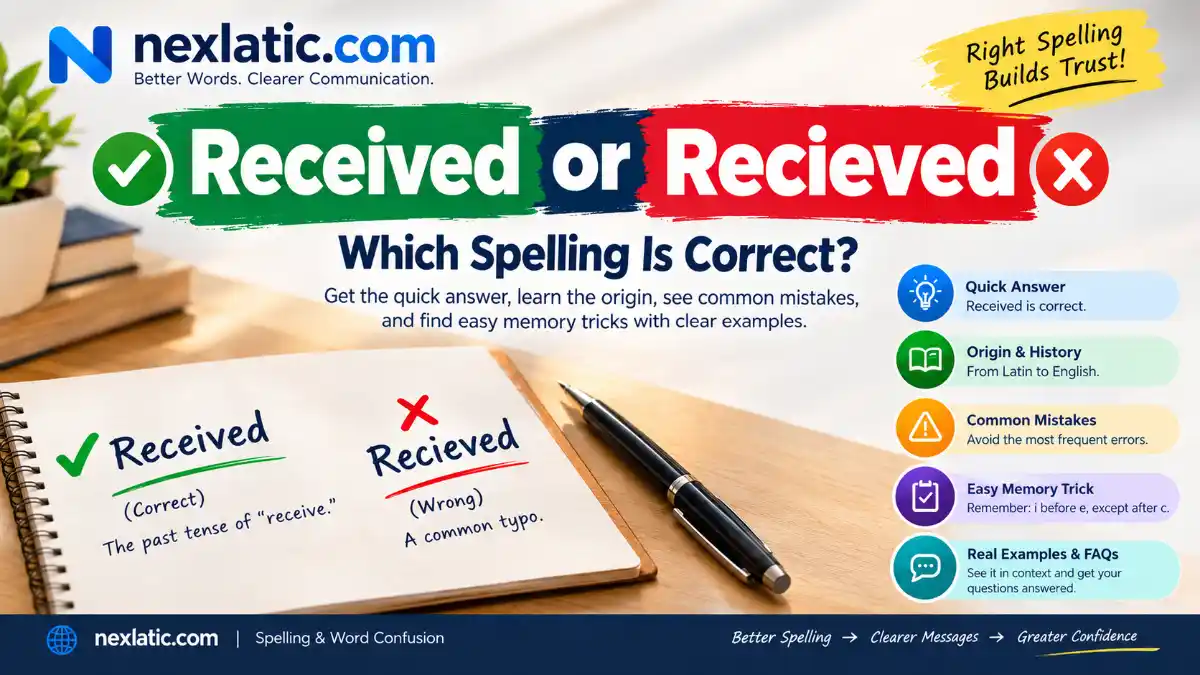
Received is correct. Recieved is wrong.
The word is the past tense of “receive.” You use it when something comes to you. A letter, a gift, a message, or an idea can all be received.
Here are simple examples:
- I received your email this morning.
- She received an award at school.
- We have received your payment.
- Did you receive my text?
Here is the wrong way:
I recieved your email.
A fast memory trick helps. Remember the rule “i before e, except after c.” The letter before the “ei” is a c, so the “e” comes first. Think of c-e-i in a row. The same trick works for receive, receiving, receipt, and receiver.
The Origin of Received or Recieved
The word has a long road behind it. It started in Latin as recipere. That word joins re (back) and capere (to take). So the old meaning was “to take back” or “to take in.”
Old French borrowed the word and shaped it into receivre and later recevoir. English then took it from French around the 1300s. At that time, spelling was loose. Writers spelled the same word in many ways.
Why do spelling mistakes happen today? English picked up words from Latin, French, and other languages. Each one brought its own spelling habits. The sound “ee” can be written as “ie” in words like believe and field. It can also be written as “ei” in words like receive and ceiling. Both spellings make the same sound, so your ear cannot tell them apart.
Printers later settled most spellings in the 1400s and 1500s. Today, only one form is standard: received. The form recieved never became correct in modern English. It stays a simple slip of the fingers or the memory.
British English vs American English Spelling
Here is a key point. Received has no British and American difference. Both countries use the same spelling. Many people search for this pair because they think it is a regional choice. It is not.
Some other words do change between the two styles. The table below shows the difference.
| Word | American English | British English | Same or different? |
| Received | received | received | Same |
| Receive | receive | receive | Same |
| Color | color | colour | Different |
| Center | center | centre | Different |
| Organize | organize | organise (or organize) | Different |
| Canceled | canceled | cancelled | Different |
| Recieved | not correct | not correct | Wrong in both |
The lesson is clear. Regional rules apply to words like color and centre. They do not apply here. Spelling “received” with the “ei” order is right everywhere.
Which Spelling Should You Use?
Use received. Always.
This advice fits every reader:
- US readers: Write received. American style guides and dictionaries list only this form.
- UK and Commonwealth readers: Write received. British, Australian, Canadian, Indian, and Pakistani English all agree.
- Global audience: Write received. Non-native speakers, teachers, and search engines all treat it as the standard.
If you write for work, school, or a website, a correct spelling builds trust. Readers notice errors fast. A clean message looks professional and careful.
Common Mistakes with Received or Recieved
People make a few repeat errors. The table shows each one and its fix.
| Wrong spelling | Correct spelling | Why the mistake happens |
| recieved | received | The “ie” and “ei” order gets swapped |
| recived | received | A letter is dropped |
| receved | received | The “i” is missing |
| receeved | received | The “e” is doubled |
| recieve | receive | Same swap in the base word |
| recieving | receiving | Same swap with “ing” |
| reciept | receipt | Same swap in a related word |
Some words break the “i before e” rule, too. Examples are weird, seize, either, neither, and science. Learn them as small exceptions. Do not let them shake your trust in the main rule.
Another tip: read your message aloud, then check any word that makes you pause. A quick look at a dictionary takes five seconds.
Received or Recieved in Everyday Examples
See how the correct word looks in real life.
Emails
- “I have received your application and will reply soon.”
- “Thank you. We received the files today.”
News
- “The town received heavy rain overnight.”
- “The player received a warm welcome from fans.”
Social media
- “Just received my new phone. So excited!”
- “Never received my order. Anyone else?”
Formal writing
- “The committee received the report on Monday.”
- “Payment must be received by the due date.”
Every example uses the same spelling. The tone changes, but the word does not.
Received or Recieved – Google Trends & Usage Data
Search data shows that people often look up spelling pairs like this one. They want a fast answer, so the search is short and direct. The wrong form, recieved, shows up in search boxes because many people type it by habit.
Usage varies by country and context:
- English-speaking countries such as the US, UK, Canada, and Australia produce steady searches from students and office workers.
- Countries where English is a second language, including India, Pakistan, and Nigeria, often show strong interest in spelling help.
- Context matters. School terms, job hunts, and business email seasons can lift searches.
In published writing, the correct form, received, appears far more often than the typo. Books, news sites, and official documents almost never use recieved.
Exact numbers change over time. For fresh data, open Google Trends, type both spellings, and compare them by country and date range.
Here is a side-by-side view of the variations:
| Variation | Status | Where you see it | Advice |
| received | Correct | Everywhere, in all English styles | Use it |
| recieved | Incorrect | Typos, quick messages | Fix it |
| receive | Correct | Present tense | Use it |
| recieve | Incorrect | Typos | Fix it |
| received by | Correct phrase | Formal and business writing | Use it |
Frequently Asked Questions
Is it received or recieved?
The right spelling is received. Recieved is a typo.
Is recieved ever correct in British English?
No. British English uses received, just like American English.
What is the rule for spelling received?
Use “i before e, except after c.” Since a c comes before the sound, write c-e-i: receive, received.
Why do so many people spell it recieved?
The sound “ee” can be spelled “ie” or “ei.” Many common words, like believe and friend, use “ie.” The brain copies that pattern by mistake.
Where does the word received come from?
It comes from the Latin recipere through Old French. The word joined English around the 1300s.
Does spell check catch recieved?
Usually, yes. Still, fast typing, autocorrect off, or a name field can let it slip through. Always give your message a last look.
What is the correct spelling of receipt and receiving?
Both follow the same rule. Write receipt and receiving, with c-e-i in each.
Conclusion
The answer to “received or recieved” is easy: write received. The other form is a spelling error, not a regional choice. British, American, and global English all agree.
We covered a lot in this article. The word comes from Latin and Old French, and its spelling shows the long road English has traveled. The “ie” and “ei” order trips up many writers, so a simple rule helps. Remember “i before e, except after c,” and picture the letters c-e-i side by side.
Watch for related words, too. Receive, receiving, receipt, and receiver all follow the same pattern. Check your emails, reports, and posts before you hit send. A small spelling fix protects your image and keeps your message clear.
In short, you never need to choose between two correct spellings here. One is right, and one is not. Save this page, share it with a friend who keeps asking, and write with confidence from now on.

Ali Bismal is the founder and writer behind Nexlatic.com, a growing online platform created to provide useful, informative, and easy-to-understand content for everyday readers. Through Nexlatic, Ali shares practical ideas, helpful guides, interesting topics, and engaging articles designed to make information simple and accessible. His goal is to create reliable, reader-focused content that helps people learn something new, find useful answers, and make everyday life a little easier.