You are typing a message. You write, “The train stoped.” Something looks off. You pause. Is it stopped or stoped?
You are not alone. Many people ask this every day. The word is short and common. Still, the spelling trips up writers of all ages.
People search for Stopped or Stoped for one reason. They want a fast, sure answer before they hit send. Maybe it is an email to a boss. Maybe it is a school essay or a blog post. A small spelling error can make you look careless, and nobody wants that.
The confusion comes from a spelling rule. Many English words drop a silent “e” and keep one “p.” Think of “hoped” and “taped.” So “stoped” feels right to some people. But “stop” follows a different rule.
This guide gives you the quick answer first. Then it explains why. You will see US and UK spelling, common mistakes, real examples, and usage trends. Let’s clear it up for good.
Stopped or Stoped – Quick Answer
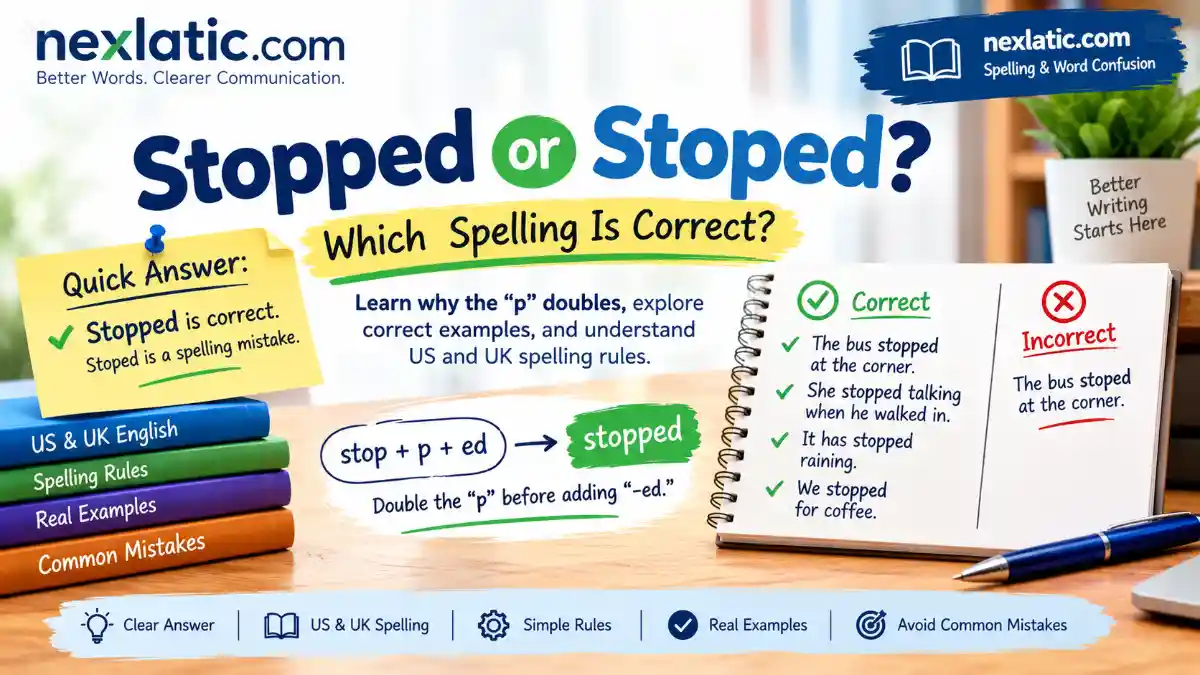
“Stopped” is correct. “Stoped” is a spelling mistake.
“Stopped” is the past tense of “stop.” It is also the past participle. You use it in both American and British English.
Here are some simple examples:
- The bus stopped at the corner.
- She stopped talking when he walked in.
- It has stopped raining.
- We stopped for coffee.
The rule is easy. Double the “p” before you add “-ed.”
stop + p + ed = stopped
The Origin of Stopped or Stoped
The word “stop” is very old. It comes from the Old English word stoppian. That word meant “to block” or “to plug a hole.” Long ago, people used it for things like stopping up a jar or a pipe.
Experts link stoppian to a Late Latin word, stuppare. It meant “to stuff with rough fiber.” That word came from Latin stuppa, which means “rough fiber” or “tow.” People used this fiber to seal gaps.
Over time, the meaning grew. “Stop” went from “plug a hole” to “end movement.” Today it means to halt, quit, or end something.
Why Do People Write “Stoped”?
The spelling difference comes from English rules about adding “-ed.”
- Words that end in a silent “e” drop the “e.” Example: hope → hoped.
- Short words with one vowel and one last consonant double that consonant. Example: stop → stopped.
The doubled letter keeps the vowel sound short. Compare these two words:
- taped (long “a” sound, from “tape”)
- tapped (short “a” sound, from “tap”)
Same with stoped and stopped. “Stoped” would look like it has a long “o,” like “hoped.” But the word “stop” has a short “o.” So the “p” must double.
A Fun Fact: “Stoped” Is a Real Word in Mining
There is one odd case. In mining, a stope is an area dug out in steps. The verb “to stope” means to dig that way. So “stoped” can be correct in mining texts. For daily writing, you will never need it.
British English vs American English Spelling
Here is the good news. Stopped is spelled the same in US and UK English. There is no split here.
But some similar words do change between the two. That is why people get unsure. Here is a side-by-side look.
| Base Word | American English | British English | Same or Different? |
| stop | stopped | stopped | Same |
| plan | planned | planned | Same |
| drop | dropped | dropped | Same |
| travel | traveled | travelled | Different |
| cancel | canceled | cancelled | Different |
| label | labeled | labelled | Different |
| model | modeled | modelled | Different |
What Is the Rule?
- One-syllable words like stop, plan, and drop double the last letter in both US and UK English.
- Words that end in “l” often change. British English doubles the “l.” American English often does not.
So “stopped” is safe everywhere. “Stoped” is wrong everywhere.
Which Spelling Should You Use?
The answer is simple: always use “stopped.”
Here is advice for each audience.
- US readers: Use “stopped.” Never use “stoped.”
- UK, Australia, Canada, India, and other Commonwealth readers: Use “stopped.” The rule is the same.
- Global readers: Use “stopped.” Every major dictionary lists it as the only standard spelling.
- Business and school writing: Use “stopped.” A spelling error can hurt trust.
- Mining writing only: “Stoped” may appear, but only as a special term.
If you want a quick tip, remember this: stop has a short “o,” so the “p” doubles.
Common Mistakes with Stopped or Stoped
Here are the most frequent errors. Each one has a quick fix.
| Mistake | Correction | Why |
| The rain stoped. | The rain stopped. | Double the “p.” |
| She was stoping the car. | She was stopping the car. | Same rule for “-ing.” |
| He stopt talking. | He stopped talking. | “Stopt” is not standard. |
| They have stop working. | They have stopped working. | Use the past participle after “have.” |
| I stop by yesterday. | I stopped by yesterday. | Use past tense for past actions. |
| Stoppped | Stopped | Only two “p” letters. |
Watch Out for “-ing” Too
The same rule works for “stopping.” People often write “stoping.” That is also wrong. The right form is stopping.
Do Not Forget Related Words
- stopper (not “stoper”)
- stoppage (not “stopage”)
- stoppable (not “stopable”)
Stopped or Stoped in Everyday Examples
Seeing the word in real use helps it stick. Here are correct examples in different places.
Emails
- “The shipment stopped in customs. I will update you soon.”
- “Our server stopped working at noon. It is fixed now.”
News
- “Police stopped the car near the bridge.”
- “Heavy snow stopped flights across the region.”
Social Media
- “I just stopped scrolling and wow, it’s 2 a.m.”
- “Who else stopped eating sugar this month?”
Formal Writing
- “The committee stopped the project after the review.”
- “The study showed the drug stopped the spread of the disease.”
In School
- “The ball stopped rolling at the wall.”
- “He stopped at each sign.”
Stopped or Stoped – Google Trends & Usage Data
I cannot pull live numbers here, and Google Trends changes often. So this section explains the general pattern you will usually see. You can check the exact data yourself at trends.google.com.
- “Stopped” is searched and used far more than “stoped.” This is true in every English-speaking country.
- “Stoped” mostly shows up as a typo or a spelling check. Many people type it to see if it is right.
- Countries with many English learners and students often show more spelling-check searches. These can include India, Pakistan, Nigeria, and the Philippines.
- US, UK, Canada, and Australia show strong use of the correct form. Searches there often come from quick typo checks.
- Context matters. “Stopped” appears in news, sports, tech, and daily talk. “Stoped” mainly appears in mining content or errors.
How to check it yourself:
- Go to Google Trends.
- Type “stopped” and “stoped” as two search terms.
- Pick your country and time range.
- Look at the “Interest by region” map.
You will see “stopped” lead by a wide margin.
Comparison Table: Keyword Variations Side by Side
| Form | Correct? | Part of Speech | Example |
| stopped | Yes | Past tense / past participle | The car stopped. |
| stoped | No (only mining) | Misspelling | |
| stopping | Yes | Present participle | He is stopping now. |
| stoping | No (only mining) | Misspelling | |
| stops | Yes | Third-person present | She stops at noon. |
| stopt | No | Misspelling | |
| stopped (UK) | Yes | Same as US | The lift stopped. |
| stopped (US) | Yes | Same as UK | The elevator stopped. |
FAQs
1. Is it stopped or stoped?
It is stopped. “Stoped” is a spelling mistake in standard English.
2. Why does “stopped” have two Ps?
The word “stop” is short and has a short vowel. English doubles the last letter before “-ed” or “-ing” to keep that short sound.
3. Is “stoped” ever correct?
Only in mining. The verb “to stope” means to dig an underground area. Outside of mining, it is wrong.
4. Is “stopped” different in British and American English?
No. Both use “stopped.” The spelling is the same everywhere.
5. What is the correct spelling of the “-ing” form?
It is stopping, with two Ps. “Stoping” is wrong.
6. Why do people confuse stopped and stoped?
Many words that end in “e” keep one consonant, like “hoped” or “taped.” People apply that rule to “stop,” but “stop” has no “e.”
7. How can I remember the right spelling?
Use this trick: short vowel, double the consonant. “Stop” has a short “o,” so write stopped. Another trick: “hop → hopped” and “stop → stopped.”
8. Can spell check catch “stoped”?
Yes. Most tools mark it right away. Still, it is smart to learn the rule so you do not depend on a tool.
Conclusion
The answer to Stopped or Stoped is clear. “Stopped” is the correct spelling. “Stoped” is a common mistake. The only exception is a rare mining term.
Here are the key points to remember:
- “Stop” has a short “o” sound, so the “p” doubles.
- The same rule gives you “stopping,” “stopper,” and “stoppage.”
- US and UK English spell this word the same way.
- Words like “travelled” and “traveled” do differ, but “stopped” does not.
- Always use “stopped” in emails, school work, news, and business writing.
When you feel unsure, use a simple test. Say the base word out loud. If the vowel is short, double the last letter. This trick works for many words, such as “plan,” “drop,” and “hop.”
Small details build trust. Clean spelling shows care. So next time you write about something that ended, use stopped and move on with confidence.

David Wilson is a writer and contributor at Nexlatic.com, where he writes about useful topics, everyday questions, and practical ideas. He enjoys turning information into simple, clear, and easy-to-read articles that readers can actually use. Through his work at Nexlatic, David aims to share helpful content that answers common questions, explains confusing topics, and gives readers something useful to take away from every article.