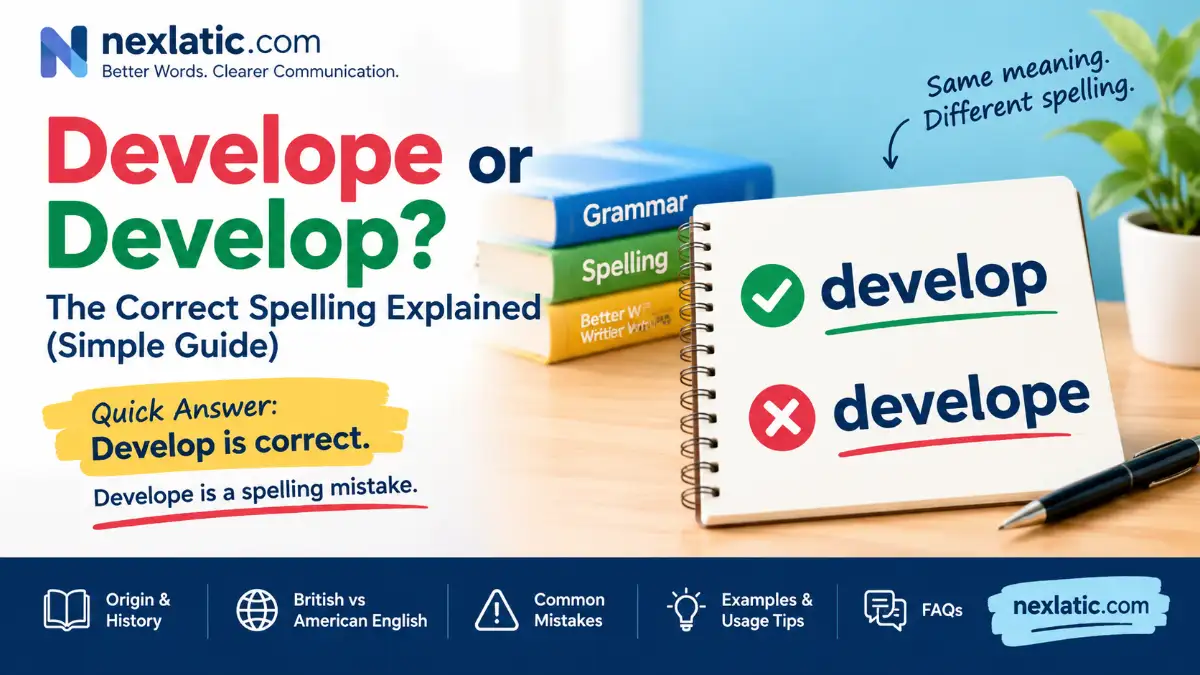
Quick answer: “Develop” is correct. “Develope” is a spelling mistake.
You are typing an email. You stop. Is it “develope” or “develop”? You stare at the word. Something feels off. You are not alone. Many people search this question every month.
People search for this because English spelling is tricky. Many words end in a silent “e,” like “envelope,” “scope,” and “hope.” So the brain adds an “e” to “develop” too. It looks right, but it is wrong. Spell checkers catch it, but not always. Students, writers, and business owners all want to be sure.
This article clears up the confusion. You get a quick answer first. Then you learn where the word came from. You see how British and American English handle it. You also see common mistakes, real examples, usage data, and FAQs. By the end, you will never doubt this word again. Let’s start with the short answer.
Develope or Develop – Quick Answer
The correct spelling is develop. It has no “e” at the end. This is true in American English. It is also true in British English. It is true everywhere.
“Develope” is not a real word. Neither British nor American English uses it. It is just a common typo.
Correct examples:
- We develop new apps every year.
- She wants to develop her skills.
- The town will develop the old park.
Wrong examples:
We develope new apps every year.She wants to develope her skills.
Here is a trick. Say the word out loud: “dih-VEL-up.” The last sound is “up.” There is no “e” sound at the end. So there is no “e” in the spelling.
The Origin of Develop
“Develop” comes from Old French. The French word was desveloper. It meant “to unwrap” or “to unfold.” Think of opening a folded cloth. Later, English borrowed it in the 1600s.
At first, the word meant “to open up” or “to reveal.” Over time, the meaning grew. Today it also means “to grow,” “to build,” or “to improve.”
Why do people add an “e”?
There are a few reasons:
- Look-alike words. “Envelope” ends in “e.” It is a close cousin of “develop” in history. Both come from French. But the spellings split apart.
- Silent “e” habit. Many English words end in a silent “e.” The brain expects it.
- Old spellings. In some very old books, you may see “develope.” Spelling was not fixed back then. Writers spelled words in different ways. Over time, “develop” became the standard form.
- French influence. The French word today is développer. It has its own spelling rules. English learners sometimes mix them up.
So the spelling difference is not about country. It is about habit and history.
British English vs American English Spelling
Here is the good news. British and American English spell “develop” the same way. There is no difference.
Many other words do change between the two. That is why people worry. They think “develop” might be one of them. It is not.
| Word Family | American English | British English | Same or Different? |
| to grow or build | develop | develop | Same |
| past tense | developed | developed | Same |
| “-ing” form | developing | developing | Same |
| a person who builds | developer | developer | Same |
| growth or progress | development | development | Same |
| a mistaken spelling | develope | develope | Wrong in both |
Now look at words that do differ. This shows why “develop” is special.
| American English | British English |
| color | colour |
| organize | organise |
| center | centre |
| license (noun) | licence (noun) |
| program | programme (in some uses) |
Key point: “Develop” is not on this list. You never need to switch it.
Which Spelling Should You Use?
Use develop. Always. The answer does not change by audience.
If your readers are in the US: Write “develop.” Use “developed,” “developing,” and “development” too.
If your readers are in the UK, Australia, India, or other Commonwealth countries: Write “develop.” It is the same.
If your readers are global: Write “develop.” It is the safest choice. Everyone understands it.
Professional advice:
- Use “develop” in resumes, reports, emails, and websites.
- Set your spell checker to flag “develope.”
- Proofread once for this word if you write often about software, business, or education.
A wrong spelling can hurt trust. A simple word, spelled right, looks professional.
Common Mistakes with Develop
Here are the errors people make most. Each one has a fix.
| Mistake | Correction | Tip |
| develope | develop | No “e” at the end |
| developement | development | Keep the “e” in “-ment,” but not after “develop” |
| developped | developed | Do not double the “p” |
| developping | developing | Do not double the “p” |
| developer’s | developers | No apostrophe for a plain plural |
| envelop vs envelope | envelope (noun) | “Envelope” holds a letter. “Envelop” means to wrap. |
Why the double “p” mistake? Words like “stop” become “stopped.” But “develop” has a weak last syllable. The stress is on the second part, “VEL.” So we do not double the “p.”
Quick memory trick: “Develop” has no “e” at the end. It ends with “op,” like “stop,” but is spelled with a “p” only.
Develop in Everyday Examples
See the word in real use.
Emails
- “We plan to develop a new plan by Friday.”
- “Our team will develop the training guide this month.”
News headlines
- “City to Develop New Park by the River”
- “Scientists Develop Faster Way to Test Water”
Social media
- “Learning to develop good habits one day at a time. #growth”
- “New to coding? You can develop real skills in six months.”
Formal writing
- “The study aims to develop a clear model of student learning.”
- “The company will develop its overseas markets over five years.”
Job posts
- “We need a developer who can develop and test new features.”
Notice the pattern. The spelling stays the same in every setting. Only the tone changes.
Develope or Develop – Google Trends & Usage Data
A note first: search numbers change all the time. For live numbers, check Google Trends yourself. Here is what you will usually see.
Overall pattern
- “Develop” is searched and used far more than “develope.” The gap is very large.
- “Develope” shows up mostly as a typo or a question. People search it to check if it is right.
By country
- United States and United Kingdom: Almost all writing uses “develop.” Searches for the typo are small.
- India, Pakistan, Nigeria, the Philippines, and other places where English is a second language: Questions about this spelling are often more common. Learners are checking the rules.
By context
- Tech and software: “Develop,” “developer,” and “development” appear very often. Typos get fixed fast.
- Education and study: Students often search for spelling help.
- Social media: Typos are more common in quick posts and texts.
What this tells us: People search “develope or develop” because they want to be sure. The answer is the same in every country: develop.
Keyword Variations Side by Side
| Variation | Correct? | Use It? | Note |
| develop | Yes | Yes | Standard spelling everywhere |
| develope | No | No | Common typo |
| developed | Yes | Yes | Past tense |
| developing | Yes | Yes | “-ing” form |
| development | Yes | Yes | Noun |
| developer | Yes | Yes | Person or job title |
| developement | No | No | Extra “e” before “-ment” |
| developped | No | No | Extra “p” |
FAQs
1. Is it “develope” or “develop”?
It is “develop.” “Develope” is a typo.
2. Is “develope” a British spelling?
No. British English also uses “develop.” There is no British version with an “e.”
3. Is “develope” an old spelling?
You may find it in very old texts. Spelling was not fixed then. Today it is wrong.
4. How do I spell the past tense?
Write “developed.” Do not add a second “p” or an extra “e.”
5. How do I spell the noun?
Write “development.” Add “-ment” straight to “develop.” Do not write “developement.”
6. What is the difference between “develop” and “envelop”?
“Develop” means to grow or build. “Envelop” means to wrap or cover. “Envelope” (with an “e”) is the paper holder for a letter.
7. How can I remember the right spelling?
Say it slowly: “dih-VEL-up.” It ends with “up,” not “up-ee.” No “e” at the end.
8. Will spell check fix this?
Usually yes. But not always. Proofread to be safe.
Conclusion
The answer is simple. Develop is the correct spelling. “Develope” is a mistake. This is true in American English, British English, and every other kind of English.
The word came from Old French. It first meant “to unwrap.” Over time, it grew to mean “to build” and “to improve.” People add an extra “e” because many English words end that way. But this word does not.
Remember these key points:
- Write develop, never “develope.”
- Write developed and developing, with one “p.”
- Write development, with no extra “e” before “-ment.”
- The spelling is the same for US, UK, and global readers.
A small spelling error can make good work look careless. A correct word builds trust. Use the trick from this guide. Say it out loud. If it ends with “up,” it has no “e.”
Now you can write with confidence. Save this guide. Share it with a friend who still doubts the word.

Ali Bismal is the founder and writer behind Nexlatic.com, a growing online platform created to provide useful, informative, and easy-to-understand content for everyday readers. Through Nexlatic, Ali shares practical ideas, helpful guides, interesting topics, and engaging articles designed to make information simple and accessible. His goal is to create reliable, reader-focused content that helps people learn something new, find useful answers, and make everyday life a little easier.