You are typing fast. You want to write about a fight between two people, or a phone with two cameras. Then you freeze. Is it duel or dual? You look at both words. They look the same. They sound the same. Spell check says nothing, because both are real words.
You are not alone. Thousands of people search “duel or dual” every month, hoping for one fast, clear answer. The mix-up happens because both words start with the Latin root for “two.” But they do not mean the same thing. One is about a fight. The other is about two parts. Using the wrong one can make a smart sentence look careless.
This guide fixes that in minutes. You will get the quick answer first, then the word origins, real examples, and the most common mistakes. There is no long rule list to memorize. Just one simple trick, and you will never mix them up again. Let’s begin.
Duel or Dual – Quick Answer
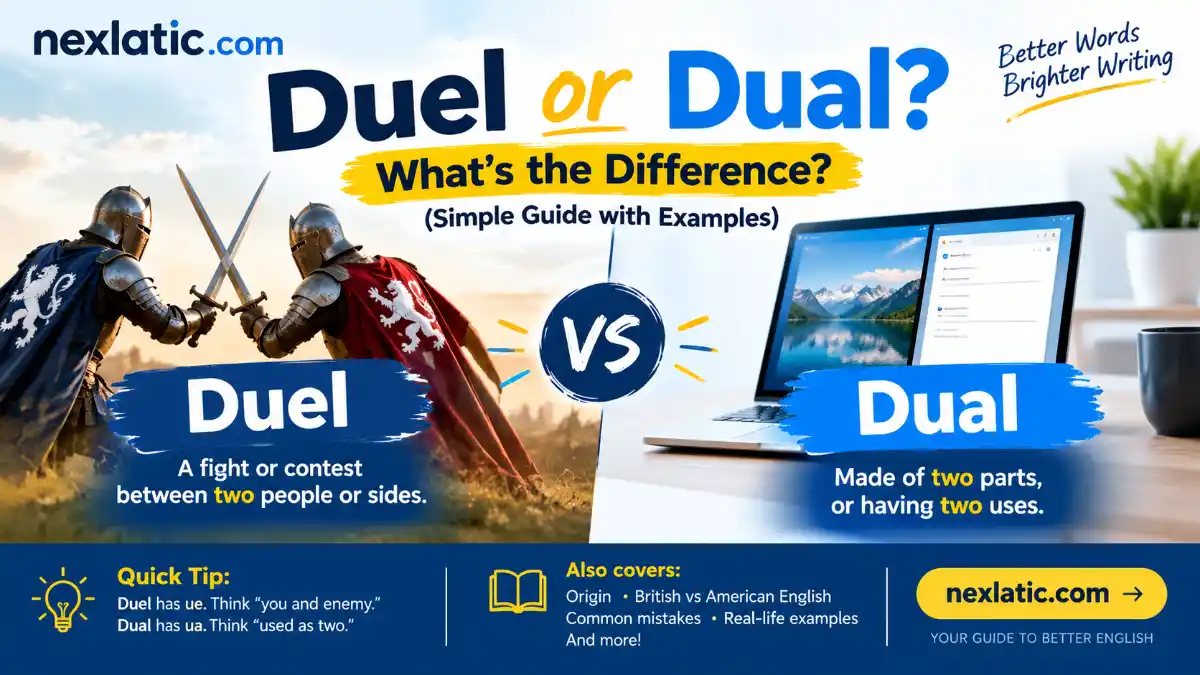
Duel is a fight or contest between two people or sides.
Dual means made of two parts, or having two uses.
They are not two spellings of one word. They are two different words.
Examples of duel:
- The two knights fought a duel at dawn.
- The singers had a duel on stage.
- The two chess champions shared a long duel.
Examples of dual:
- She has dual citizenship.
- The car has dual exhaust pipes.
- He plays a dual role in the film.
Easy trick: Duel has ue. Think u and e for “you and enemy.” A duel needs two rivals. Dual has ua. Think “used as two,” or two parts.
The Origin of Duel and Dual
Both words come from Latin. Both are linked to the word duo, which means “two.” That is why they look so alike.
Duel comes from the Latin word duellum. It was an old form of bellum, which means “war.” Later, people in the Middle Ages linked it to duo. They saw a duel as a fight between two people. The word came into English in the 1500s.
Dual comes from the Latin word dualis. It means “containing two.” It entered English in the 1600s.
So why are the spellings close? Because they share the same root idea: two. They also took different paths into English, which gave us two words with two meanings.
British English vs American English Spelling
Here is the key point: duel and dual are not British or American spellings of each other. They are two separate words. Both countries spell both words the same way.
Some words do change between UK and US English. For example, colour and color. But that rule does not apply here.
| Word | Meaning | US spelling | UK spelling |
| Duel | A fight between two | duel | duel |
| Dual | Having two parts | dual | dual |
| Dueling / Duelling | Fighting in a duel | dueling | duelling |
| Duelist / Duellist | A person in a duel | duelist | duellist |
The only real spelling difference is in the forms made from duel. US English uses one l (dueling, duelist). UK English often uses two (duelling, duellist). The word dual has no such change.
Which Spelling Should You Use?
The choice depends on meaning, not on where you live.
- Fighting or a contest between two? Use duel.
- Two parts or two uses? Use dual.
For the “-ing” forms of duel, follow your audience:
- US readers: dueling, duelist
- UK, Canada, Australia, and most Commonwealth readers: duelling, duellist
- Global readers: Pick one style and use it everywhere in your text.
Always check that your spelling tool is set to the right English for your readers.
Common Mistakes with Duel and Dual
1 Mistake : Using “dual” for a fight.
- Wrong: The two rivals met in a dual.
- Right: The two rivals met in a duel.
2 Mistake : Using “duel” for two parts.
- Wrong: The phone has duel cameras.
- Right: The phone has dual cameras.
3 Mistake : Mixing up the forms.
- Wrong: dualing
- Right: dueling (US) or duelling (UK)
4 Mistake : Trusting spell check. Both words are real words. Spell check will not catch the error. Read your sentence and ask: “Is this a fight, or is this two parts?”
Duel and Dual in Everyday Examples
In emails
- Our team has dual goals this quarter: speed and quality.
- Please use dual monitors for the training.
In news
- Two senators entered a verbal duel on live TV.
- The airport now has dual runways.
On social media
- Dance duel tonight! Who will win?
- Just got dual SIM phone. Love it!
In formal writing
- The company holds dual listings on two stock exchanges.
- Historians study the famous duel between Hamilton and Burr.
Duel or Dual – Google Trends & Usage Data
I can’t pull live Google Trends numbers for this article, so I won’t make any up. Check Google Trends yourself for current figures. Here is what you can usually expect to find, and why.
Why people search it: Both words sound the same when spoken. People hear them more than they write them. So they stop and check the spelling.
By country: English-speaking countries such as the US, UK, Canada, Australia, and India tend to show the most interest. The search is about meaning, not about a UK or US spelling gap.
By context:
- Duel often shows up around games, movies, sports, and history.
- Dual often shows up around tech, cars, school, and law (for example, dual citizenship, dual screens, dual SIM).
Tip: Compare “duel” and “dual” in Google Trends. Then add “duel meaning” and “dual meaning.” Look at the “Related queries” and “Interest by region” sections.
Side-by-side comparison
| Feature | Duel | Dual |
| Part of speech | Noun, verb | Adjective |
| Meaning | A fight or contest between two | Made of two parts; double |
| Sounds like | “DOO-ul” | “DOO-ul” |
| Common phrases | Duel at dawn, pistol duel | Dual role, dual citizenship |
| Related forms | Dueling, duelling, duelist | Duality, dually |
| Origin | Latin duellum | Latin dualis |
| Best used for | Fights, rivalry, contests | Two parts, two uses |
FAQs
1. Is it duel or dual?
Both are correct. They have different meanings. Use duel for a fight between two. Use dual for two parts.
2. Do duel and dual sound the same?
Yes. Most people say both words the same way. That is why they get mixed up in writing.
3. Is “dual” a British spelling of “duel”?
No. They are two separate words. Both UK and US English use both words.
4. Is it “dueling” or “duelling”?
Both are right. US English uses dueling. UK English uses duelling.
5. Can “duel” be a verb?
Yes. Example: The two chefs will duel for the prize.
6. Is “dual” a noun?
Mostly it is an adjective. It tells us something has two parts. Example: dual controls.
7. What is a simple way to remember the difference?
Duel has “ue” like “you and enemy.” Dual has “ua” like “used as two.”
Conclusion
Duel or dual? Now you know. A duel is a fight or contest between two people or sides. Dual means having two parts or two uses. Both words come from the Latin word for “two,” which is why they look so alike. But they have different jobs, and they are never swapped.
Keep these points in mind. Duel and dual are not British and American spellings of each other. Both countries spell both words the same way. Only the forms of duel change: dueling and duelist in the US, duelling and duellist in the UK. And do not trust spell check here. Both words are real, so it will not warn you when you pick the wrong one.
Before you hit send, ask one small question: “Is this a fight, or is this two parts?” Fight means duel. Two parts means dual. Use that quick check every time, and your writing will look sharp, clear, and professional.

David Wilson is a writer and contributor at Nexlatic.com, where he writes about useful topics, everyday questions, and practical ideas. He enjoys turning information into simple, clear, and easy-to-read articles that readers can actually use. Through his work at Nexlatic, David aims to share helpful content that answers common questions, explains confusing topics, and gives readers something useful to take away from every article.