Picture this. You are writing an email about a country’s top diplomat. Your fingers type “embassador,” and the word looks odd. So you stop and search.
You are not alone. Many people mix up embassador and ambassador every month. The word “embassy” is the cause. Embassy starts with “em,” so the mind expects the person to start the same way.
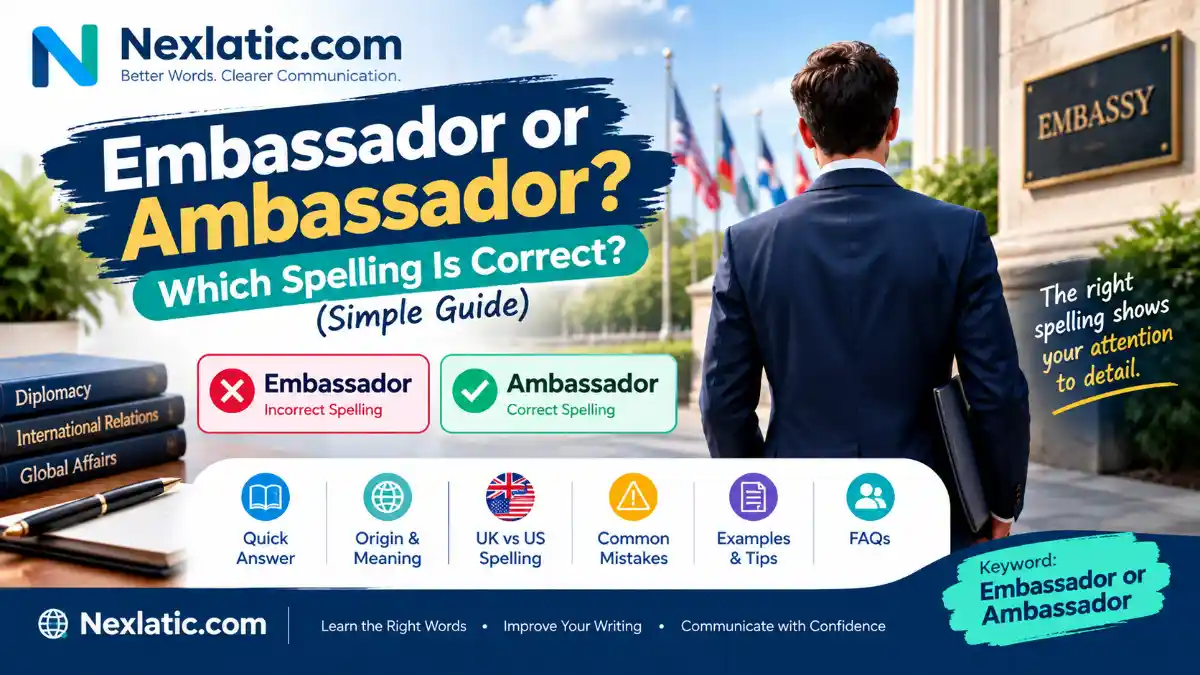
Here is the short answer: ambassador is the only correct spelling. Embassador is a common mistake. No country treats it as a valid variant, whether British or American.
This guide clears up the confusion. You will learn where the word comes from and why people get it wrong. A simple memory trick will help you remember the right spelling. Real examples, a handy table, and clear answers to common questions are inside too. Whether you write emails, essays, or news posts, the right spelling keeps your writing sharp. Read on and never doubt this word again.
Embassador or Ambassador – Quick Answer
Ambassador is correct. Embassador is wrong.
An ambassador is a person. This person speaks for a country or a group. Always start the word with “am.”
Here are some examples:
- Correct: The ambassador met the president on Monday.
- Wrong: The embassador met the president on Monday.
- Correct: She became the ambassador to Japan.
- Correct: The brand ambassador shared a new video.
Memory trick: Think “I AM the ambassador.” The word starts with “am,” just like “I am.”
Keep one more rule in mind. The building is an embassy, and it starts with “em.” The person is an ambassador, and it starts with “am.” Two words, two starts.
The Origin of Embassador or Ambassador
The word came into English from Old French. The French form was “ambassadeur.” French took it from Italian and Provençal words like “ambasciatore.” These words trace back to Medieval Latin “ambactia,” which meant a mission or a service.
Go back further and you reach Latin “ambactus,” which meant a servant. Latin borrowed that word from Gaulish. So an ambassador was first a ruler’s servant, sent on an errand.
“Embassy” grew from the same root. That is why the two words look so close. Over time, they ended up with different first letters.
Why did the spelling wobble? Before dictionaries, writers spelled by ear. The first sound in this word is soft, so “am” and “em” sound almost the same. Old English texts sometimes show “embassador” for that reason. Dictionaries later settled the matter. They chose “ambassador” for the person and “embassy” for the place.
The “em” start also feels natural because English has many words like it. Think of embrace, embark, and embed. The brain sees a pattern and applies it here by mistake.
British English vs American English Spelling
Many spelling pairs differ between the UK and the US. Honor and honour are one example. Ambassador is not one of them.
Both American and British English use ambassador. Canadian, Australian, Indian, and other Commonwealth English follow the same rule. No major dictionary lists “embassador” as a normal variant today.
| Word | American English | British English | Status |
| Person who represents a country | ambassador | ambassador | Correct in both |
| Common misspelling | embassador | embassador | Wrong in both |
| Office building | embassy | embassy | Correct in both |
| Respect for others | honor | honour | Real regional difference |
| Hue | color | colour | Real regional difference |
| Middle point | center | centre | Real regional difference |
The last three rows show true UK and US differences. The first three rows show that ambassador does not belong in that group.
Which Spelling Should You Use?
The answer is the same for every reader. Use ambassador.
- US audience: Use ambassador. Spell checkers in the US flag embassador.
- UK and Commonwealth audience: Use ambassador. Nothing changes across the Atlantic.
- Global audience: Use ambassador. It works for students, business teams, and news sites everywhere.
One extra tip helps with capital letters. Use a capital “A” when the word comes right before a name, as in “Ambassador Lee.” Use a small “a” when it stands alone, as in “the ambassador spoke.”
Common Mistakes with Embassador or Ambassador
Here are the errors people make most, with the fix for each:
- Embassador → Ambassador. This is the top mistake. Start with “am.”
- Ambasador → Ambassador. The word needs a double “s.”
- Ambassodor → Ambassador. The ending is “or,” not “er” or “odor.”
- Ambassy → Embassy. People sometimes flip the error the other way. The building starts with “em.”
- “She works at the ambassador” → “She works at the embassy.” A person is not a building.
- Wrong capital letters. Write “the ambassador said,” but write “Ambassador Lee said.”
Embassador or Ambassador in Everyday Examples
Dear Ambassador Khan,
Thank you for meeting our team. We look forward to your visit to our office next week.
News
The ambassador told reporters that talks will continue next month.
Social media
So proud to be a brand ambassador for this team! #ambassador
Formal writing
The ambassador presented her credentials to the head of state in a short ceremony.
Each example uses the correct spelling. Notice that none of them could use “embassador” without looking like a typo.
Embassador or Ambassador – Google Trends & Usage Data
I can’t give you exact live numbers here, because Trends data changes all the time. You can check it in two minutes. Go to Google Trends, type both words, and compare them by country and by date.
Here is the usual pattern:
- Ambassador gets far more searches than the misspelling.
- Embassador gets small but steady searches. Most of them come from people who want to check the spelling.
- Interest in ambassador rises when diplomatic news breaks. New appointments, summits, and elections all cause spikes.
- Brand and marketing use keeps the word popular all year. Companies love the phrase “brand ambassador.”
- Writers who learn English as a second language often search the spelling. Their searches add to the steady interest in the question.
This pattern is why your quick-answer section matters. Most searchers want one fast fact, and then they leave.
Embassador vs Ambassador: Side-by-Side Comparison
| Variation | Correct? | Meaning | Example |
| ambassador | Yes | A person who represents a country or group | The ambassador arrived early. |
| embassador | No | A misspelling of ambassador | Avoid this form. |
| embassy | Yes | The office building of an ambassador | The embassy opens at nine. |
| ambassy | No | A misspelling of embassy | Avoid this form. |
| ambassadorial | Yes | Linked to an ambassador | She took an ambassadorial role. |
| brand ambassador | Yes | A person who promotes a brand | He is our brand ambassador. |
| ambasador | No | Missing a letter “s” | Avoid this form. |
FAQs
1. Is it embassador or ambassador?
It is ambassador. Embassador is a spelling mistake.
2. Is embassador a British spelling?
No. British English uses ambassador, just like American English.
3. Was embassador ever correct?
Some old texts used it, because spelling was loose then. Today, no modern dictionary treats it as standard.
4. What is the difference between an embassy and an ambassador?
An embassy is a building. An ambassador is the person who leads the work there.
5. How do I remember the right spelling?
Think “I AM the ambassador.” Both start with “am.”
6. Do I capitalize ambassador?
Capitalize it before a name, as in Ambassador Lee. Keep it lowercase on its own, as in “the ambassador.”
7. Is “brand ambassador” spelled the same way?
Yes. The rule does not change. Write brand ambassador with “am.”
Conclusion
The answer is simple. Ambassador is correct, and embassador is a mistake. No difference exists between British and American spelling here, so you can use the same word anywhere in the world.
Remember the key points. The word comes from old French and Latin roots, and it has always been a hard one to spell. Embassy causes most of the mix-ups, since it starts with “em.” Use “am” for the person and “em” for the building. Capitalize the word only when it comes before a name, as in Ambassador Lee.
Mistakes happen to every writer. A quick check before you hit send keeps your work clean and trusted. Readers notice small errors, especially in emails, news, and formal papers.
Save this guide and share it with a friend or teammate. Next time you doubt the spelling, picture the phrase “I am the ambassador.” Those two letters at the start will point you to the right answer every time.

David Wilson is a writer and contributor at Nexlatic.com, where he writes about useful topics, everyday questions, and practical ideas. He enjoys turning information into simple, clear, and easy-to-read articles that readers can actually use. Through his work at Nexlatic, David aims to share helpful content that answers common questions, explains confusing topics, and gives readers something useful to take away from every article.