You are writing an email. You type, “I want to you that the work is done.” Then you stop. Is the word assure or ensure? You are not alone. These two words look alike and sound alike. Both have to do with being sure, and even skilled writers mix them up. That is why so many people search for “assure or ensure” every day.
The good news is that the rule is simple. One word is about people. The other word is about things. Once you see the pattern, you will not forget it. In this article, you get a quick answer first. Next, you will learn where the words came from and how British and American writers use them. After that come common mistakes, real-life examples, a handy table, and answers to common questions.
By the end, you will pick the right word fast. Your writing will carry more trust and less doubt. Let us clear up the confusion once and for all.
Assure or Ensure – Quick Answer
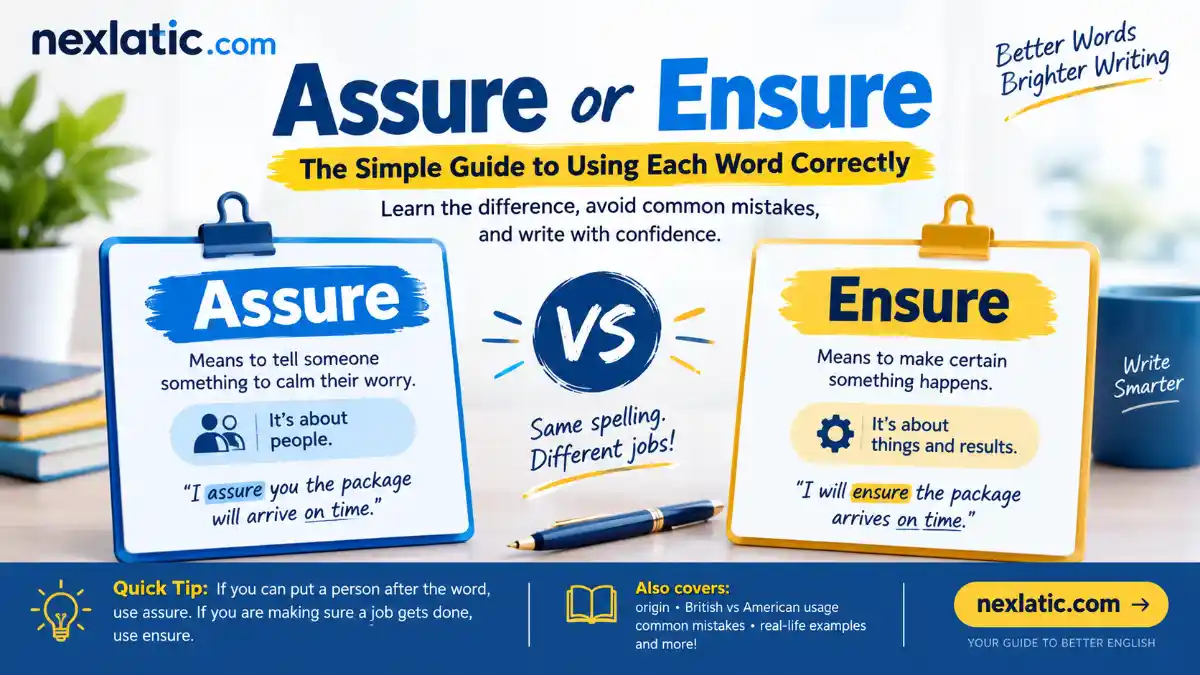
Assure means to tell someone something to calm their worry. It is about people.
Ensure means to make certain something happens. It is about things and results.
Examples:
- “I assure you the package will arrive on time.” (You calm a person.)
- “I will ensure the package arrives on time.” (You make it happen.)
- “She assured her son that the storm was safe.” (She comforted him.)
- “Please ensure the door is locked.” (Make sure the door is locked.)
Easy trick: If you can put a person right after the word, use assure. If you are making sure a job gets done, use ensure.
There is a third word, insure. It is mostly about money and insurance. We cover it below.
The Origin of Assure and Ensure
Both words come from the same old roots. That is why they feel so close.
Assure came into English from Old French. The French word came from Latin. It joined ad (meaning “to”) and securus (meaning “safe” or “free from worry”). So assure once meant “to make someone feel safe.”
Ensure also came through French. It was built from en (meaning “make”) and seur (meaning “sure”). So ensure meant “to make sure.”
Insure grew from the same family. In early English, ensure and insure often did the same job. Over time, insure became tied to money and protection. Ensure kept the meaning of making certain.
Why are the spellings so close? English borrowed these words from French at different times. Each time, the spelling shifted a little. Writers also spelled words in many ways before dictionaries fixed the rules. So we ended up with three similar words, each with its own job.
British English vs American English Spelling
Here is a surprise. The spelling of assure and ensure is the same in British and American English. There is no “color vs colour” type of split here.
The real difference is in how people use the words, especially insure and assurance.
| Word | American English | British English |
| Assure | To comfort a person | To comfort a person |
| Ensure | To make certain | To make certain |
| Insure | Money cover, and sometimes “make certain” | Money cover only (usually) |
| Assurance | Promise or confidence | Promise, and also some life cover |
| Insurance | Money cover | Money cover |
Key points:
- The spelling does not change between the US and UK.
- In the US, some people use insure where they mean ensure. Many style guides still say to avoid this.
- British writers often use assurance for life cover. You may see “life assurance” there.
Which Spelling Should You Use?
Because the spelling is the same, your choice depends on meaning, not country.
If your readers are in the US:
- Assure fits people.
- For making sure a task is done, pick ensure.
- Save insure for money cover only.
If your readers are global:
- Stick to the simple rule: assure for people, ensure for results, insure for money.
- This is safe in every country.
Work tip: In business writing, ensure is the word you will use most. Save assure for moments when you want to ease a person’s worry.
Common Mistakes with Assure or Ensure
1 Mistake : Using ensure for a person.
- ❌ “I ensure you we will finish.”
- ✅ “I assure you we will finish.”
2 Mistake : Using assure for a result.
- ❌ “Please assure the form is signed.”
- ✅ “Please ensure the form is signed.”
3 Mistake : Using insure when you mean ensure.
- ❌ “Insure that the lights are off.”
- ✅ “Ensure that the lights are off.”
4 Mistake : Mixing up assure with reassure.
- Reassure means to calm someone again. It is used when a person was already worried.
- ✅ “She reassured him after the bad news.”
5 Mistake : Forgetting the person after assure.
- ❌ “I assure that it will work.”
- ✅ “I assure you that it will work.”
Assure or Ensure in Everyday Examples
In emails:
- “I assure you that we are working on your order.”
- “Please ensure all files are attached.”
In the news:
- “The mayor assured voters that the roads would be fixed.”
- “Workers must ensure the site is safe.”
On social media:
- “Trust me, I assure you this recipe is easy!”
- “Always ensure your phone is charged before a trip.”
In formal writing:
- “The company will ensure that all rules are followed.”
- “The manager assured the team that no jobs were at risk.”
In everyday talk:
- “I assure you, I locked the door.”
- “Let me ensure I locked the door.”
Assure or Ensure – Google Trends & Usage Data
Searches for “assure or ensure” tend to come from places where English is widely used for work and school. Think of the US, the UK, India, Canada, Australia, Nigeria, and Pakistan.
Here is what usually drives the searches:
- Work and business writing. People write emails, reports, and cover letters. They want to sound professional.
- School and tests. Students and teachers look for grammar help. Interest often rises in exam seasons.
- Non-native speakers. Learners of English often look up word pairs that seem close.
I cannot pull live numbers here, so please check the current data yourself. Open Google Trends, enter “assure or ensure,” and compare countries and time periods. Try adding “assure vs ensure” and “ensure or insure” as well. You will see which phrasing people use most in your target region.
Of the three words, ensure is generally the most common in everyday and business writing. Assure is less common. It shows up when someone is calming a person.
Side-by-side comparison of keyword variations:
| Search phrase | Main question behind it | Best short answer |
| assure or ensure | Which word do I use? | Assure = people, ensure = results |
| assure vs ensure | What is the difference? | Calm someone vs make certain |
| ensure or insure | Are these the same? | Ensure = make sure, insure = money cover |
| assure or insure | Which one is right? | Assure = promise, insure = money cover |
| ensure vs assure vs insure | How do all three differ? | People, results, money |
| assure vs reassure | Is there a difference? | Reassure = calm again |
Frequently Asked Questions
1. What is the main difference between assure and ensure?
Assure is about calming a person. Ensure is about making sure something happens.
2. Can I use ensure and assure the same way?
No. They have different jobs. Pair assure with a person. For a result or task, choose ensure.
3. Is “ensure” the same in British and American English?
Yes. The spelling and the meaning are the same in both.
4. When should I use insure?
Use insure for money cover, like car or home insurance. For making sure, use ensure.
5. Is “I assure you” correct?
Yes. It is a common and polite phrase. It means “I promise you.”
6. What does “ensure that” mean?
It means “make certain that.” For example: “Ensure that the water is off.”
7. What is the difference between assure and reassure?
Assure is to promise or comfort. Reassure is to comfort again, after worry has already started.
8. Is “life assurance” a mistake?
No. It is a normal term in the UK. It means life cover.
Conclusion
Now you know the simple rule. Assure is for people. It calms a worry or makes a promise. Ensure is for things. It makes sure a result happens. Insure is for money, and it covers a loss. Keep these three jobs apart, and you will never mix them up again.
Here are the quick tests. Is a person right after the word? Choose assure. Are you making sure a task gets done? Choose ensure. Are you talking about a policy or a payment? Choose insure. The spelling is the same in the US and the UK, so you do not need to worry about regions. The only local twist is that “assurance” can mean life cover in British English.
Watch for the common slips. Writing “I ensure you” is wrong. So is “assure the door is locked.” Use these tips in emails, reports, and posts, and your writing will look clean and sure. The next time you ask, “Assure or ensure?”, you will have your answer in seconds.

Ali Bismal is the founder and writer behind Nexlatic.com, a growing online platform created to provide useful, informative, and easy-to-understand content for everyday readers. Through Nexlatic, Ali shares practical ideas, helpful guides, interesting topics, and engaging articles designed to make information simple and accessible. His goal is to create reliable, reader-focused content that helps people learn something new, find useful answers, and make everyday life a little easier.