You are writing an email. You want to say you are cutting ties with a group. Then you stop. Is it “dissociate” or “disassociate”? Both look right. Both sound right. One has an extra “a” and an extra syllable.
You are not alone. Thousands of people search this question every month. Writers, students, and busy professionals all trip over it. No one wants to look careless in a report or a post.
This article clears up the confusion fast. Here is the short version: both words are real. Both mean to separate or break a link. Both work in American and British English. The real question is which one fits your reader best.
You will get a quick answer, the history of each word, and a spelling guide for the US, the UK, and the wider world. You will also see common mistakes, real-life examples, usage patterns, and a full FAQ. By the end, you will pick the right word with ease.
Dissociate or Disassociate – Quick Answer
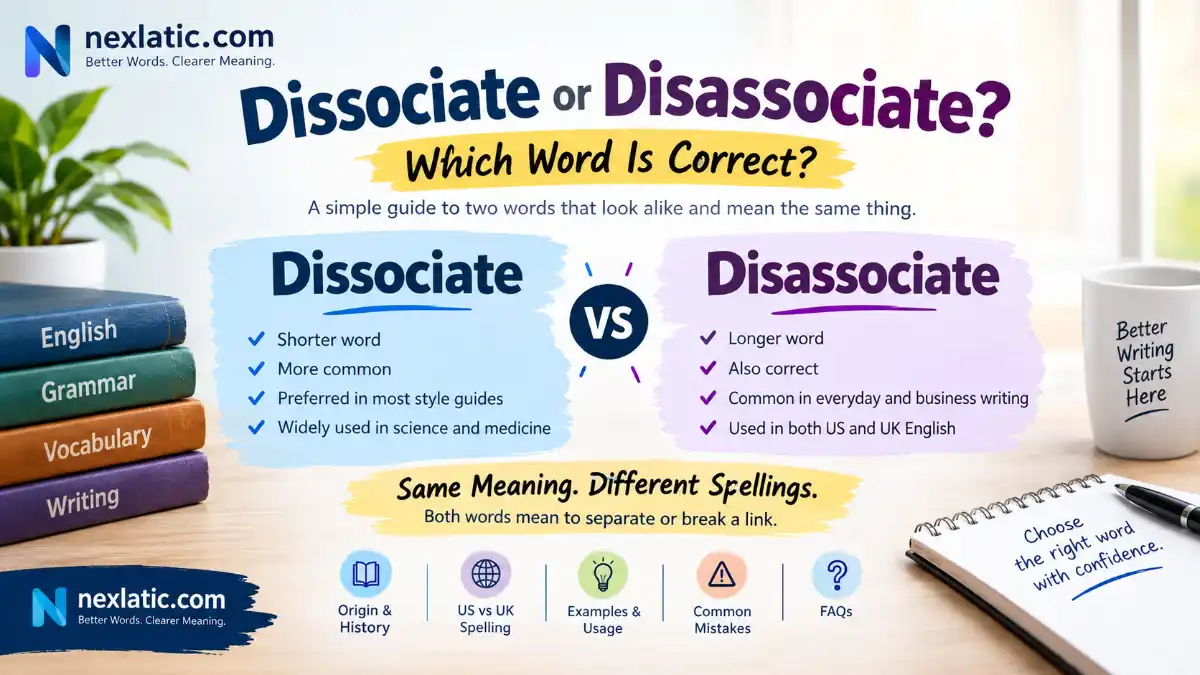
Both are correct. They mean the same thing: to separate, or to cut a link between two things or people.
Dissociate is the shorter word. It is more common. Most dictionaries list it first. Most editors prefer it.
Disassociate is the longer form. It is also correct. Some style guides call it wordy, but it is not wrong.
Here are simple examples:
- She wants to dissociate herself from the scandal.
- The company chose to disassociate its brand from the group.
- Scientists can dissociate the molecule into two parts.
- He tried to disassociate the two ideas in his mind.
Pro tip: If you are unsure, use dissociate. It is safe in every country and every type of writing.
The Origin of Dissociate and Disassociate
Both words come from Latin. They share the same root.
The root is sociare. It means “to join” or “to unite.” You can see it in words like social, society, and associate.
Dissociate comes from the Latin dissociare. The prefix dis- means “apart” or “away.” So the word means “to join apart,” or “to separate.”
Disassociate was built a different way. English speakers took the word associate and added dis- in front. The new word also means “to undo an association.”
So why do two spellings exist? English often does this. Writers build new words from old parts. Over time, both forms stay in use. Neither one wins completely.
The shorter word, dissociate, became the standard in science and medicine. You see it in words like dissociation and dissociative. The longer word, disassociate, stayed common in everyday talk, business, and news.
That is why you will meet both. They are cousins, not rivals.
British English vs American English Spelling
Here is the key point. This is not a US vs UK spelling issue. Both words are used in both places.
Many people think it works like color and colour. It does not. In those cases, each country has one preferred spelling. With dissociate and disassociate, both countries accept both words.
Let’s compare. First, a real British vs American spelling pair. Then our two words.
| Word pair | American English | British English | Is it a regional difference? |
| Color / Colour | color | colour | Yes |
| Center / Centre | center | centre | Yes |
| Organize / Organise | organize | organise (or organize) | Yes |
| Dissociate | accepted | accepted | No |
| Disassociate | accepted | accepted | No |
See the difference? The first three rows change by country. The last two do not.
Some editors in both countries prefer dissociate. They say it is shorter and cleaner. But that is a style choice. It is not a rule of US or UK spelling.
Which Spelling Should You Use?
Your best choice depends on your reader. Here is simple advice.
If your audience is in the US: Use dissociate. It is the most common choice in American news, law, and science. Disassociate is fine, but it may look less formal to some readers.
If your audience is in the UK or Commonwealth: Use dissociate. This includes Canada, Australia, India, Pakistan, and South Africa. British dictionaries list both words, but dissociate is the standard pick.
If your audience is global: Use dissociate. Use dissociate. The word is shorter. Readers scan it with ease. Non-native English speakers also learn it faster.
If you write for a school, journal, or company: Check the style guide. Then follow it. If there is no guide, choose dissociate and use it every time.
One more rule: Do not mix both words in one document. Pick one and stay with it.
Common Mistakes with Dissociate or Disassociate
Here are the errors people make most often, with easy fixes.
| Mistake | Why it is wrong | Correct version |
| “I dissociate with that group.” | Wrong preposition | “I dissociate from that group.” |
| “He disassosiate himself.” | Spelling error | “He disassociated himself.” |
| “She dissassociated from it.” | Extra “s” and “a” | “She dissociated from it.” |
| “The salt will disassociate in water.” | Unusual in science; “dissociate” is standard | “The salt will dissociate in water.” |
| “They dissociate and disassociate.” | Mixing both forms | Pick one word. |
| “Dissociate” used to mean “dissolve” | Different meaning | Use dissolve for melting into liquid. |
Memory trick: Say “dissociate from.” Both words take from. Never with.
Spelling trick: Dissociate has two s’s in a row, then one o. Think: dis-so-ci-ate. The longer word, dis-as-so-ci-ate, adds as in the middle.
Dissociate or Disassociate in Everyday Examples
Words make more sense in real life. Here are examples from different settings.
In an email
- “I would like to dissociate myself from the earlier message sent in my name.”
- “Please note that our team will disassociate from the project as of Friday.”
In the news
- “The senator moved to dissociate himself from the controversial remarks.”
- “The brand tried to disassociate itself from the viral video.”
On social media
- “I need to dissociate my name from that old account. Long story.”
- “Can we disassociate good music from bad people? Hard to do.”
In formal writing
- “The court may dissociate the two claims for separate review.”
- “It is difficult to dissociate the author’s life from the text.”
In science and health
- “Acids dissociate into ions when placed in water.”
- “Some people dissociate during a stressful event. Doctors call this dissociation.”
Notice that science and medicine almost always use dissociate. Business and casual writing use both.
Dissociate or Disassociate – Google Trends & Usage Data
Note: Search numbers change all the time. For live data, check Google Trends yourself. Below are the general patterns writers and editors see.
Which word is more popular? In most large English text collections, dissociate appears more often than disassociate. The longer word still shows up often, especially in news and business writing.
Popularity by country
- United States: The most searches overall, mainly because of its large population. Both words are searched. People often ask which one is correct.
- United Kingdom: Both words are used. Dissociate is the more common pick in formal and academic writing.
- Canada and Australia: Usage looks much like the UK and the US.
- India, Pakistan, and Nigeria: Many searches come from students and professionals who write in English. They often want to confirm the right spelling for exams and reports.
Popularity by context
- Psychology and health: Dissociate, dissociation, and dissociative dominate. Search interest here is high and steady.
- Chemistry: Dissociate is the standard term.
- Business and PR: Both words appear. Disassociate is common when companies cut ties.
- Social media: Mixed use. Many users search the words to check spelling.
Side-by-Side Comparison
| Feature | Dissociate | Disassociate |
| Meaning | To separate or cut a link | To separate or cut a link |
| Correct? | Yes | Yes |
| Length | 4 syllables | 5 syllables |
| Common in the US? | Yes | Yes |
| Common in the UK? | Yes | Yes |
| Most used overall | Yes | Less often |
| Science and medicine | Standard | Rare |
| Business and news | Common | Common |
| Noun form | Dissociation | Disassociation (or dissociation) |
| Adjective form | Dissociative | Disassociative (rare) |
| Best for global readers | Yes | Okay |
FAQs
1. Is it dissociate or disassociate? Both are correct. They mean the same thing. Dissociate is shorter and more common, so it is the safer choice.
2. Is disassociate a real word? Yes. It is in major dictionaries. Some editors think it is too long, but it is not an error.
3. Is dissociate British or American spelling? Neither. Both countries use both words. It is not like color and colour.
4. Which word is better for formal writing? Use dissociate. It is cleaner and is the standard in law, science, and medicine.
5. What preposition goes with dissociate? Use from. For example: “She dissociated herself from the group.” Do not use with.
6. What is the noun form? The noun is dissociation. People also use disassociation, but dissociation is far more common.
7. Does dissociate mean the same as dissolve? No. Dissociate means to separate or break a link. Dissolve means to melt into a liquid or to end something. In chemistry, a compound can dissociate into ions when it dissolves.
8. Can I use both words in one article? It is better not to. Pick one and use it every time. This keeps your writing clean and professional.
Conclusion
So, dissociate or disassociate? Both are correct. Both mean to separate or cut a link. Here are the key points to remember.
Dissociate is shorter and more common. Disassociate is a valid variant, but some editors call it wordy. The two words come from the same Latin root, so the difference is not about the US or the UK. It is about style.
Use dissociate when you want a clean, professional tone. Science, law, and psychology also treat it as the standard term. If your reader or style guide prefers disassociate, pick that one, but stay consistent. Do not mix both in one document.
Watch for the common slips: the wrong preposition, odd spellings like “disassosiate,” and mixing up dissociate with dissolve. Remember that both words take from.

Ali Bismal is the founder and writer behind Nexlatic.com, a growing online platform created to provide useful, informative, and easy-to-understand content for everyday readers. Through Nexlatic, Ali shares practical ideas, helpful guides, interesting topics, and engaging articles designed to make information simple and accessible. His goal is to create reliable, reader-focused content that helps people learn something new, find useful answers, and make everyday life a little easier.