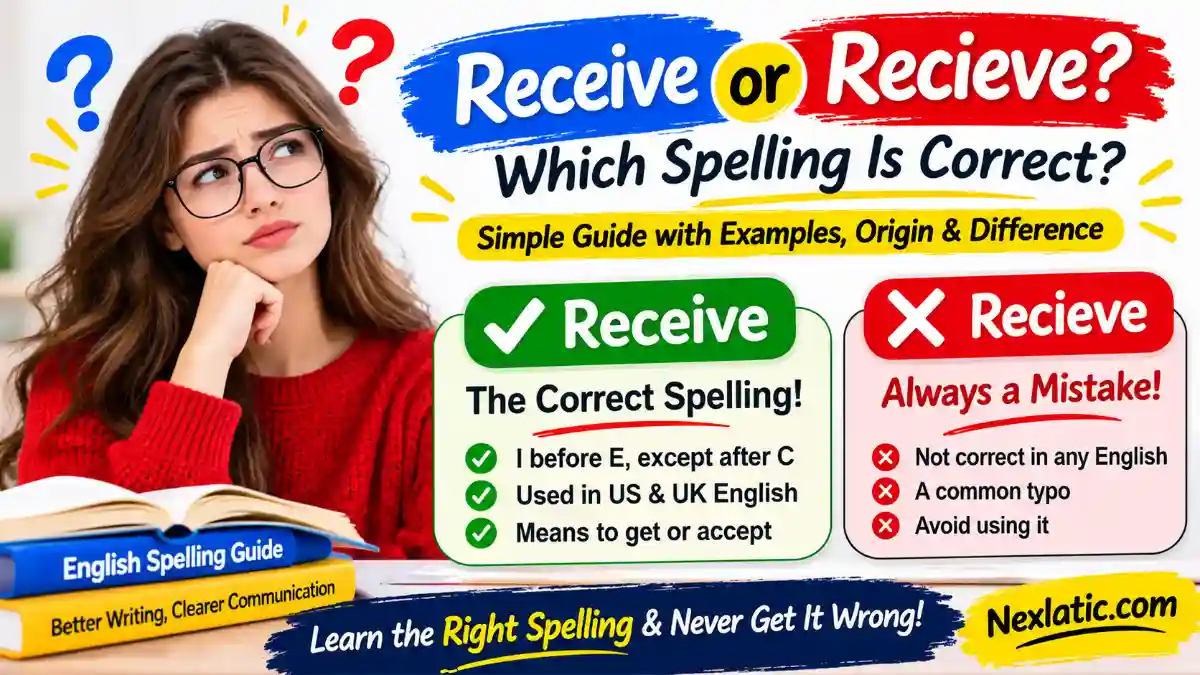
You are writing an email. You stop. Is it “receive” or “recieve”? Both look right. Your brain says one thing. Your eyes say another.
You are not alone. Millions of people search this every year. English spelling is tricky. Many words break the rules. “Receive” is one of them, and it trips up even careful writers.
People search “Receive or Recieve” because they want a fast, safe answer before they hit send. They do not want to look careless in a work email, a school paper, or a social post. One small typo can make a big message look weak.
This guide clears up the confusion. You get the short answer first. Then you learn where the word came from and why so many people spell it wrong. You will also see if British and American English spell it differently. (Spoiler: they do not.)
Receive or Recieve – Quick Answer
“Receive” is the correct spelling. “Recieve” is always a mistake. American and British writers both spell it ‘receive.’” The paragraph now reads smoothly, and the point is unchanged.
Here is the rule in one line: I before E, except after C. The letter C comes before the pair. So you write c-e-i, not c-i-e.
Correct examples:
- I will receive your package on Monday.
- Did you receive my email?
- She received an award last night.
- We are receiving new guests today.
Wrong examples:
I will recieve your package on Monday.Did you recieve my email?
Same rule helps with other words: deceive, perceive, conceive, ceiling, receipt. All of them have “cei.”
The Origin of Receive
The word “receive” is old. It came into English around the 1200s. It came from Old French, from the word receivre (later recevoir). French got it from Latin: recipere.
Latin recipere has two parts:
- re- means “back.”
- capere means “to take.”
So the word first meant “to take back” or “to take in.” Today it means to get or accept something.
Why is the spelling odd? In early English, spelling was not fixed. Writers spelled words how they sounded to them. You could see receyve, receive, and resceyve in old books. Printing in the 1400s and 1500s slowly made spelling more steady. Writers and printers settled on “receive” and kept the Latin and French link.
The sound is the problem. In “receive,” the letters “ei” sound like a long “ee.” Many other words with that sound use “ie,” like believe, relieve, and field. So the ear says “ie.” The rule says “ei” after C. That clash is why “recieve” is one of the most common typos in English.
British English vs American English Spelling
Here is good news. There is no British or American difference for this word. Both spell it “receive.”
People often expect a split because other words do differ. Think of color and colour, or center and centre. But “receive” is not one of them.
So why does the question come up? Because many writers think “recieve” might be an older or British version. It is not. It is just a typo.
| Word | American English | British English | Is “recieve” ever correct? |
| Receive | receive | receive | No |
| Received | received | received | No |
| Receiving | receiving | receiving | No |
| Receipt | receipt | receipt | No |
| Color / Colour | color | colour | Not related |
| Center / Centre | center | centre | Not related |
| Organize / Organise | organize | organise (or organize) | Not related |
Notice the first four rows. They match in every country. Only the last three rows show real US and UK splits.
Which Spelling Should You Use?
The answer is easy: always use “receive.”
If your reader is in the US: Use “receive.” Your word processor will flag “recieve” in red.
If your reader is in the UK, Australia, Canada, India, or another Commonwealth country: Use “receive.” Same word. Same spelling.
If your reader is global: Use “receive.” It is the only form that every dictionary accepts.
For school, work, and websites: A wrong spelling can hurt trust. Teachers may take off points. Hiring managers may notice it in a résumé. Search engines may also treat your page as less careful. Use “receive” every time.
Quick memory tricks:
- “I before E, except after C.” After C, flip it: cei.
- Think of the phrase: “Never believe a lie.” Believe has “ie.” Receive has “ei.” They are opposites.
- Remember: “C-E-I” sounds like “See, I.” See, I receive.
Common Mistakes with Receive or Recieve
Most errors come from the same rule. Here are the ones you will see most often.
| Wrong | Correct | Tip |
| recieve | receive | Put E before I after C |
| recieved | received | Same rule |
| recieving | receiving | Same rule |
| reciept | receipt | Same rule |
| reciever | receiver | Same rule |
| recive | receive | Do not drop the E |
| receeve | receive | The end is “-ceive,” not “-ceeve” |
| recieveing | receiving | Drop the final E before “-ing” |
Other things to watch:
- Mixing up words. “Receive” is not “perceive.” To receive is to get. To perceive is to notice.
- Over-fixing. Some people learn “cei” and then write “decieve.” That is wrong too. It is deceive.
- Exceptions to the rule. Some words break “I before E, except after C.” Examples: science, species, weird, seize, either. Learn them one by one. But “receive” follows the rule and does not break it.
Receive in Everyday Examples
See the word in real life. It always has the same spelling.
In emails:
- “Thank you. I received your file this morning.”
- “Please confirm that you receive this message.”
In news:
- “The team will receive the trophy on Friday.”
- “Families received help after the storm.”
On social media:
- “Just received my new phone! So happy.”
- “Did anyone else receive the update?”
In formal writing:
- “Applicants will receive a reply within ten days.”
- “The committee received the report on Monday.”
In school:
- “Students who finish early will receive extra credit.”
Tip: Use “get” when you want a casual, short word. Use “receive” when you want a clear, professional tone.
Receive or Recieve – Google Trends & Usage Data
Spelling questions like this one are very popular online. People search them again and again because the typo is so common.
Here is what usually shows up when you study search trends for this keyword:
- Interest spikes during school terms. Students write essays and check spelling often.
- Interest is strong in English-speaking countries. The US, UK, Canada, Australia, India, Nigeria, Pakistan, and the Philippines all have many English learners and writers.
- Most searches are for the typo. People type “recieve” or “recieved” because that is how they spell it, then look for a fix.
- “Received” and “receipt” also get many searches. The same rule is behind them.
- Usage in print and web text favors “receive” by a huge margin. Correct spelling is far more common than the typo in books, news, and official sites.
Note: Numbers change over time. For the newest data, check Google Trends yourself. Compare “receive” and “recieve” by country and date range.
Why does it matter? Because it shows many people share your doubt. It is normal. Checking is smart.
Keyword Variations Side by Side
| Variation | Status | Where used | Example |
| receive | Correct | Everywhere | I will receive it soon. |
| recieve | Incorrect | Nowhere (typo) | |
| received | Correct | Everywhere | She received a gift. |
| recieved | Incorrect | Nowhere (typo) | |
| receiving | Correct | Everywhere | We are receiving calls. |
| recieving | Incorrect | Nowhere (typo) | |
| receipt | Correct | Everywhere | Keep the receipt. |
| reciept | Incorrect | Nowhere (typo) | |
| receiver | Correct | Everywhere | The receiver caught the ball. |
| reciever | Incorrect | Nowhere (typo) |
FAQs
1. Is it “receive” or “recieve”?
It is “receive.” “Recieve” is a spelling mistake.
2. Is “recieve” a British spelling?
No. British English also uses “receive.” There is no UK version with “ie.”
3. What is the rule for spelling “receive”?
Use “I before E, except after C.” Since the letter before is C, write “ei.”
4. Is “received” or “recieved” correct?
“Received” is correct. “Recieved” is wrong.
5. Why do so many people misspell “receive”?
The “ee” sound looks like it should be “ie,” like in believe. The C rule changes the order, and many people forget it.
6. Is “receipt” spelled “reciept”?
No. It is “receipt.” Same C rule. (The P is silent.)
7. What is an easy way to remember it?
Think: “After C, E comes first.” Or remember: “See, I receive.”
8. Does spell check catch “recieve”?
Usually yes. Most tools mark it in red. But always read your work once before you send it.
Conclusion
The answer to “Receive or Recieve” is simple. Receive is right. Recieve is wrong. This is true in the US, the UK, and every other English-speaking place.
Remember the key points:
- Use the rule “I before E, except after C.” After C, write EI.
- The word came from Old French and Latin, and its spelling stayed fixed over time.
- There is no British or American split for this word.
- The same rule works for received, receiving, receipt, receiver, deceive, and perceive.
- Typos like recieve and reciept are very common. Do not worry. Just fix them.
When you write for work, school, or your own site, small details build trust. A clean spelling tells readers you care. So next time you type this word, pause for one second. Think “C, then E, then I.” Then hit send with confidence.

Ali Bismal is the founder and writer behind Nexlatic.com, a growing online platform created to provide useful, informative, and easy-to-understand content for everyday readers. Through Nexlatic, Ali shares practical ideas, helpful guides, interesting topics, and engaging articles designed to make information simple and accessible. His goal is to create reliable, reader-focused content that helps people learn something new, find useful answers, and make everyday life a little easier.