If you’ve ever paused mid sentence wondering whether to write “stationary” or “stationery,” you’re not alone. These two words are among the most commonly confused in the English language they sound identical, share nine of ten letters, and yet mean completely different things. One describes something that doesn’t move. The other refers to pens, paper, and envelopes. Mixing them up in a business email or school assignment is an easy mistake, but it’s one that can make your writing look careless.
This confusion exists because English is full of homophones words that sound the same but are spelled differently and carry different meanings. “Stationary” and “stationery” are a textbook example. People search for this term because they need a quick, reliable way to remember which spelling fits which meaning, especially when writing something formal like a cover letter, business proposal, or school paper.
This guide breaks down the exact difference, the history behind the spelling, regional variations, common mistakes, and real world examples so you never have to second guess yourself again.
Stationary or Stationery Quick Answer
Here’s the simple rule:
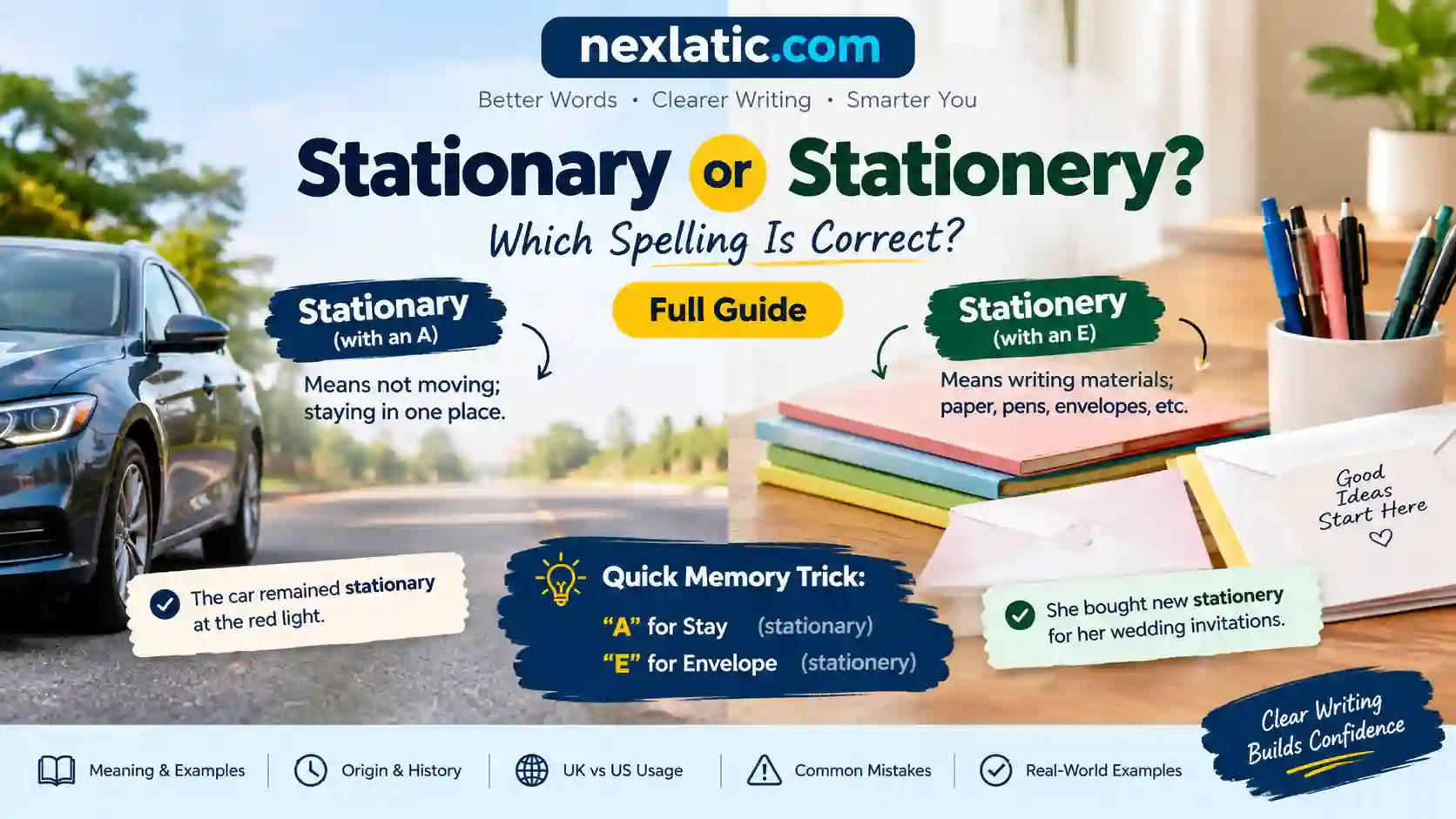
- Stationary (with an A) means not moving staying in one place.
- Stationery (with an E) means writing materials paper, pens, envelopes, and related office supplies.
Examples:
- The car remained stationary at the red light for two minutes.
- She bought new stationery for her wedding invitations.
- Because the bus was stationary, we assumed it had broken down.
- The office ordered fresh stationery for the new branch.
A simple memory trick: “E” for envelope (stationery = paper products), and “A” for stay (stationary = staying still). Both memory tricks pair the vowel in the word with a vowel in a clue word, making them easy to recall under pressure.
The Origin of Stationary and Stationery
Both words trace back to the same Latin root: statio, meaning “a standing” or “a fixed position.” In medieval Europe, this root gave rise to the word “stationer” a merchant who sold books and writing materials from a fixed shop location, unlike traveling peddlers who sold goods from town to town.
Because booksellers operated from permanent stalls, they became known as “stationers,” and the goods they sold paper, ink, and writing tools became known as “stationery.” Over time, English speakers needed a separate word for the general concept of “not moving,” and “stationary” evolved as the adjective form, while “stationery” stayed tied to its original commercial meaning.
The two words split apart in spelling sometime in the 18th century, once English dictionaries began standardizing spelling conventions. Before that period, spelling was much looser, and both versions were occasionally used interchangeably. Modern English fixed the distinction we still use today: ” ary” for the adjective describing motionlessness, and ” ery” for the noun describing writing supplies.
British English vs American English Spelling
Unlike many British American spelling differences (such as “colour” vs “color”), stationary and stationery are spelled identically in both British and American English. There’s no regional variation here the confusion is purely about meaning, not dialect.
However, usage habits differ slightly. British English tends to use “stationery” more broadly to include office supplies and school materials, while American English sometimes uses “school supplies” or “office supplies” as informal alternatives, reserving “stationery” specifically for paper and greeting cards.
| Feature | Stationary | Stationery |
| Part of speech | Adjective | Noun |
| Meaning | Not moving; fixed in place | Paper, pens, envelopes, and writing materials |
| British English | Same spelling | Same spelling |
| American English | Same spelling | Same spelling |
| Common context | Vehicles, objects, exercise equipment | Offices, weddings, schools, letter writing |
| Example | A stationary bike | A stationery shop |
Which Spelling Should You Use?
Since spelling doesn’t change by region, the real question isn’t “US vs UK” it’s “which word matches your meaning.”
- If you’re describing something that isn’t moving (a vehicle, a stance, a stationary bike at the gym), use stationary.
- If you’re referring to paper goods, pens, or office/school supplies, use stationery.
- Global English learners: focus on the meaning first, spelling second. Once you know what you’re trying to say, the correct spelling follows automatically.
- Business and formal writing: double check this word specifically, since it’s one of the most flagged errors in professional documents and can undercut credibility in resumes, proposals, or client emails.
Common Mistakes with Stationary and Stationery
- Writing “stationary store” instead of “stationery store.” A shop selling pens and paper is a stationery store the products aren’t moving, but that’s not the point being made.
- Describing an idle car as “stationery.” A car that isn’t moving is stationary, not stationery.
- Autocorrect swaps. Many spellcheckers won’t catch this error because both words are spelled correctly just used incorrectly. Always proofread manually.
- Confusing “stationary bike” with “stationery bike.” Gym equipment that stays in place is a stationary bike.
- Business letterhead mix ups. Companies sometimes misspell “stationery” on their own letterhead or website, which looks unprofessional.
- Assuming spelling changes by country. As shown above, this pair doesn’t follow the usual American British spelling divide, so switching spelling based on audience location is unnecessary and incorrect.
Stationary and Stationery in Everyday Examples
For example in emails:
“Please find attached our updated stationery templates for the new fiscal year.”
In news writing:
“Traffic remained stationary for nearly three hours after the highway closure.”
In social media captions:
“Just restocked my favorite stationery new notebooks, pens, and washi tape! 📝”
In formal/business writing:
“The company’s stationary crane on site required additional safety inspections before operation resumed.”
In academic writing:
“Students were asked to bring their own stationery, including pens, rulers, and notebooks, for the exam.”
Stationary vs Stationery Google Trends & Usage Data
Search interest in “stationery” (writing supplies) is generally higher and steadier worldwide, driven by stationery shopping, back to school season, and wedding planning searches. “Stationary” (motionless) tends to spike around topics like fitness equipment (“stationary bike”), vehicles, and physics or science related content.
In countries like India, the UK, and the Philippines, “stationery shop” and “stationery items” are frequently searched in a retail context, reflecting strong cultural demand for school and office supplies. In the US, “stationary bike” often ranks among the most searched variants due to fitness trends, while “stationery” searches cluster around gifting occasions like weddings and holidays.
| Search Term | Typical Context | Common Regions |
| Stationery shop | Retail, shopping | UK, India, Philippines |
| Stationary bike | Fitness, gym equipment | US, Canada, Australia |
| Wedding stationery | Events, invitations | UK, US, Australia |
| Stationary vehicle | News, traffic reports | Global |
| Stationery set | Gifting, school supplies | Global |
Keyword Variation Comparison Table
| Term | Correct Meaning | Example Sentence |
| Stationary | Not moving | The train stayed stationary at the platform. |
| Stationery | Writing materials | She designed custom stationery for the event. |
| Stationary bike | Fitness equipment | He rides a stationary bike every morning. |
| Stationery store | Shop selling paper goods | The stationery store had beautiful notebooks. |
| Stationary object | Something fixed in place | A stationary object doesn’t move under normal force. |
| Office stationery | Workplace writing supplies | The company ordered new office stationery. |
FAQS
1. Is it “stationary” or “stationery” for pens and paper?
It’s “stationery” (with an E) this word refers to paper, pens, and writing materials.
2. What does “stationary” mean in a sentence?
“Stationary” means not moving or fixed in one place, such as “The car remained stationary.”
3. Why are “stationary” and “stationery” spelled so similarly?
Both words come from the same Latin root, statio, meaning “a fixed position,” which is why their spellings overlap despite different modern meanings.
4. Does British English spell these words differently than American English?
No. Both words are spelled identically in British and American English this pair isn’t part of the usual US UK spelling differences.
5. What’s an easy way to remember the difference?
Remember “E for envelope” (stationery = paper products) and “A for stay” (stationary = staying still).
6. Is “stationary bike” spelled with an A or an E?
“Stationary bike” is spelled with an A, since it refers to equipment that doesn’t move.
7. Can “stationery” ever mean something other than paper products?
No, “stationery” specifically refers to writing and office supplies like paper, pens, envelopes, and notecards it doesn’t have alternate meanings.
8. Is this mistake common in professional writing?
Yes, it’s one of the most frequently flagged spelling errors in business and academic writing, since spellcheckers often miss it.
Conclusion
The difference between “stationary” and “stationery” comes down to one letter but that letter changes the entire meaning of your sentence. “Stationary” describes something that isn’t moving, while “stationery” refers to paper, pens, and other writing supplies. Because both words are spelled correctly in isolation, spellcheckers often miss this mistake, making manual proofreading essential.
Remembering the simple tricks “E for envelope” and “A for stay” can help you get it right every time, whether you’re writing a business email, a wedding invitation, or a school assignment. Unlike many British American spelling pairs, this one doesn’t change based on region, so the rule stays consistent no matter where your audience is located.
Next time you’re unsure, pause and ask yourself: am I describing something that isn’t moving, or something you’d find in an office supply store? That one question will guide you to the correct spelling every time and help your writing look polished and professional.

Ali Bismal is the founder and writer behind Nexlatic.com, a growing online platform created to provide useful, informative, and easy-to-understand content for everyday readers. Through Nexlatic, Ali shares practical ideas, helpful guides, interesting topics, and engaging articles designed to make information simple and accessible. His goal is to create reliable, reader-focused content that helps people learn something new, find useful answers, and make everyday life a little easier.