You just took your favorite sweater out of the dryer. It’s tiny now. But did it “shrank” or did it “shrunk”? You pause. Neither word sounds quite right, and both sound a little wrong.
This is one of the most common mix ups in English. The verb “shrink” has three forms, and most people only remember two of them. That’s why “shrank or shrunk” gets searched thousands of times every month. People aren’t confused about the meaning they know something got smaller. They’re confused about the grammar.
The confusion makes sense. English has many irregular verbs like this: sing, sang, sung; drink, drank, drunk; shrink, shrank, shrunk. These verbs don’t follow the normal “added” pattern, so our brains struggle to store the right form for the right moment.
This article gives you the quick answer first. Then it explains the history, the British vs. American differences, the common mistakes, and real examples from emails, news, and social media. By the end, you’ll never second guess this word again.
Shrank or Shrunk Quick Answer
Here’s the simple rule:
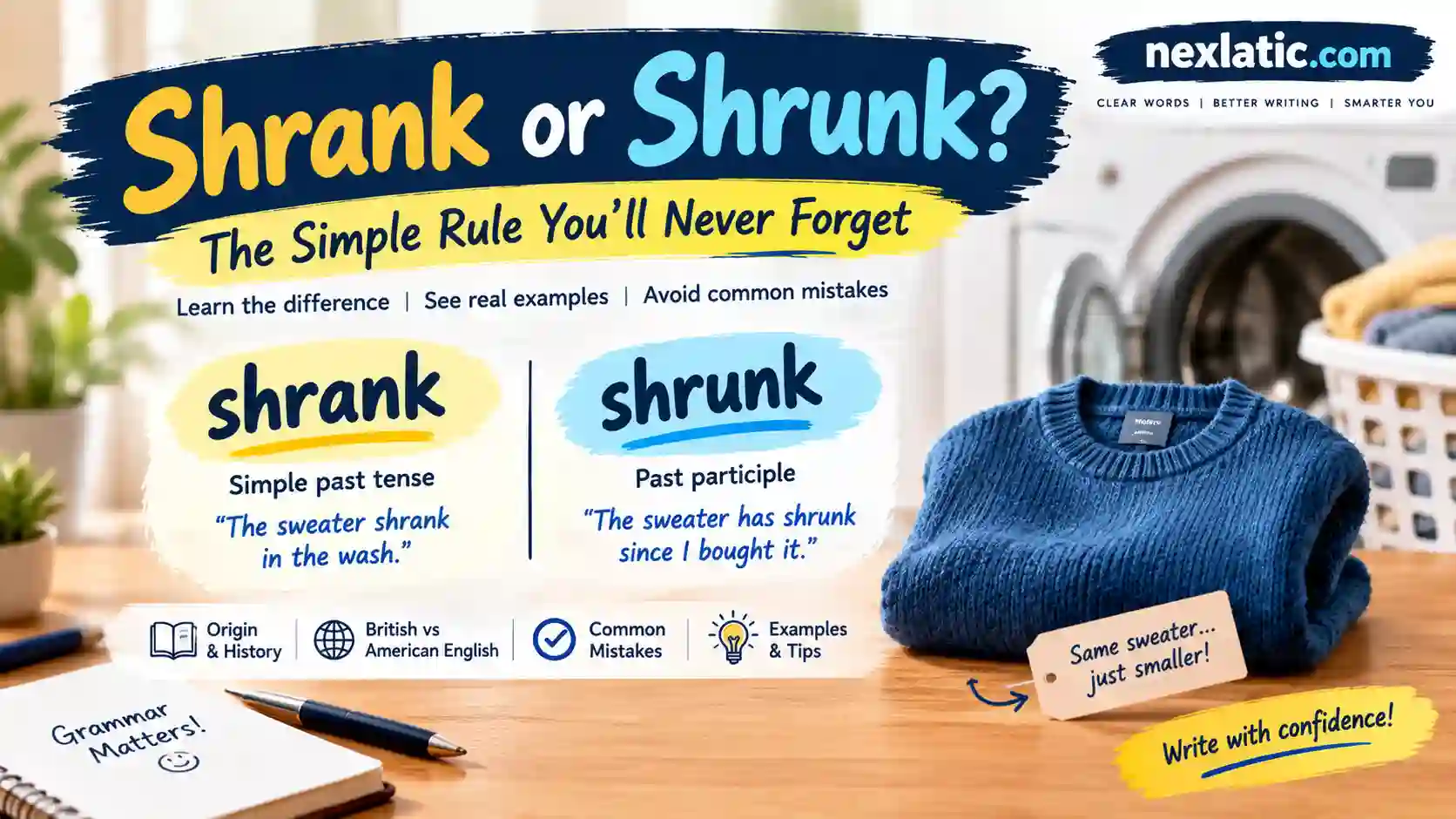
- Shrank is the simple past tense. Use it alone, right after a subject.
- The shirt shrank in the wash.
- Shrunk is the past participle. Use it with a helping verb like “has,” “have,” or “had.”
- The shirt has shrunk since I bought it.
Think of it this way: if there’s no helper word before it, use shrank. If there’s a helper word (has, have, had, was, is), use shrunk.
Quick test:
- ✅ “The economy shrank last quarter.” (no helper word)
- ✅ “The economy has shrunk for three straight quarters.” (helper word: has)
- ❌ “The economy has shrank.” (wrong needs shrunk)
- ❌ “The economy shrunk last quarter.” (informal technically nonstandard, though common in casual speech)
The Origin of Shrank or Shrunk
“Shrink” comes from the Old English word scrincan, meaning to shrivel, contract, or draw in. It belongs to a group of verbs linguists call “strong verbs.” Instead of adding “ed” for the past tense (like “walk” becomes “walked”), strong verbs change their internal vowel sound. This pattern is called ablaut, and it’s a leftover from very old Germanic languages.
That’s why “shrink” behaves like “sing” (sang, sung) and “drink” (drank, drunk) instead of like “walk” (walked, walked). These verbs are ancient, and English has kept their irregular patterns for over a thousand years.
Spelling differences around “shrunk” also exist because informal spoken English has slowly blurred the line between the simple past and the past participle. Many English speakers now say “shrunk” for both forms in casual conversation, even though formal grammar still separates them.
British English vs American English Spelling
Good news: both British and American English use the same three forms shrink, shrank, shrunk. There’s no spelling difference like “colour” vs. “color.” The difference is about usage habits, not spelling rules.
British English tends to hold onto the traditional grammar rule more strictly in formal writing. American English is a bit more relaxed, and “shrunk” often appears as a simple past tense in casual speech and pop culture (think of movie titles like Honey, I Shrunk the Kids).
| Form | British English | American English | Formal Use |
| Shrink | Present tense | Present tense | Same |
| Shrank | Simple past (strictly used) | Simple past (preferred in formal writing) | Correct in both |
| Shrunk | Past participle only | Past participle (also used casually as past tense) | Technically only past participle |
Which Spelling Should You Use?
Your choice depends on your audience and context.
If you’re writing formally (US, UK, or anywhere): Follow the rule strictly. Use “shrank” for simple past tense and “shrunk” with a helper verb. This applies to essays, business writing, news articles, and exams.
If you’re in the US and speaking casually: You’ll hear “shrunk” used as a simple past tense often (“It shrunk in the dryer”). It’s common, but it’s still considered informal or nonstandard by grammar guides.
If you’re in the UK or Commonwealth countries (Canada, Australia, India): Formal writing sticks closely to “shrank” for simple past. Casual speech is more flexible, but the traditional rule is taught more consistently in schools.
If you’re writing for a global or professional audience: Always use “shrank” and “shrunk” correctly according to the rule above. It signals careful, polished writing no matter where your reader is from.
Common Mistakes with Shrank or Shrunk
- Using “shrunk” without a helper verb ❌ “The budget shrunk this year.” ✅ “The budget shrank this year.”
- Using “shrank” after a helper verb ❌ “Sales have shrank since last spring.” ✅ “Sales have shrunk since last spring.”
- Mixing up “shrink” as a noun “Shrink” can also mean a psychiatrist in slang (“I’m seeing a shrink”). Don’t confuse this with the verb forms.
- Assuming both forms are always interchangeable In casual speech, people blur the line. In formal or academic writing, the distinction still matters.
- Forgetting the present tense Some writers jump straight to past forms and misuse “shrink” itself. Remember: shrink (now), shrank (past), shrunk (past participle).
Shrank or Shrunk in Everyday Examples
In emails: “Please note that our department’s budget shrank by 10% this quarter.” “The client base has shrunk since the merger, so we need a new outreach plan.”
In news headlines: “UK Economy Shrank 0.3% in Q2, Data Shows” “Manufacturing Sector Has Shrunk for Sixth Consecutive Month”
In social media posts: “My jeans shrunk in the dryer again 😩” (common casual usage) “Lol my savings account has shrunk since I started online shopping”
In formal writing: “The glacier has shrunk significantly over the past decade due to rising temperatures.” “Voter turnout shrank compared to the previous election cycle.”
Notice how formal contexts (news, reports, academic writing) follow the strict rule, while social media leans on “shrunk” for both cases.
Shrank or Shrunk Google Trends & Usage Data
Search interest in “shrank or shrunk” reflects genuine day to day confusion rather than a seasonal or trending topic people search it year round whenever they’re writing a sentence and pause to check themselves.
Generally speaking:
- US searchers are more likely to look up whether “shrunk” is acceptable as a simple past tense, reflecting its common use in American casual speech.
- UK and Commonwealth searchers tend to search for confirmation of the traditional rule, often for schoolwork, exams, or professional writing.
- Global English learners (especially ESL students) search this term frequently, since irregular verbs like “shrink” are a known trouble spot in English language learning.
Because “shrink” is used constantly in economic reporting (shrinking economies, budgets, markets) and everyday life (shrinking clothes, shrinking plastic, shrinking populations), the keyword sees steady, consistent interest rather than sharp spikes.
Keyword Variations Comparison
| Variation | Correct Use | Example |
| Shrink | Present tense | “Prices shrink during a recession.” |
| Shrank | Simple past tense | “Prices shrank last year.” |
| Shrunk | Past participle (with helper verb) | “Prices have shrunk since January.” |
| Shrinking | Present participle / gerund | “Prices are shrinking fast.” |
| Shrunken | Adjective form | “A shrunken budget worried investors.” |
FAQS
1. Is it correct to say “I shrunk it”? In casual speech, yes, many people say this. But in formal or grammatically strict writing, the correct form is “I shrank it.”
2. What is the past tense of shrink? The simple past tense is “shrank.” Example: “The wool sweater shrank in hot water.”
3. What is the past participle of shrink? The past participle is “shrunk.” It’s used with helper verbs like has, have, or had. Example: “It has shrunk two sizes.”
4. Why do people say “shrunk” instead of “shrank”? Spoken English often simplifies irregular verb forms over time. “Shrunk” has become common in casual American speech as a substitute for “shrank.”
5. Is “shrunk” ever correct without a helper verb? Not in formal grammar. Strict rules require “shrank” for simple past tense. However, informal and conversational English often accepts “shrunk” alone.
6. Do British and American English spell “shrank” and “shrunk” differently? No. The spelling is identical in both. The difference lies in how often each form is used in casual versus formal speech.
7. What’s the difference between “shrank” and “shrunken”? “Shrank” is a verb (past tense). “Shrunken” is an adjective describing something that has become smaller, as in “a shrunken head” or “a shrunken economy.”
Conclusion
The “shrank or shrunk” confusion comes down to one simple grammar rule: shrank stands alone as the simple past tense, while shrunk needs a helper verb like has, have, or had. Both words are correct they just serve different jobs in a sentence.
This mix up is common because “shrink” is an irregular verb, part of an old pattern in English that doesn’t follow normal “ed” rules. British and American English don’t spell these words differently, but American casual speech often blurs the line, using “shrunk” for both forms.
For everyday texting or social media, either form usually gets your point across. But for professional emails, news writing, essays, or exams, stick to the rule: no helper verb means “shrank,” a helper verb means “shrunk.” Keep this quick test in mind, and you’ll always pick the right word with confidence, whether you’re writing about a shrinking budget, a shrunk sweater, or a shrinking economy.

David Wilson is a writer and contributor at Nexlatic.com, where he writes about useful topics, everyday questions, and practical ideas. He enjoys turning information into simple, clear, and easy-to-read articles that readers can actually use. Through his work at Nexlatic, David aims to share helpful content that answers common questions, explains confusing topics, and gives readers something useful to take away from every article.