Have you typed “signor” into an email and then stopped, unsure if it’s right? You are not alone. Many people search for “signor or signer” because they think these are two spellings of the same word. They are not. They are two different words with two different jobs.
This mix up happens a lot. Both words look alike. Both sound close when spoken fast. And spellcheck tools do not always catch the error, since both are real words in English.
People search this term for three reasons. First, they want to know which word fits their sentence. Second, they want to avoid an embarrassing mistake in a formal letter or contract. Third, they have seen “signor” used as an Italian title and wonder if it also means “one who signs.”
This article gives you a quick answer, then a full breakdown. You will learn the origin of each word, how to use them correctly, and how to avoid the most common errors. By the end, you will never confuse them again.
Signor or Signer Quick Answer
Here is the short version.
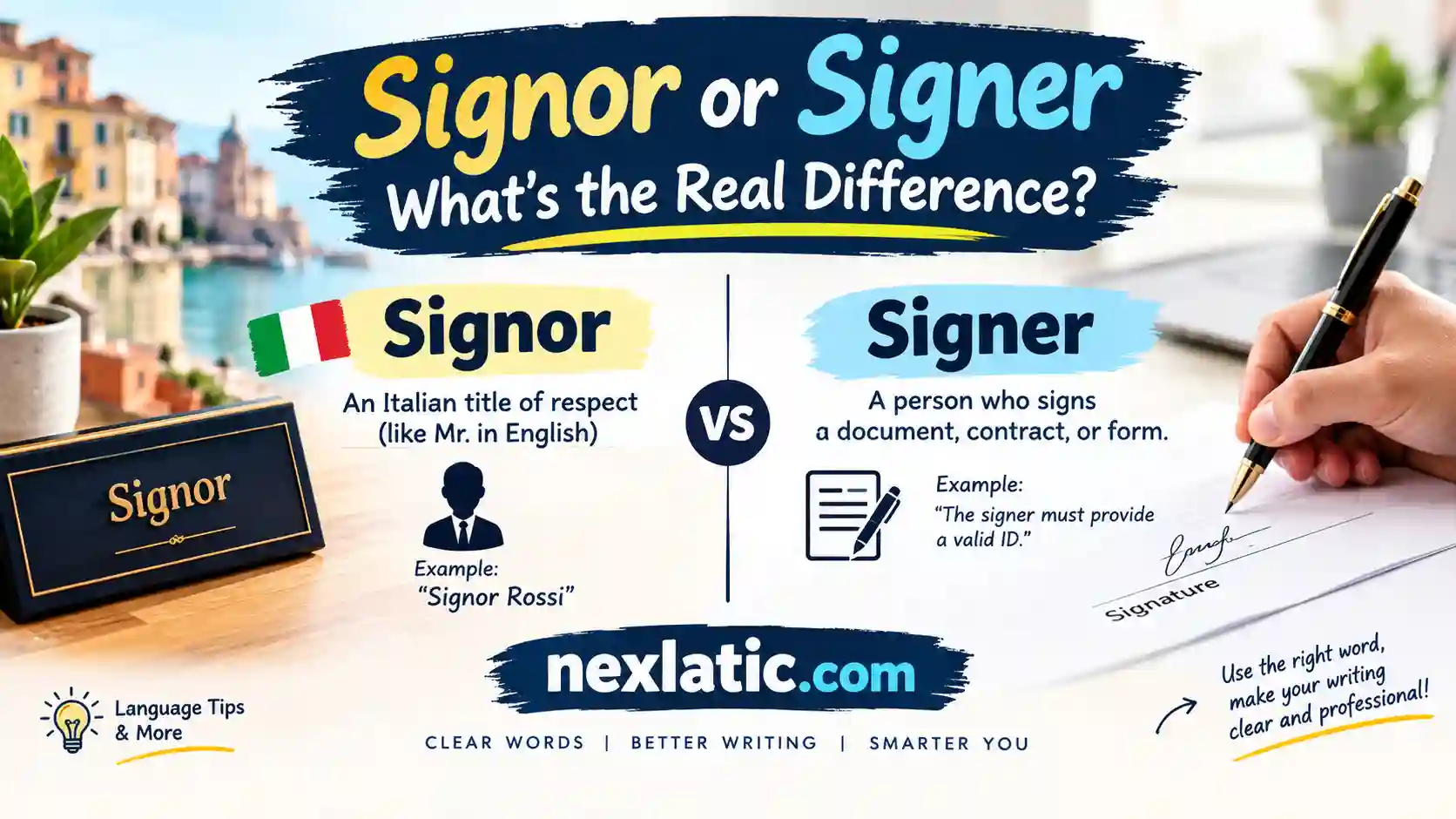
- Signer means a person who signs something, like a document, contract, or petition.
- Signor is an Italian title of respect, similar to “Mr.” or “Sir” in English.
Example:
- “The signer of the contract must provide a valid ID.” (correct)
- “Signor Rossi will meet us at the hotel.” (correct)
These words are not interchangeable. If you mean “a person who signs,” use signer. If you are addressing an Italian man with respect, use signor.
The Origin of Signor and Signer
Signer comes from the English verb “sign,” which traces back to the Latin word signum, meaning “mark” or “token.” Add the suffix “er,” which turns a verb into “a person who does the action.” A signer is simply “one who signs.”
Signor comes from Italian. It is the short form of signore, which means “lord” or “sir.” Italian speakers use it before a man’s name, much like “Mr.” in English. The word entered English through literature, opera, and travel writing, where it kept its Italian spelling and meaning.
So the confusion is not really about spelling rules. It is about two separate word families that happen to look alike:
- Sign + er = signer (English root)
- Signore → signor (Italian root)
Is “Signor” a British Spelling of “Signer”?
Some people assume this is a British English versus American English spelling issue, like “colour” and “color.” It is not. Both British and American English use signer the same way, and both use signor the same way, as a borrowed Italian title.
There is no regional spelling rule that changes “signer” into “signor,” or the other way around. The difference is meaning, not geography.
| Word | Type | Used In | Example |
| Signer | English word | US, UK, and all English speaking regions | “She is the signer of the lease.” |
| Signor | Borrowed Italian title | Used when addressing or referring to Italian men, in any English speaking region | “Signor Bianchi arrived early.” |
| Signore | Full Italian form | Formal Italian text or speech | “Buongiorno, Signore.” |
| Signeur | Not standard English | Rare, often a misspelling | Avoid using this |
Which Word Should You Use?
Your choice depends on what you are writing, not where you live.
- Writing a contract, form, or legal document? Use signer. This applies whether you are in the US, UK, Canada, Australia, or anywhere else English is used.
- Addressing or referring to an Italian man politely? Use signor before his surname, such as “Signor Marchetti.”
- Writing in a global or international context? Use signer for anyone who signs something. Reserve signor only for Italian names or Italian themed writing.
- Unsure which one fits? Ask yourself: “Am I naming a person who signed something, or am I addressing an Italian man?” That answer tells you the right word.
Common Mistakes with Signor or Signer
- Using “signor” instead of “signer” in legal writing. Wrong: “The signor must sign below.” Right: “The signer must sign below.”
- Using “signer” as an Italian title. Wrong: “Signer Conti will call you back.” Right: “Signor Conti will call you back.”
- Spelling it “signeur” or “signour.” These are not standard English or Italian words. Avoid them.
- Forgetting the capital letter for “Signor.” Since it works like a title, capitalize it before a name: “Signor Rossi,” not “signor Rossi.”
- Mixing plural forms. The plural of signer is signers. The plural of signor is signori in Italian, though English writers often just use “signor” with each name separately.
Signor or Signer in Everyday Examples
For example in emails: “Please confirm you are the authorized signer on this account before we proceed.”
In news articles: “Signor Alberti, the mayor of the small Italian town, welcomed the new policy.”
In social media posts: “Just became an official signer on my first home loan! 🏡”
In formal writing and contracts: “The undersigned signer agrees to the terms listed in Section 4.”
In travel or cultural writing: “Our guide, Signor Ferrari, showed us the old city walls at sunset.”
Signor or Signer Google Trends & Usage Data
Search interest in “signer” is far higher than “signor” across English speaking countries, since it is used daily in banking, legal, and business writing. Searches for signer spike around tax season, loan applications, and election petition periods.
Searches for “signor” are smaller and tend to come from readers of Italian news, opera fans, and travelers researching Italian etiquette. Interest in “signor” is highest in countries with strong ties to Italian culture, tourism, or media.
Globally, “signer” also gets extra search volume from American Sign Language contexts, where it can describe someone who signs using ASL. This is a separate, valid use worth knowing about.
Comparison Table: Keyword Variations
| Term | Meaning | Common Region | Correct Usage |
| Signer | Person who signs a document | Global (English) | “The signer initialed each page.” |
| Signor | Italian title for a man | Global, Italian contexts | “Signor Bruno owns the café.” |
| Signora | Italian title for a woman | Global, Italian contexts | “Signora Bruno runs the shop.” |
| Signori | Plural of signor | Italian contexts | “Buonasera, signori.” |
| Co signer | Second person guaranteeing a loan | Global (English) | “My father is my co signer.” |
FAQS
1. Is “signor” a misspelling of “signer”? No. Both are correct words with different meanings. “Signor” is an Italian title; “signer” is an English word for someone who signs.
2. Can I use “signor” in a legal document? No. Legal documents need “signer,” since that word means “the person who signs.”
3. Do British and American English spell this word differently? No. Both use “signer” for a person who signs, and both use “signor” the same way as a borrowed Italian title.
4. What is the female version of “signor”? “Signora” is the female form, used the same way as “signor” but for women.
5. Is “signer” used in sign language contexts? Yes. A “signer” can also mean someone who communicates using sign language, such as ASL.
6. What is a “co signer”? A co signer is a second person who signs a loan or lease with the main applicant, sharing responsibility for it.
7. How do I know which word to use in a sentence? Ask if you mean “a person who signs” (use signer) or “an Italian title of respect” (use signor).
Conclusion
“Signor” and “signer” look similar, but they are not the same word, and they are not regional spelling variants. Signer describes anyone who signs a document, contract, or form, and it works the same way in both American and British English. Signor is a borrowed Italian title, used to address or refer to a man with respect, much like “Mr.” in English.
The key to using them correctly is simple: think about meaning, not spelling rules. If you are talking about someone putting their name on paper, use signer. If you are writing about or speaking to an Italian man, use signor.
Keep this rule in mind, and you will avoid one of the most common word mix ups in English writing. Whether you are drafting a contract, writing a travel blog, or sending a quick email, choosing the right word makes your writing clearer and more professional.

Ali Bismal is the founder and writer behind Nexlatic.com, a growing online platform created to provide useful, informative, and easy-to-understand content for everyday readers. Through Nexlatic, Ali shares practical ideas, helpful guides, interesting topics, and engaging articles designed to make information simple and accessible. His goal is to create reliable, reader-focused content that helps people learn something new, find useful answers, and make everyday life a little easier.