Staring at two equations and wondering if their lines are parallel, perpendicular, or neither? You’re not alone. This is one of the most common questions in algebra and geometry classes, and it trips up students because the answer hides inside a single number: the slope. Get the slope rule wrong, and the whole answer falls apart.
People search this term because textbooks often explain the rule quickly and move on, leaving the “why” behind. Some students memorize the rule without understanding it, then freeze when the numbers look unfamiliar like fractions, negative slopes, or equations not written in slope intercept form.
This confusion matters because classifying lines shows up everywhere: geometry proofs, coordinate graphing, architecture, engineering, and standardized tests. Knowing the rule cold not just memorized, but understood saves time and prevents careless errors.
This guide gives you the quick answer, the math behind it, common mistakes, real examples, and a clear comparison table so you never have to guess again.
Parallel, Perpendicular, or Neither Quick Answer
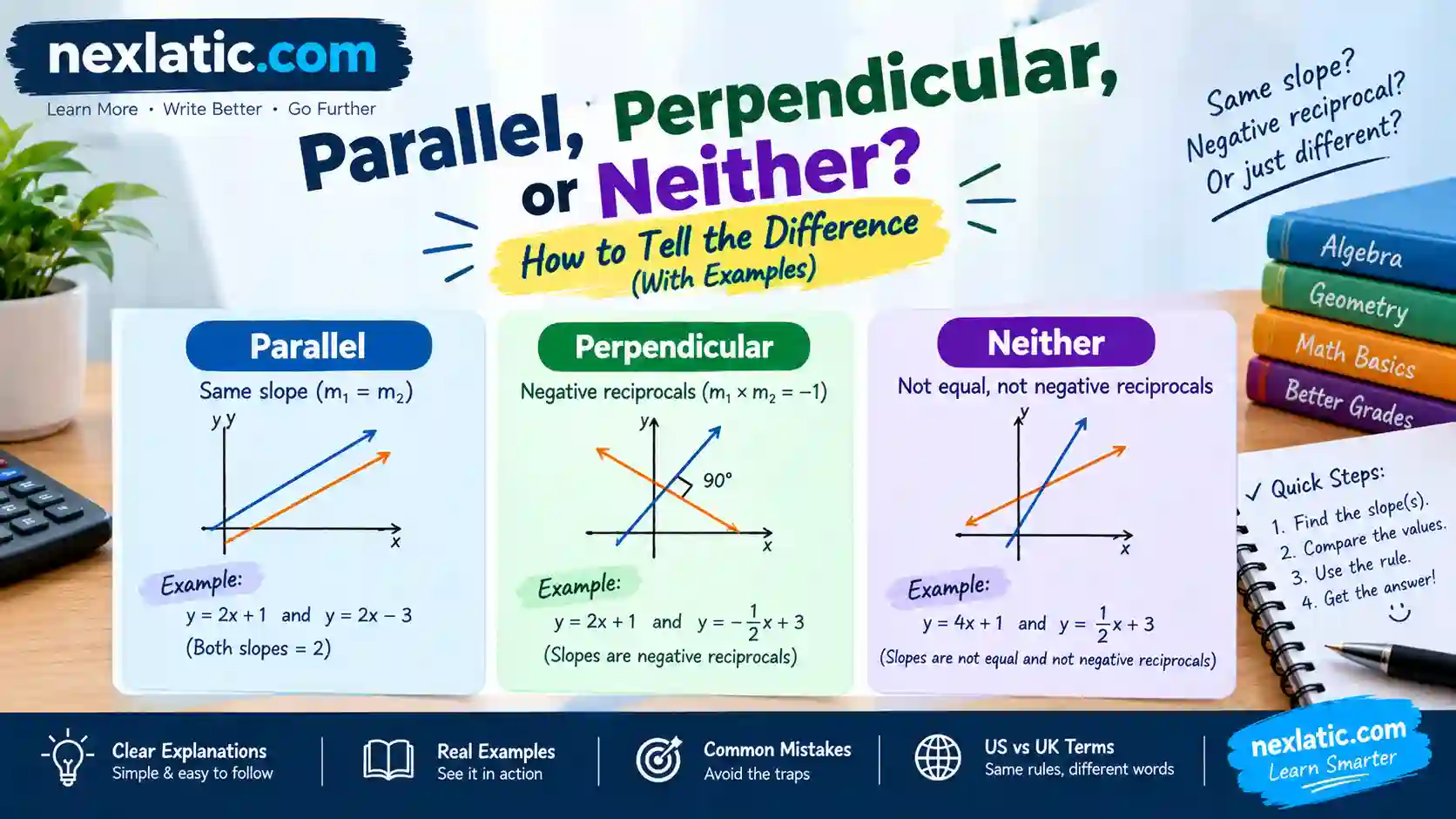
Compare the slopes of the two lines:
- Parallel lines have the same slope.
- Perpendicular lines have slopes that are negative reciprocals of each other (multiply to 1).
- Neither means the slopes don’t match either rule.
Examples:
- Line A: slope = 2. Line B: slope = 2. → Parallel (same slope)
- Line A: slope = 3. Line B: slope = 1/3. → Perpendicular (negative reciprocals)
- Line A: slope = 4. Line B: slope = 1/2. → Neither (not equal, not negative reciprocals)
That’s the whole rule. Everything else in this guide builds on this one idea.
The Origin of “Parallel” and “Perpendicular”
Both words come from ancient roots tied to measurement and construction. “Parallel” comes from the Greek parallelos, meaning “beside one another” a combination of para (beside) and allelon (one another). Ancient Greek geometers, including Euclid, used the concept to describe lines that never meet, no matter how far they extend.
“Perpendicular” comes from the Latin perpendicularis, related to perpendiculum, meaning “a plumb line” the weighted string builders used to check that a wall stood exactly upright. Over time, the word came to describe any two lines meeting at a perfect right angle (90 degrees).
The mathematical rules for identifying these relationships using slope were formalized centuries later, once coordinate geometry (developed by René Descartes in the 1600s) made it possible to describe lines using numbers and equations instead of only physical drawings.
US vs UK Math Terminology
Unlike spelling pairs, “parallel” and “perpendicular” are spelled and defined the same way worldwide. However, the terminology used to describe slope differs slightly between regions, which can confuse students using international resources.
| Term | US Terminology | UK Terminology |
| Rate of steepness | Slope | Gradient |
| Line equation form | Slope intercept form (y = mx + b) | Gradient intercept form (y = mx + c) |
| Right angle symbol | Same | Same |
| “Negative reciprocal” rule | Same | Same |
| Parallel/perpendicular definitions | Same | Same |
The core rules never change only the vocabulary used to teach them does.
Which Method Should You Use?
- US students: Your textbook will use “slope” and the equation form y = mx + b. Focus on comparing the “m” values directly.
- UK and Commonwealth students: Your textbook likely uses “gradient” and y = mx + c. The rule is identical just swap the vocabulary.
- Global learners and test takers: Standardized tests (SAT, ACT, GCSE, IB) all use the same underlying slope rule. Learn the concept once, and the terminology becomes a non issue.
- Professionals (engineering, architecture, design): Precision matters more than vocabulary. Always double check slope calculations rather than relying on visual estimation, especially with steep or fractional slopes.
Common Mistakes When Classifying Lines
- Forgetting to flip the sign for perpendicular lines. A slope of 2 has a perpendicular slope of 1/2, not just 1/2. Skipping the negative sign is the most frequent error.
- Confusing “reciprocal” with “negative reciprocal.” Reciprocal alone isn’t enough the slopes must multiply to exactly 1.
- Misreading equations not in slope intercept form. Students often forget to rearrange an equation like 3x + 2y = 6 into y = mx + b before comparing slopes.
- Assuming vertical and horizontal lines follow the normal rule. A vertical line (undefined slope) is always perpendicular to a horizontal line (slope = 0) this special case doesn’t fit the standard negative reciprocal formula.
- Rounding decimal slopes too early. Rounding can make two non parallel lines look parallel, leading to a wrong “neither” or “parallel” conclusion.
- Assuming “neither” means an error was made. “Neither” is a valid, correct answer not a sign that something went wrong.
Parallel, Perpendicular, or Neither in Everyday Examples
For example in classroom emails:
“Please review problems 510 before Friday’s quiz on identifying parallel and perpendicular lines from slope.”
In news and science writing:
“Engineers confirmed the new support beams were perpendicular to the foundation, ensuring structural stability.”
In social media (study accounts):
“POV: you finally understand negative reciprocals and every ‘parallel, perpendicular, or neither’ question becomes easy 📐✨”
For example in formal/technical writing:
“The architectural blueprint specifies that all support walls must remain perpendicular to the primary load bearing beam.”
In academic test prep:
“Determine whether the lines represented by y = 4x + 1 and y = 4x 7 are parallel, perpendicular, or neither.”
Parallel, Perpendicular, or Neither Google Trends & Usage Data
Search interest in this exact phrase spikes predictably during the school year, especially during algebra and geometry units covering linear equations. Searches peak in SeptemberNovember and again in FebruaryApril, aligning with common semester schedules in the US.
In the US, searches often include “worksheet” or “answer key,” reflecting homework driven searches. In the UK, India, and other Commonwealth countries, related searches more often include “gradient” instead of “slope,” reflecting local curriculum language. Globally, this topic also sees steady interest from test prep audiences studying for the SAT, ACT, GCSE Maths, and IB Mathematics exams.
| Search Variation | Typical Context | Common Regions |
| Parallel perpendicular or neither worksheet | Homework, practice | US |
| Gradient parallel perpendicular | Classroom terminology | UK, India |
| How to tell if lines are perpendicular | Concept explanation | Global |
| Slope of perpendicular line calculator | Tool based search | Global |
| Parallel and perpendicular lines equations | Algebra coursework | US, Canada |
Keyword Variation Comparison Table
| Term | Meaning | Example |
| Parallel | Same slope, lines never intersect | y = 2x + 1 and y = 2x 5 |
| Perpendicular | Slopes are negative reciprocals (multiply to 1) | y = 3x and y = 1/3x |
| Neither | Slopes don’t match either rule | y = 4x and y = 1/2x |
| Vertical & horizontal | Special case, always perpendicular | x = 5 and y = 3 |
| Coinciding lines | Same slope AND same y intercept (identical line) | y = 2x + 1 and y = 2x + 1 |
FAQS
1. How do you know if two lines are parallel, perpendicular, or neither?
Compare their slopes. Equal slopes mean parallel. Negative reciprocal slopes (multiply to 1) mean perpendicular. Anything else means neither.
2. What is the slope rule for perpendicular lines?
Multiply the two slopes together if the result is 1, the lines are perpendicular.
3. Can two lines with the same slope but different y intercepts be considered the same line?
No. Lines with the same slope but different y intercepts are parallel, not identical. Identical lines need the same slope and the same y intercept.
4. Are vertical and horizontal lines always perpendicular?
Yes. A vertical line and a horizontal line are always perpendicular to each other, even though this doesn’t follow the standard negative reciprocal formula.
5. What does “neither” mean in this context?
“Neither” means the two lines are not parallel and not perpendicular their slopes don’t satisfy either rule.
6. Do UK and US math courses use different rules for this concept?
No, the rules are identical. The UK typically uses “gradient” instead of “slope,” but the underlying math doesn’t change.
7. Why do I need to rewrite an equation before comparing slopes?
Slopes are easiest to compare when equations are in slope intercept form (y = mx + b). Skipping this step often leads to comparing the wrong numbers.
8. Is there a shortcut to identify perpendicular slopes quickly?
Yes flip the fraction and change the sign. If one slope is 2/3, its perpendicular slope is 3/2.
Conclusion
Classifying two lines as parallel, perpendicular, or neither comes down to one comparison: their slopes. Equal slopes mean parallel lines. Slopes that multiply to 1 mean perpendicular lines. Anything else falls into the “neither” category and that’s a perfectly valid answer, not a mistake.
The vocabulary may shift slightly between regions (slope vs. gradient), but the math stays exactly the same everywhere in the world. Understanding the reasoning behind the rule rather than memorizing it blindly makes it far easier to apply confidently on homework, tests, or real world problems involving angles and structures.
Next time you face this question, rewrite both equations in slope intercept form, compare the slopes, and apply the rule. With a little practice, identifying parallel, perpendicular, or neither becomes second nature.

David Wilson is a writer and contributor at Nexlatic.com, where he writes about useful topics, everyday questions, and practical ideas. He enjoys turning information into simple, clear, and easy-to-read articles that readers can actually use. Through his work at Nexlatic, David aims to share helpful content that answers common questions, explains confusing topics, and gives readers something useful to take away from every article.