You are writing an email. You type a sentence about your job. Then you stop. Is it “my new role” or “my new roll”? You are not alone. Many people pause at this exact spot. The two words sound the same. They look almost the same. But they mean very different things.
People search “role or roll” for one reason. They want a fast, safe answer. Maybe it is a resume. Maybe it is a school essay. A wrong word looks small, but it can make you look careless.
Many people also wonder if the spelling changes between American and British English. That is a smart question. Some words do change, like “color” and “colour.” This one does not.
This guide clears up the confusion. You will get a quick answer first. Then you will learn where the words came from, how to use them, and how to avoid common mistakes. You will also see real examples and a simple table. By the end, you will never mix them up again.
Role or Roll Quick Answer
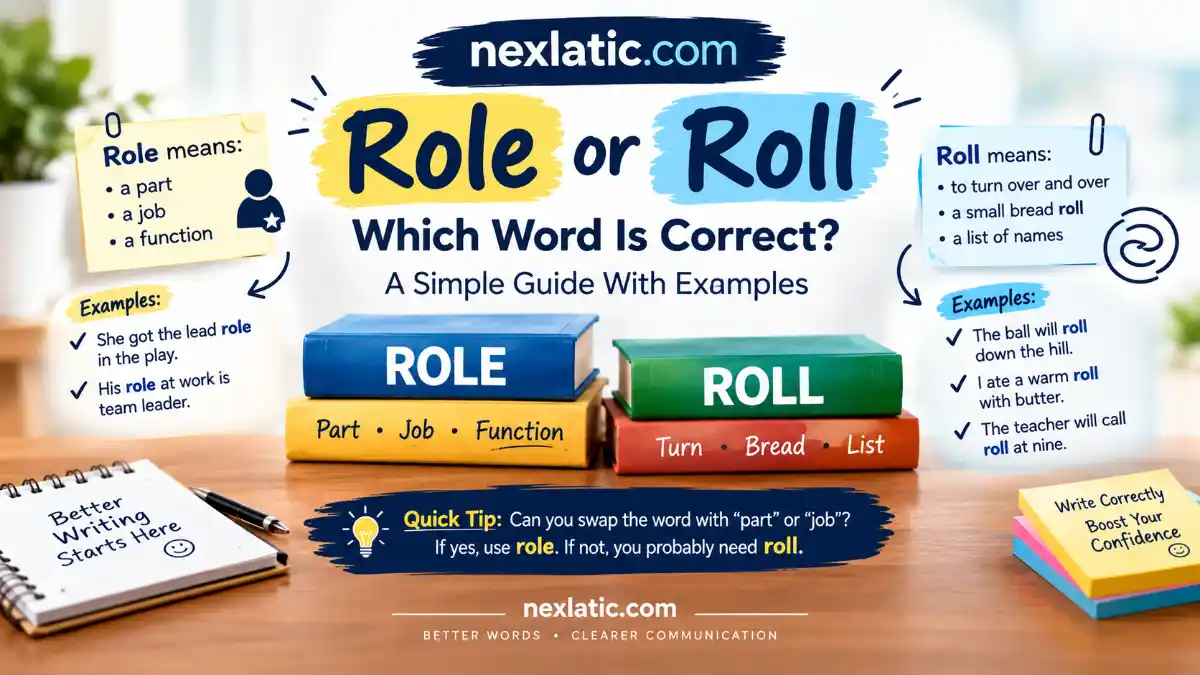
Role means a part, a job, or a function.
Roll means to turn over and over, a small piece of bread, or a list of names.
Here are quick examples:
- She got the lead role in the play. (a part)
- His role at work is team leader. (a job)
- The ball will roll down the hill. (to turn)
- I ate a warm roll with butter. (bread)
- The teacher will call roll at nine. (a list of names)
A fast test: Can you swap the word with “part” or “job”? If yes, use role. If not, you probably need roll.
The Origin of Role or Roll
Here is a fun fact. These two words share the same family tree.
Roll came from the Latin word rotulus, which means “small wheel.” It passed into Old French as rolle and then into English. It has been used in English for hundreds of years. The idea is simple: something round that turns, or something rolled up.
Role also comes from rotulus. It came into English from French in the 1600s. Long ago, actors got their lines on a roll of paper. The roll held their part. Over time, people used the word for the part itself. Later, it grew to mean any job or duty in life.
So why are they spelled differently? English took the words in at different times and from different paths. Roll came in early and kept the double L. Role came later from French and kept its French style ending. Old texts sometimes wrote it as rôle, with a small hat on the o. Today we drop the hat.
The two words also sound the same. Words that sound alike but have different meanings are called homophones. That is why people mix them up.
British English vs American English Spelling
Good news: there is no difference here. British and American English spell both words the same way. You do not need to switch anything.
| Word | American English | British English | Meaning |
| Role | role | role | A part or job |
| Roll | roll | roll | To turn; bread; a list |
| Role play | role play | role play | Acting out a situation |
| Roll call | roll call | roll call | Reading names aloud |
| Enroll / Enrol | enroll | enrol | To sign up |
| Payroll | payroll | payroll | List of paid workers |
The only spelling split in this word family is enroll (US) and enrol (UK). Even that has a twist. Both countries use “enrolment” or “enrollment” slightly differently, so check your style guide.
Which Spelling Should You Use?
You do not choose between “role” and “roll” by country. You choose by meaning. Still, here is helpful advice for each audience.
US readers: Use role for jobs and parts. Use roll for turning, bread, and lists. Use “enroll” with two Ls.
UK and Commonwealth readers (Canada, Australia, India, and more): The rule is the same. Use “enrol” with one L in the UK, Australia, and New Zealand. Canada often uses “enrol” too, though “enroll” appears as well.
Global or mixed readers: Stay with the simple rule. Role means part or job. Roll means turn, bread, or list. Both words look the same on every screen in the world.
Pro tip: If you write for a website, pick one style and keep it. Being consistent matters more than the style you pick.
Common Mistakes with Role or Roll
Here are the most frequent errors and how to fix them.
| Wrong | Right | Why |
| Role call | Roll call | It is a list of names. |
| Roll model | Role model | A role model shows how to act. |
| I’m on a role | I’m on a roll | Being “on a roll” means a winning streak. |
| Roles and responsibilities (with roll) | Roles and responsibilities | Use role for job duties. |
| Rock and role | Rock and roll | It is the music style. |
| Role out the plan | Roll out the plan | Roll out means to launch. |
| Drum role | Drum roll | It is the rolling sound of a drum. |
| Roll play | Role play | It means acting a part. |
Memory trick: Roll has two Ls. Picture two wheels turning. Role is the part you play.
Role or Roll in Everyday Examples
In emails
- “I am excited about the new role on your team.”
- “Please roll out the update by Friday.”
In news
- “The mayor played a key role in the deal.”
- “The team is on a roll after five straight wins.”
On social media
- “Just started a new role today! Wish me luck.”
- “Sunday brunch = cinnamon roll heaven.”
In formal writing
- “The role of the committee is to review all reports.”
- “The clerk will call the roll before the vote.”
Notice a pattern. Role is about people and duties. Roll is about motion, food, and lists.
Role or Roll Google Trends & Usage Data
I can’t pull live Google Trends numbers from this chat, so I won’t invent any. Here is what to expect, and how to check it yourself.
General patterns
- “Role” is far more common in everyday writing. It shows up in job posts, resumes, movie news, and business talk.
- “Roll” is also very common, but it is spread across many topics, such as food, sports, and phrases like “roll out.”
- Searches about “role or roll” are usually spelling and grammar questions. They tend to rise when people write resumes, essays, and cover letters.
Where searches often come from
- English speaking countries such as the US, UK, Canada, Australia, and India
- Countries where many people learn English as a second language, where homophone questions are common
How to check it yourself
- Go to Google Trends.
- Type “role or roll” in the search box.
- Compare it with “role vs roll.”
- Filter by country and time range.
- Look at “Related queries” to see what people want to know.
| Context | Likely usage |
| Job and career searches | Role |
| Food and recipes | Roll |
| Grammar and spelling checks | Both (comparison searches) |
| Sports and news | Both (“play a role,” “on a roll”) |
Role or Roll Side by Side Comparison
| Feature | Role | Roll |
| Part of speech | Noun | Noun and verb |
| Main meaning | A part, job, or function | To turn; bread; a list |
| Sounds like | “rohl” | “rohl” |
| US vs UK spelling | Same | Same |
| Example | “Her role is manager.” | “The ball will roll.” |
| Common phrases | Role model, role play, leading role | Roll call, drum roll, on a roll |
| Swap test | Can swap with “part” or “job” | Can swap with “turn” or “list” |
FAQS
1. Is it “role” or “roll”?
It depends on meaning. Use “role” for a part or job. Use “roll” for turning, bread, or a list.
2. Is “role” British or American?
Both. The spelling is the same in the US and UK.
3. Do “role” and “roll” sound the same?
Yes. They are homophones. Most English speakers say them the same way.
4. Is it “role model” or “roll model”?
It is always role model. It means a person others copy.
5. Is it “roll call” or “role call”?
It is roll call. The word roll here means a list of names.
6. Can “roll” ever mean a job?
No. If you mean a job, use “role.”
7. Which is correct on a resume: “new role” or “new roll”?
“New role.” A “new roll” would mean a new piece of bread.
8. Is it “on a role” or “on a roll”?
It is on a roll. It means you are having a lucky streak.
Conclusion
Role and roll sound alike, but they are two different words. Here is what to remember.
Use role for a part, a job, or a function. An actor has a role. A manager has a role. A parent has a role in a child’s life.
Use roll for a turning move, a small piece of bread, or a list of names. A ball can roll. You can eat a roll. A teacher takes roll.
The spelling does not change between American and British English. Role is role in New York and in London. Roll is roll everywhere. You do not need to guess your audience.
Here is a fast test. Can you swap the word with “part” or “job”? If yes, write role. If the word means spin, turn, or a rounded thing, write roll.
Watch out for common traps. It is roll call, not role call. It is role model, not roll model.
Keep this guide handy the next time you write a resume, an email, or a post. One small word can make your writing look sharp and professional.

David Wilson is a writer and contributor at Nexlatic.com, where he writes about useful topics, everyday questions, and practical ideas. He enjoys turning information into simple, clear, and easy-to-read articles that readers can actually use. Through his work at Nexlatic, David aims to share helpful content that answers common questions, explains confusing topics, and gives readers something useful to take away from every article.