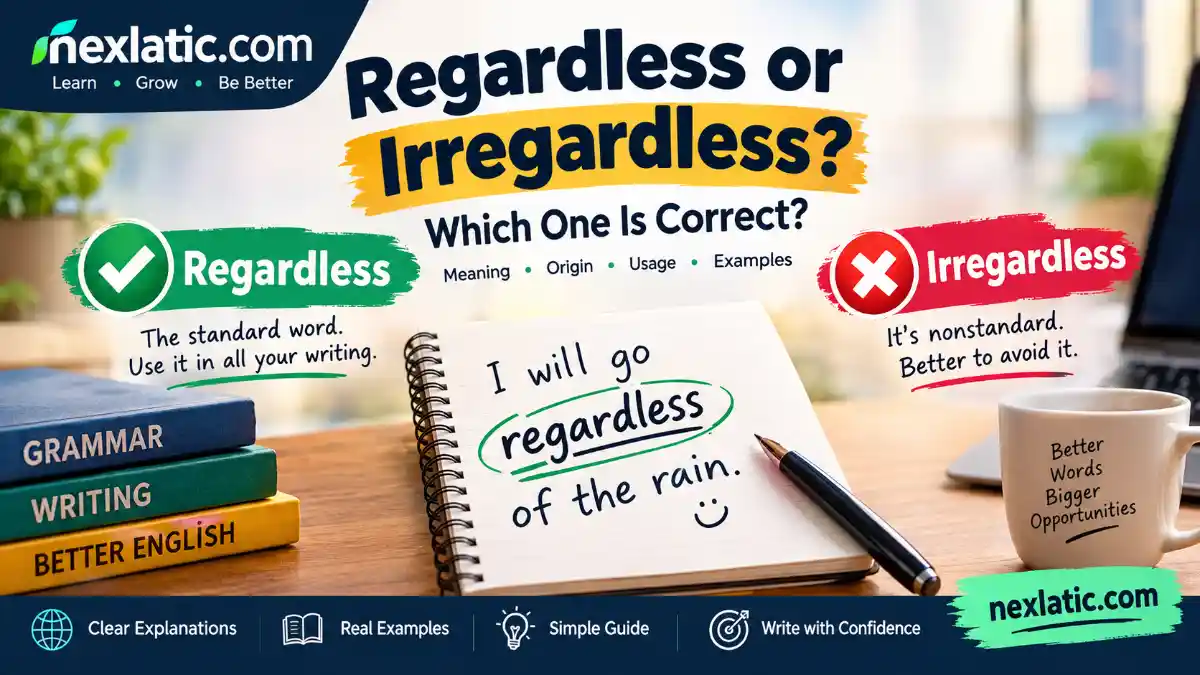
You are typing an email. You want to write, “I will go regardless of the rain.” Then you stop. Is it regardless? Or irregardless? Your spell checker flags one. Your friend swears by the other. So you open Google.
You are not alone. Many people search “regardless or irregardless” every month. The two words look alike. They sound alike. And people use both in real life. That makes the choice feel tricky.
This article clears it up fast. You get a quick answer first. Then you learn where each word came from. You see how US and UK writers treat them. You also see common mistakes, real examples, and answers to common questions.
By the end, you will know which word to use in every setting. You will write with more confidence. No more second-guessing at the send button.
Let’s start.
Regardless or Irregardless – Quick Answer
Use “regardless.” It is the standard word in American, British, and global English.
“Irregardless” is nonstandard. Major dictionaries list it, but they label it nonstandard. Many readers see it as a mistake.
Both words mean “without concern for” something. So the meaning is the same. The difference is how people judge them.
Correct:
- I will call you regardless of the time.
- Regardless of the cost, we need a new laptop.
- She smiled, regardless.
Not recommended:
- I will call you irregardless of the time.
- Irregardless of the cost, we need a new laptop.
Short rule: if you are unsure, write regardless. You will never be wrong.
The Origin of Regardless and Irregardless
Regardless is an old word. It comes from “regard” plus “-less.” Regard means to pay attention to something. -less means “without.” So regardless means “without regard.” It has been in English for centuries.
Irregardless is newer. Most sources place its rise in the early 1900s in the United States. Many word experts think it is a blend of two words: irrespective and regardless. Speakers mixed them, and a new word was born.
Here is the problem. The prefix ir- means “not.” And -less also means “without.” So irregardless has two negatives. In theory, they cancel out. That would mean “with regard.” But people use it to mean the same as regardless.
Why do both spellings exist? Because speech comes before spelling. People said the blended word out loud. Then they wrote it down. Dictionaries later recorded it, because it was in real use. Recording a word does not mean approving it.
British English vs American English Spelling
Here is a key point. This is not a UK versus US spelling issue. Words like color and colour differ by region. Regardless and irregardless do not.
Both countries spell regardless the same way. Both countries treat irregardless as nonstandard. So there is no “British spelling” or “American spelling” of this word.
The difference is in how often people use it. Irregardless began in the US. Americans hear it more in speech. British writers see it less.
| Feature | Regardless | Irregardless |
| Standard in US English | Yes | No (nonstandard) |
| Standard in UK English | Yes | No (nonstandard) |
| Spelling differs by region | No | No |
| Found in dictionaries | Yes | Yes, with a usage warning |
| Safe for formal writing | Yes | No |
| Meaning | Without concern for | Same, but disputed |
Which Spelling Should You Use?
The answer is simple. Use regardless in every case. Here is the advice by audience.
US readers: Use regardless. Editors and teachers often mark irregardless as an error.
UK and Commonwealth readers: Use regardless. British, Australian, Canadian, and Indian writers all treat irregardless as wrong or odd.
Global or business audiences: Use regardless. Many readers speak English as a second language. Clear, standard words help them most.
Casual speech: People may say irregardless to be funny or out of habit. Even then, regardless sounds cleaner.
When to use irregardless on purpose: Only when you quote someone, write dialogue, or make a joke about the word.
Common Mistakes with Regardless and Irregardless
Mistake 1: Using irregardless in formal writing.
- Wrong: Irregardless of the results, we will continue.
- Right: Regardless of the results, we will continue.
Mistake 2: Writing “regardless” with a missing “of.”
- Wrong: Regardless the weather, we will play.
- Right: Regardless of the weather, we will play.
Mistake 3: Writing “regardless” as two words.
- Wrong: Regard less of the cost…
- Right: Regardless of the cost…
Mistake 4: Mixing it up with “irrespective.” Irrespective is a real, standard word. But it needs “of” too.
- Right: Irrespective of age, all are welcome.
Mistake 5: Thinking “irregardless” is more polite or fancy. It is not. It just looks like an error to many readers.
Regardless in Everyday Examples
Email:
- “Regardless of your schedule, please send the report by Friday.”
- “We will launch on Monday regardless.”
News:
- “The vote will go ahead regardless of the weather.”
- “Prices rose regardless of new rules.”
Social media:
- “Rain or shine, I’m going regardless.”
- “Regardless of what people say, I love this show.”
Formal writing:
- “The law applies to all citizens, regardless of background.”
- “The company must follow the rule regardless of size.”
Dialogue (where irregardless may appear on purpose):
- “Irregardless,” said Grandpa, “I’m not moving.”
That last one shows how a writer can use the word to show a character’s voice.
Regardless or Irregardless – Google Trends & Usage Data
Note: I can’t pull live Google Trends numbers here. Check trends.google.com and add your current figures before you publish. The points below are general patterns.
Regardless is used far more than irregardless in books, news, and web pages. It is a common everyday word.
Irregardless gets searches mostly because people are unsure about it. Many searches are questions like “is irregardless a word?” That means people search for the word to check it, not to copy it.
By country: Interest tends to be strongest in the United States, where the word began. Searches also appear in the UK, Canada, Australia, and India, often from students and writers checking grammar.
By context: Searches often rise when the word appears in a viral post, a TV show, or a school lesson. People then rush to check if it is real.
Here is a side-by-side view of related terms:
| Term | Standard? | Typical use | Best for |
| Regardless | Yes | All writing and speech | Everything |
| Irregardless | No (nonstandard) | Casual speech, jokes | Quoting or humor only |
| Irrespective (of) | Yes | Formal, legal, business | Formal writing |
| Nevertheless | Yes | Standalone contrast | Starting a new clause |
| Despite / In spite of | Yes | Simple contrast | Everyday writing |
| Regardless of | Yes | Most common phrase | Everything |
| Irregardless of | No (nonstandard) | Speech | Avoid |
FAQS
1. Is “irregardless” a real word?
Yes, in the sense that it is in dictionaries and people use it. But dictionaries label it nonstandard.
2. Is “regardless” or “irregardless” correct?
Regardless is correct. Use it in all writing.
3. Do they mean the same thing?
Yes. Both mean “without concern for.” But irregardless is disputed.
4. Why do people say “irregardless”?
It likely came from mixing irrespective and regardless. Habit kept it alive.
5. Is “irregardless” British or American?
It began in American English. Neither the US nor the UK treats it as standard.
6. Can I use “irregardless” in an essay or work email?
Avoid it. Readers may think you made an error.
7. Is “irrespective” the same as “regardless”?
Nearly. Irrespective of is more formal. Both are standard.
8. Does “regardless” need “of”?
Usually yes when a noun follows. “Regardless of the cost.” But it can stand alone: “I’ll go regardless.”
Conclusion
So, regardless or irregardless? The answer is clear. Use regardless.
Here are the key points to remember:
- Regardless is the standard word in the US, the UK, and around the world.
- Irregardless means the same thing but is nonstandard. Many readers see it as an error.
- Irregardless likely formed from irrespective and regardless. It began in the US in the early 1900s.
- This is not a UK versus US spelling difference. Both treat it the same way.
- Use “regardless of” when a noun follows. Use regardless alone at the end of a sentence.
- Save irregardless for quotes, dialogue, or jokes.
The advice is easy. If you want to sound clear and professional, pick regardless. It works in emails, essays, news, and social posts. It never hurts your message. And it keeps your reader focused on your ideas, not your word choice.
Next time you reach the send button, you will know what to type. Write regardless, and move on with confidence.

Ali Bismal is the founder and writer behind Nexlatic.com, a growing online platform created to provide useful, informative, and easy-to-understand content for everyday readers. Through Nexlatic, Ali shares practical ideas, helpful guides, interesting topics, and engaging articles designed to make information simple and accessible. His goal is to create reliable, reader-focused content that helps people learn something new, find useful answers, and make everyday life a little easier.