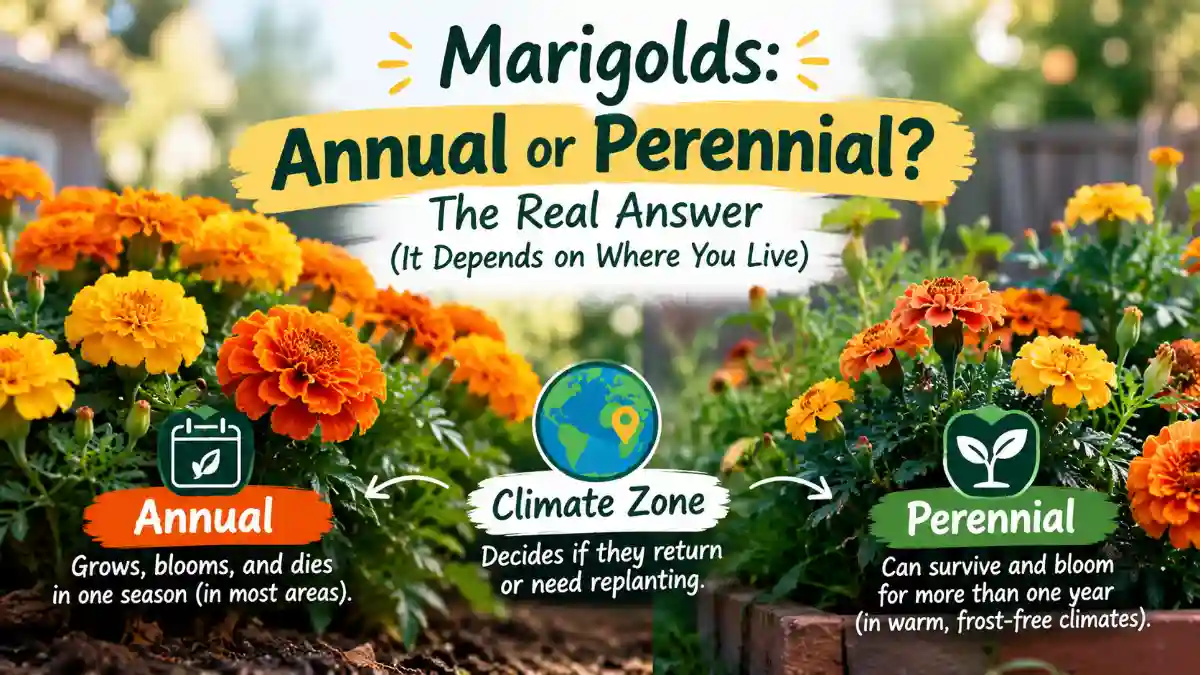
You bought a pack of marigold seeds, planted them, and watched them bloom all summer. Now it’s fall, the flowers are dying back, and you’re wondering: did you do something wrong, or are marigolds just supposed to die every year?
This is one of the most searched gardening questions for a simple reason the answer isn’t the same for everyone. Marigolds are grown differently depending on climate, and gardening guides rarely explain why. Some websites call marigolds “annuals.” Others call them “perennials.” Neither is lying. They’re just writing from different parts of the world.
People search “marigolds annual or perennial” because they want to know if they need to replant every spring, or if their marigolds should come back on their own. The confusion usually hits after a first growing season, when a plant that looked so strong suddenly disappears with the first frost.
This article gives you the quick answer, the reason behind the confusion, and clear advice so you know exactly what to expect from your marigolds no matter where you garden.
Marigolds Annual or Perennial – Quick Answer
Most marigolds grown in home gardens are annuals. They complete their full life cycle sprout, grow, flower, seed, and die in a single year, and cold weather kills them.
But in warm, frost-free climates, some marigold species behave like short-lived perennials, surviving and blooming for two or more years.
Examples:
- French marigolds (Tagetes patula) and African marigolds (Tagetes erecta) grown as annuals almost everywhere, since they’re highly frost-sensitive.
- Signet marigolds (Tagetes tenuifolia) also typically annual.
- In frost-free zones (parts of the southern US, the Mediterranean, and tropical regions), marigolds can self-seed or survive through winter, acting like perennials even though they’re not technically classified that way.
So the plant itself is botanically an annual. Climate decides whether it behaves like one.
The Origin of “Annual” and “Perennial”
The word annual comes from the Latin annus, meaning “year” a plant that lives and dies within one year. Perennial comes from Latin per (“through”) + annus (“year”) a plant that lives “through the years,” or indefinitely.
Marigolds themselves get their common name from “Mary’s Gold,” a reference to the Virgin Mary, tracing back to medieval Europe where the flower was used in religious festivals. The genus name Tagetes comes from Tages, an Etruscan god.
The confusion around “annual or perennial” isn’t really about word origin it’s about botanical classification versus real-world growing experience. Technically, most marigold species are annuals by definition. But gardening is practical, not academic, and when a plant survives winter and blooms again, gardeners naturally start calling it a perennial, regardless of the textbook label.
Regional Differences: US vs. UK/Commonwealth Growing Conditions
This is where most of the confusion comes from not spelling, but climate zones and terminology.
In the United States, gardeners think in USDA Hardiness Zones (1–13). Marigolds are frost-tender, so:
- In Zones 3–7 (most of the US), they’re grown strictly as annuals.
- In Zones 9–11 (Florida, southern Texas, southern California), marigolds can survive winter and act as short-lived perennials.
In the UK and Commonwealth countries, gardeners use the RHS Hardiness Rating system. The UK’s cooler, wetter climate means marigolds are almost always grown as annuals or “half-hardy annuals” a UK-specific term for plants that can’t survive frost and are typically started indoors before the last frost date.
In tropical and subtropical regions (parts of India, Southeast Asia, Africa, Central America), marigolds often self-seed freely and bloom nearly year-round, making them feel like true perennials to local gardeners.
| Region | Typical Classification | Why |
| US Zones 3–7 (most of the country) | Annual | Winter frost kills the plant |
| US Zones 9–11 (Florida, S. Texas, S. California) | Short-lived perennial | Frost-free or mild winters |
| UK / Ireland | Half-hardy annual | Cool, frost-prone climate |
| Tropical regions (India, SE Asia) | Perennial-like behavior | No frost, year-round warmth |
| Mediterranean climates | Perennial-like behavior | Mild winters |
Which Approach Should You Use?
If you’re in a cold or temperate climate (most of the US, UK, Canada, Northern Europe):
Treat marigolds as annuals. Replant seeds or transplants every spring after the last frost. Don’t expect them to survive winter outdoors.
If you’re in a warm, frost-free climate (southern Florida, parts of California, the Mediterranean, tropical Asia):
You can let marigolds self-seed or survive as short-lived perennials. They may need less replanting, but flowering can slow down after a year or two, so many gardeners still refresh plants annually for the best blooms.
If you’re unsure of your zone:
Check your local frost dates. If your area gets hard frost, marigolds are annuals for you full stop.
Common Mistakes with Marigolds as Annuals or Perennials
- Mistake: Assuming all marigolds are the same species. Correction: French, African, and Signet marigolds have different growth habits and cold tolerance.
- Mistake: Expecting marigolds to come back automatically after winter in a cold climate. Correction: In frost zones, they will not survive replant each spring.
- Mistake: Confusing self-seeding with being perennial. Correction: If marigolds “return” from dropped seeds, that’s a new generation, not the original plant surviving.
- Mistake: Overwatering in an attempt to “help them survive winter.” Correction: Cold, wet soil speeds up plant death it won’t make an annual perennial.
- Mistake: Buying marigold varieties online without checking your hardiness zone. Correction: Always match the variety to your local climate.
Marigolds in Everyday Examples
In gardening emails/newsletters: “Reminder: marigold seedlings should go in the ground after your last frost date they won’t survive a cold snap.”
For example in news/lifestyle articles: “Marigolds remain one of the most popular annual flowers for pest-repelling companion planting in vegetable gardens.”
In social media captions: “My marigolds are still going strong in October anyone else in Zone 9 keeping theirs alive through winter?”
In formal horticultural writing: “Tagetes species are cultivated as annuals in temperate regions but may exhibit perennial characteristics in frost-free climates.”
Marigolds – Search Trends & Usage Data
Search interest in “marigolds annual or perennial” tends to spike seasonally rising sharply in early spring (planting season) and again in early fall, when marigolds start dying back and gardeners want to know why.
Search behavior also varies by country. US searches are heavily weighted toward zone-specific questions (“marigolds perennial zone 9,” “marigolds annual zone 5”). UK searches lean toward “half-hardy annual” terminology and frost timing. Searches from India and Southeast Asia more often ask about marigolds blooming “all year” reflecting the perennial-like behavior common in those climates.
| Keyword Variation | Typical Region/Context |
| “marigolds annual or perennial” | General/global |
| “marigolds perennial zone 9” | US, warm climates |
| “marigolds half-hardy annual” | UK |
| “do marigolds come back every year” | General/global |
| “marigolds annual UK” | UK-specific |
| “marigolds perennial India” | Tropical regions |
FAQs
1. Are marigolds annuals or perennials?
Most marigolds are annuals, completing their life cycle in one year. In frost-free climates, some varieties can behave like short-lived perennials.
2. Do marigolds come back every year on their own?
In cold climates, no frost kills them. They may self-seed, producing new plants the following year, which can look like the same plant returning.
3. Which marigold varieties are most likely to act as perennials?
African and French marigolds in frost-free zones (like southern Florida or tropical climates) are most likely to survive multiple seasons.
4. What USDA zone do marigolds survive winter in?
Generally Zones 9–11, where winters stay frost-free.
5. Do marigolds need to be replanted every spring in the UK?
Yes. UK marigolds are classified as half-hardy annuals and are typically replanted each year after the last frost.
6. Can I bring marigolds indoors to keep them alive through winter?
Yes, marigolds can survive indoors in a sunny spot with good drainage, though they often decline in vigor and flower less than fresh spring plants.
7. Why do some websites call marigolds perennials?
Because in warm, frost-free regions, marigolds genuinely survive and rebloom for more than one year, even though the species is botanically classified as annual.
Conclusion
So, are marigolds annual or perennial? For most gardeners, the honest answer is annual marigolds are frost-sensitive plants that complete their life cycle in a single growing season and need replanting each spring. But climate changes the story. In frost-free regions like southern Florida, parts of California, the Mediterranean, and tropical Asia, marigolds can survive winter and behave like short-lived perennials.
The key takeaway is that classification depends on where you garden, not just the plant itself. If you live somewhere with hard winter frost, plan to replant marigolds every year. If you’re in a warm, frost-free zone, you may get multiple seasons from the same plants, though many gardeners still replant annually for the fullest blooms.
Check your local hardiness zone before deciding how to plan your garden, and don’t be surprised if a “perennial” claim online simply reflects a warmer climate than your own.

Ali Bismal is the founder and writer behind Nexlatic.com, a growing online platform created to provide useful, informative, and easy-to-understand content for everyday readers. Through Nexlatic, Ali shares practical ideas, helpful guides, interesting topics, and engaging articles designed to make information simple and accessible. His goal is to create reliable, reader-focused content that helps people learn something new, find useful answers, and make everyday life a little easier.