You are typing fast. You want to write about a heavenly being, or maybe a corner in a room. Your fingers write “angle.” Or was it “angel”? You stop and look at the word. It looks wrong, but it also looks right.
You are not alone. Many people search “angel or angle” every year. The two words use the same five letters. Only the last two letters switch places. That tiny swap changes the meaning completely. One word is a kind, spiritual messenger. The other is a shape, a slant, or a point of view.
People search this phrase for three main reasons. Some are writers checking a spelling. Some are students learning English. Others are parents naming a baby or picking a tattoo. Spell checkers do not always help, because both words are real. The computer sees no error, even when you meant the other word.
This guide clears up the confusion fast. You will get a quick answer, the history of each word, simple examples, common mistakes, and easy tricks to remember. By the end, you will never mix them up again.
Angel or Angle – Quick Answer
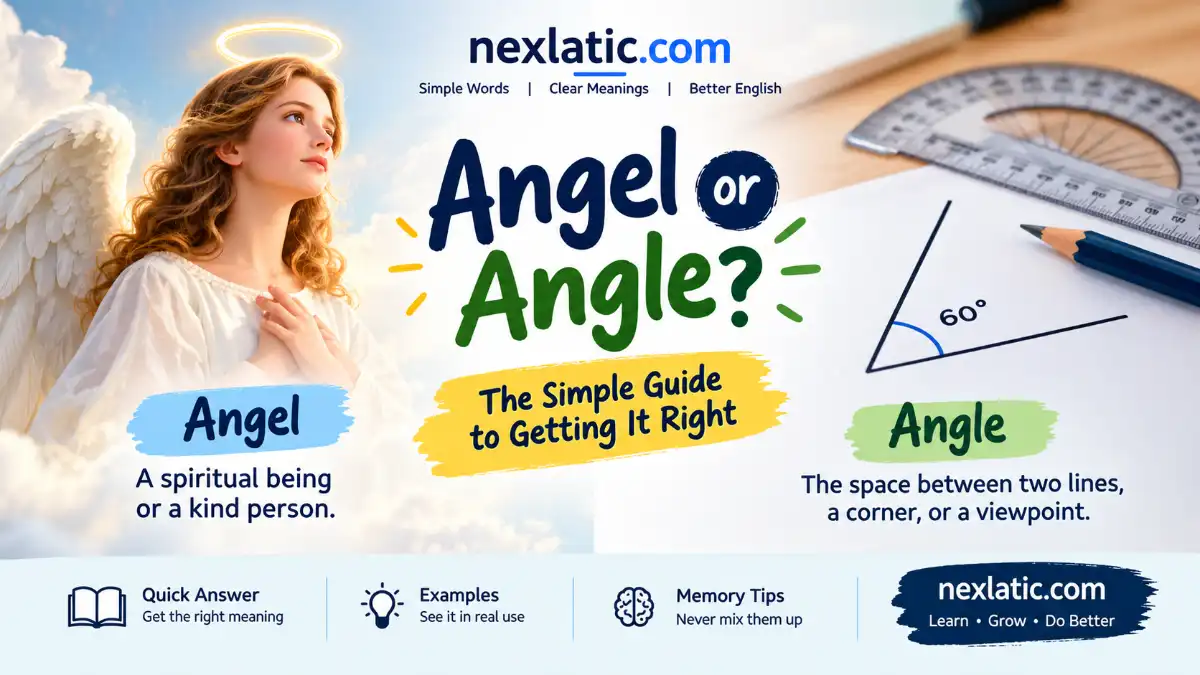
Angel is a spiritual being, or a very kind person.
Angle is the space between two lines, a corner, or a way of looking at something.
Examples:
- She is an angel. She helps everyone. ✅
- The angle of the ramp is too steep. ✅
- The story has a new angle. ✅
- The angel watched over the child. ✅
Memory trick: Angel has the letter E before L. Think of “Every Little Angel.” Angle ends in LE, like “triangle” and “rectangle.” Both angle and triangle end the same way.
The Origin of Angel and Angle
The two words look alike, but their stories are different.
Angel comes from the Greek word angelos, which means “messenger.” Latin borrowed it as angelus. Old English then turned it into engel. Over time, the spelling became “angel.” The word carried a religious meaning from the start.
Angle comes from the Latin word angulus, which means “corner” or “bend.” It passed into Old French as angle, and then into English. This is why we use it in math and design.
There is a second angle in English. It is a verb that means “to fish with a hook.” It comes from an old Germanic word for a fishhook. So you can “angle” for fish, or “angle” for a compliment.
Why do people mix them up? The two words are anagrams. They share the same letters in a slightly different order. Our brains often read the first and last letters and skip the middle. That is why the mistake is so easy to make.
British English vs American English Spelling
Here is the good news. Angel and angle are spelled the same in British and American English. This is not a UK versus US spelling problem. It is a mix-up between two different words.
The words even sound different:
- Angel sounds like “AYN-jul”
- Angle sounds like “ANG-gul”
Some other words do change between the two kinds of English. Here is a quick look:
| Word type | American English | British English |
| Angel | angel | angel |
| Angle | angle | angle |
| Color | color | colour |
| Center | center | centre |
| Theater | theater | theatre |
| Organize | organize | organise |
As you can see, angel and angle stay the same in both.
Which Spelling Should You Use?
Pick the word by meaning, not by country.
- Writing for the US: Use angel for a spirit or kind person. Use angle for shapes and viewpoints.
- Writing for the UK or Commonwealth: The same rule applies. No change.
- Writing for a global audience: The same rule applies. Keep your sentences short and clear.
Ask yourself one question: “Am I talking about a person or being, or a shape or viewpoint?”
- Person or being → angel
- Shape, corner, or viewpoint → angle
Common Mistakes with Angel and Angle
| Mistake | Correction |
| The angel of the roof is 30 degrees. | The angle of the roof is 30 degrees. |
| She is a real angle. | She is a real angel. |
| Let’s look at it from a new angel. | Let’s look at it from a new angle. |
| A guardian angle protects you. | A guardian angel protects you. |
| Triangel | Triangle |
| Angal or angil | Angel |
Other common errors:
- Writing “angel” in math homework.
- Writing “angle” on cards, gifts, and tattoos. This is the most embarrassing one.
- Trusting spell check. Both words are real, so the tool may not warn you.
Fix: Read your sentence out loud. If you say “AYN-jul,” write angel. If you say “ANG-gul,” write angle.
Angel and Angle in Everyday Examples
Email:
- “Thank you for your help. You are an angel!”
- “Can we look at this from a different angle?”
News:
- “Police are checking every angle of the case.”
- “Volunteers were called angels by the local community.”
Social media:
- “Best photo angle ever! 📸”
- “My sister is an angel. Love her so much. 💛”
Formal writing:
- “The engineer measured the angle of the bridge.”
- “The painting shows an angel with open wings.”
Angel or Angle – Google Trends and Usage Data
I can’t pull live Google Trends numbers here, so I won’t make any up. But we can talk about the general patterns.
Where people search it: This kind of spelling question is common in countries with many English learners and students. That includes India, Pakistan, the Philippines, Nigeria, and many other places, as well as the US and UK.
When people search it:
- School seasons: Students search when they do math or writing homework.
- Holiday seasons: Searches for angel can rise near religious holidays, when people write cards and messages.
- Design and photo work: People use angle in photography, DIY, and marketing.
Why the interest stays steady: Both words are common and easy to swap. As long as people type quickly, this question will keep coming up.
Want the real numbers? Visit Google Trends, type “angel or angle,” and compare it by country and date range.
Angel and Angle: Side-by-Side Comparison
| Word | Meaning | Part of speech | Sounds like | Example |
| Angel | Spiritual being; very kind person | Noun | AYN-jul | She is an angel. |
| Angels | More than one angel | Noun | AYN-julz | The angels sang. |
| Angelic | Like an angel; sweet | Adjective | an-JEL-ik | An angelic smile. |
| Angle | Corner; viewpoint | Noun | ANG-gul | A 90° angle. |
| Angles | More than one angle | Noun | ANG-gulz | Try new angles. |
| Angle | To fish; to aim for something | Verb | ANG-gul | He angled for praise. |
| Angled | Set at a slant | Adjective/Verb | ANG-guld | An angled shelf. |
| Triangle | Shape with three angles | Noun | TRY-ang-gul | Draw a triangle. |
FAQS
1. What is the difference between angel and angle?
An angel is a spiritual being or a very kind person. An angle is the space between two lines, or a way of looking at something.
2. Is “angle” a wrong spelling of “angel”?
No. Both are correct words. They just have different meanings. It is only a mistake if you use the wrong one.
3. Are angel and angle spelled differently in British and American English?
No. Both countries use the same spelling for each word.
4. How do I remember which is which?
Angel has E then L. Think “Every Little Angel.” Angle ends in LE, like “triangle.”
5. Are angel and angle pronounced the same?
No. Angel sounds like “AYN-jul.” Angle sounds like “ANG-gul.”
6. Which one do I use for “guardian ___”?
Use angel. The correct phrase is “guardian angel.”
7. Which one do I use for “a new ___ on the story”?
Use angle. It means a new point of view.
8. Will spell check catch the mistake?
Not always. Both words are real, so the tool may miss it. Always re-read your sentence.
Conclusion
Angel and angle look almost the same, but they are very different words. An angel is a spiritual being or a kind person. An angle is a corner, a slant, or a point of view. The two share the same letters, so the mix-up is easy and very common.
Remember these key points:
- Spelling does not change between British and American English.
- The words sound different: “AYN-jul” and “ANG-gul.”
- Angel has E before L. Angle ends in LE, like “triangle.”
- Do not trust spell check. Both words are real.
- Read your sentence out loud before you send it.
Choose the word by meaning. If you mean a person or being, use angel. If you mean a shape or viewpoint, use angle. This rule works for emails, homework, news, social media, and formal papers.
A small spelling mistake can change your message. It can even make a sweet card sound silly. Take five seconds to check, and your writing will look clear and professional. Now you know the difference, so write with confidence.

Ali Bismal is the founder and writer behind Nexlatic.com, a growing online platform created to provide useful, informative, and easy-to-understand content for everyday readers. Through Nexlatic, Ali shares practical ideas, helpful guides, interesting topics, and engaging articles designed to make information simple and accessible. His goal is to create reliable, reader-focused content that helps people learn something new, find useful answers, and make everyday life a little easier.