You are in the middle of a sentence. You stop. Do you write “and”? Or do you write “but”? It feels like a tiny choice. It is not. One word can change what your reader thinks.
Many people search “and or but” for this reason. Some want a fast rule. Some are stuck in the middle of an email. Some are students. Some are learning English. Some just want to know if a sentence can start with one of these words. (Yes, it can.)
The confusion is simple. Both words join ideas. But they do different jobs. “And” adds. “But” shows a change or a clash. Some people also mix up “and or but” with “and/or,” which is something else.
This guide clears it all up. You get a quick answer first. Then you get the history, examples, common mistakes, and FAQs. No hard grammar words. Just clear help you can use today.
And or But – Quick Answer
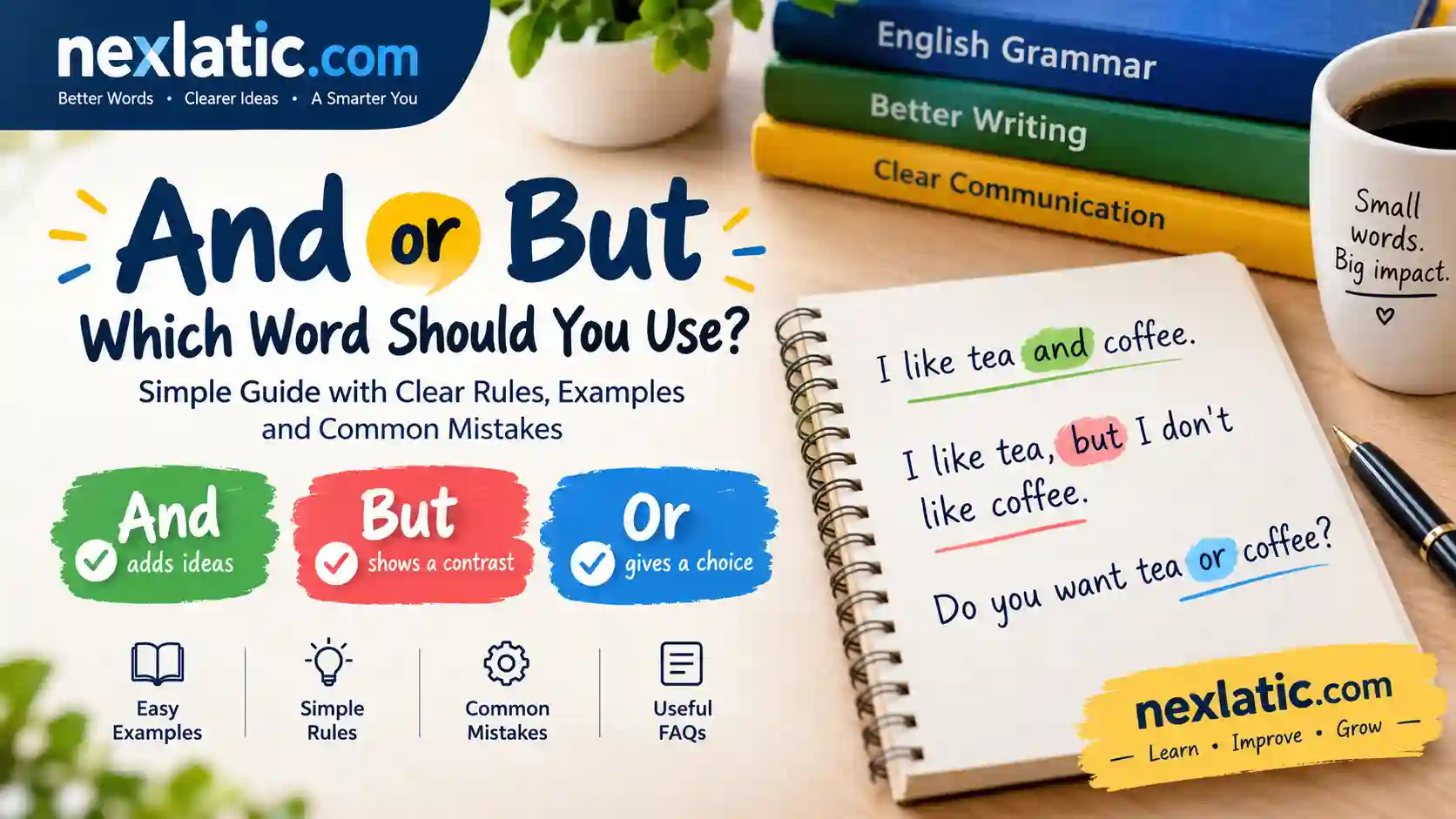
Use “and” when you add one idea to another. The ideas go the same way.
Use “but” when the second idea goes against the first. The ideas clash.
- I like tea and I like coffee. (Both are true. Adding.)
- I like tea, but I do not like coffee. (A clash.)
- She was tired and she went to bed. (One thing follows another.)
- She was tired, but she kept working. (A surprise.)
Simple test: Ask yourself, “Does the second part surprise me?” If yes, use “but.” If no, use “and.”
The Origin of And or But
These are very old words. They come from Old English, the language spoken in England over 1,000 years ago.
- And comes from the Old English word “and.” It has always meant “in addition.”
- But comes from the Old English “butan,” which meant “outside of” or “except.” Over time it came to mean “on the other hand.”
- Or grew out of older Old English words that meant “either” or “other.”
Why do people talk about spelling differences? Because many English words are spelled differently in the US and UK, like “color” and “colour.” But these three words are so short and old that they never split. They are spelled the same everywhere. The confusion is not about spelling. It is about meaning and use.
British English vs American English Spelling
Good news: there is nothing to memorize here.
| Word | American English | British English | Same? |
| And | and | and | Yes |
| But | but | but | Yes |
| Or | or | or | Yes |
| And/or | and/or | and/or | Yes |
| Color (for contrast) | color | colour | No |
| Center (for contrast) | center | centre | No |
The last two rows show what a real spelling difference looks like. “And,” “but,” and “or” do not have one.
There is one small style difference. Some British writers put fewer commas before “and” in a list. Many American writers use the “Oxford comma” (a comma before the last “and”). Example: “apples, pears, and plums.” Both are fine. Just be consistent.
Which Spelling Should You Use?
Since the spelling is the same, the real question is style and tone. Here is how to choose:
- US readers: Use “and” and “but” as you like. The Oxford comma is common. Starting a sentence with “But” is fine in most writing.
- UK and Commonwealth readers: Same words. Commas may be lighter. Starting with “But” is fine in most writing, but some teachers still dislike it.
- Global readers: Keep sentences short. Use “but” to show a clash. Use “and” to add. Skip “and/or” when you can, because it can confuse people who are learning English.
- Formal writing (reports, law, school): Prefer “but” inside a sentence after a comma. Use “however” to start a new sentence when you need a formal tone.
Common Mistakes with And or But
1. Using “and” when the ideas clash
- Wrong: I studied hard and I failed.
- Better: I studied hard, but I failed.
2. Using “but” when nothing clashes
- Wrong: I was hungry, but I ate lunch.
- Better: I was hungry, so I ate lunch. (Or: “I was hungry and I ate lunch.”)
3. Using two clashing words together
- Wrong: Although it rained, but we went out.
- Better: Although it rained, we went out. (Or: “It rained, but we went out.”)
4. Forgetting the comma before “but”
- Weak: I wanted to go but I was sick.
- Better: I wanted to go**,** but I was sick.
5. Thinking you cannot start a sentence with “And” or “But”
- This is a myth. Good writers do it all the time. Use it for effect, but not in every line.
6. Mixing up “and/or” with “and” or “or”
- “And/or” means one or both. Example: “Bring a pen and/or a pencil.” Many style guides say to avoid it in formal writing. Plain “or” often works.
And or But in Everyday Examples
Emails
- Thanks for your note**, but** I cannot join the call.
- I will send the file today and the report tomorrow.
News headlines
- Prices rise but sales stay strong.
- Mayor opens park and promises more.
Social media
- Loved the movie**, but** the ending was odd.
- New phone and new case. Life is good.
Formal writing
- The plan is sound**; however**, it needs more money. (More formal than “but.”)
- The committee reviewed the budget and approved the changes.
Everyday speech
- Nice idea**, but** let’s wait.
- I’ll cook and you clean.
And or But – Google Trends & Usage Data
I can’t pull live search numbers here, so I won’t give you exact figures. Here is what is generally true about how people search for this kind of keyword:
- Who searches: Students, non-native English speakers, and office workers who write emails all day.
- Where: Interest tends to be strong in countries with many English learners and English-language schools, such as India, Pakistan, the Philippines, Nigeria, and the US.
- When: Searches often rise during school terms and exam seasons.
- Why: People want a fast rule, a fix for a sentence, or proof that they can start a sentence with “But.”
Want real data? Open Google Trends, type “and or but,” and compare it with “and vs but” or “and/or.” Then filter by country and date range. This gives you the current picture.
Keyword Variations Side by Side
| Phrase | What it means | Best use |
| And | Adds an idea | Same-direction ideas |
| But | Shows a clash | Surprise or contrast |
| Or | Gives a choice | Options |
| And/or | One or both | Forms, legal text (use sparingly) |
| And but | Two joiners together | Usually a mistake |
| However | Formal “but” | Start of a formal sentence |
FAQS
1. What is the difference between “and” and “but”?
“And” adds a similar idea. “But” shows a clash or surprise.
2. Can I start a sentence with “And” or “But”?
Yes. It is fine in most writing. Do not overuse it, and in very formal work you may prefer “However.”
3. Do I need a comma before “but”?
Usually yes, when “but” joins two full sentences. Example: “I like it, but it costs too much.”
4. Is “and but” correct?
No. Pick one. Use “and” to add or “but” to contrast.
5. What does “and/or” mean?
It means one or both. “Bring a pen and/or a pencil” means you can bring either one or both.
6. Is the spelling different in British and American English?
No. “And,” “but,” and “or” are spelled the same in every English-speaking country.
7. Should I use “and/or” in formal writing?
Try not to. Many style guides say to use “and” or “or” instead. If you need both, write it out: “a pen, a pencil, or both.”
8. What can I use instead of “but”?
“Yet,” “however,” “although,” and “though” all work, depending on the sentence.
Conclusion
“And” and “but” are small words with big jobs. “And” adds one idea to another. “But” shows a clash, a surprise, or a change. If you remember this one rule, you will get most sentences right.
There is no spelling trouble here. The words are the same in American and British English. The real trouble is meaning. Ask yourself if the second idea goes with the first or against it. If it goes with it, write “and.” If it goes against it, write “but.”
Remember a few more tips. Put a comma before “but” when it joins two full sentences. Never write “and but” together. Skip “and/or” in formal writing when plain “or” will do. And yes, you can start a sentence with “And” or “But” when it helps your voice.
Keep your sentences short. Read them out loud. If they sound right, they usually are. With a little practice, this choice will feel easy every time.

Ali Bismal is the founder and writer behind Nexlatic.com, a growing online platform created to provide useful, informative, and easy-to-understand content for everyday readers. Through Nexlatic, Ali shares practical ideas, helpful guides, interesting topics, and engaging articles designed to make information simple and accessible. His goal is to create reliable, reader-focused content that helps people learn something new, find useful answers, and make everyday life a little easier.