You are writing an email. You type “The team will work onsite.” Then you stop. Should it be “on site”? Or “on-site”? Now you are not sure.
You are not alone. Many people search “onsite or on site” every day. The words sound the same, but they look different on the page. One small space or dash can make you doubt your writing, especially in a work email, a job post, or a report.
This confusion is real because English has no single rule that everyone follows. Dictionaries, style guides, and companies do not always agree. Some words start as two words, then get a dash, then become one word over time. “Onsite” is in the middle of that change.
This guide clears it up. You will get a quick answer first. Then you will see where the word comes from, how to use each form, which mistakes to avoid, and which spelling fits your reader. The language is simple, and the advice is practical.
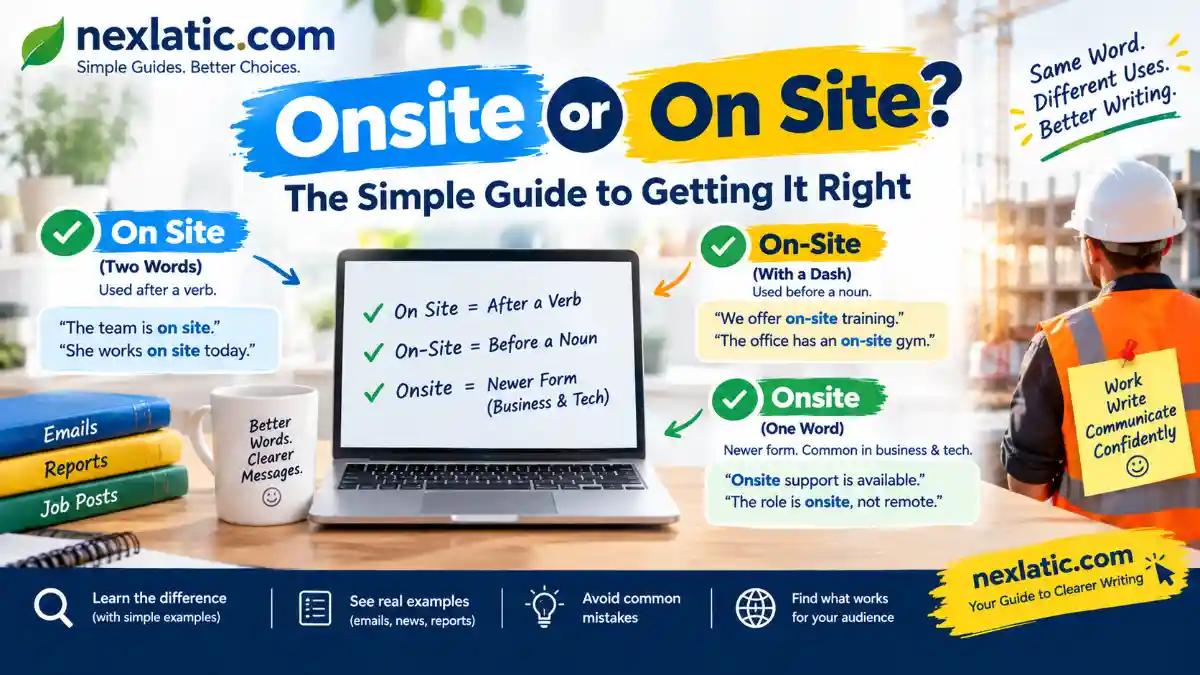
Onsite or On Site – Quick Answer
Here is the short answer:
- On site (two words) is used after a verb. Example: “The nurse is on site.”
- On-site (with a dash) is used before a noun. Example: “We offer on-site training.”
- Onsite (one word) is a newer form. Many businesses and tech writers use it. Some dictionaries list it, but many style guides still prefer the dash.
Safe rule: Use “on-site” before a noun. Use “on site” after a verb. Both are correct in almost every setting.
More examples:
- “Our engineers work on site.” (after a verb)
- “The company has an on-site gym.” (before a noun)
- “Onsite support is available.” (common in business writing, but less formal)
The Origin of Onsite or On Site
Both small words are very old. “On” comes from Old English. “Site” comes from the Latin word situs, which means “place” or “position.” It came into English through French.
For a long time, people wrote “on the site” or “on site” as two plain words. In the 20th century, business and building work grew fast. People needed a short way to say “at the place where the work happens.” So “on-site” appeared as an adjective, with a dash to join the two words.
Why do spellings differ? English often changes in steps:
- Two words: on site
- Joined with a dash: on-site
- One word: onsite
Think of “email.” It was once “e-mail.” Many writers now use “email.” “Onsite” may follow the same path. Right now, the different spellings show a word that is still changing.
British English vs American English Spelling
This is not a true UK-versus-US spelling fight. It is more about style and habit. Words like “color” and “colour” follow a clear split. “Onsite” and “on-site” do not.
Here is what you can say safely:
- Major dictionaries in both countries list the dashed form, “on-site.”
- The one-word form, “onsite,” shows up more in business, tech, and marketing writing in both places.
- Many news style guides prefer “on-site” or “on site,” depending on the sentence.
| Form | Where it is common | Formality | Example |
| on site | Both, after a verb | Formal and safe | “The manager is on site.” |
| on-site | Both, before a noun | Formal and safe | “on-site parking” |
| onsite | Both, more in business and tech | Informal to neutral | “onsite support” |
The best advice: do not pick a spelling by country. Pick it by sentence type and by the style guide you follow.
Which Spelling Should You Use?
Match your spelling to your reader.
If you write for a US audience: Use “on-site” before a noun and “on site” after a verb. This follows the most common style guides. “Onsite” is fine in tech or marketing copy.
If you write for a UK or Commonwealth audience: The same rule works. “On-site” and “on site” look the safest in formal writing. Check your company or publisher style guide first.
If you write for a global audience: Choose “on-site” and “on site.” Readers around the world know them well.
If you write for a company: Follow the brand style. Consistency matters more than which form you pick. Do not mix “onsite” and “on-site” in one document.
If you are unsure: Use the dash before a noun. It is the safest choice.
Common Mistakes with Onsite or On Site
Mistake 1: Using two words before a noun.
- Wrong: “We provide on site training.”
- Better: “We provide on-site training.”
Mistake 2: Using a dash after a verb.
- Wrong: “The team is on-site today.”
- Better: “The team is on site today.”
- Note: Some writers accept the dash here. Two words is the safest choice.
3: Mixing forms in one document.
- Wrong: “Onsite support and on-site training.”
- Better: “On-site support and on-site training.”
Mistake 4: Confusing “on site” with “on sight.”
- “Sight” means seeing. “Site” means a place.
- Wrong: “The manager is on sight.”
- Better: “The manager is on site.”
Mistake 5: Forgetting the opposite word.
- The opposite is “off site” or “off-site.” Use the same rule for it.
Onsite or On Site in Everyday Examples
In emails:
- “The technician will be on site at 10 a.m.”
- “Please confirm your on-site visit.”
In news writing:
- “Police were on site within minutes.”
- “The plant has an on-site clinic.”
On social media:
- “Loving the onsite coffee bar! ☕”
- “Job alert: on-site role in Chicago.”
In formal writing:
- “All on-site inspections must follow safety rules.”
- “Staff must remain on site during the audit.”
In job posts:
- “This is an on-site job, not remote.”
- “Hybrid: two days on site each week.”
Onsite or On Site – Google Trends & Usage Data
I cannot pull live Google Trends numbers here, so I will not make any up. Here is what writers and SEO tools usually show, and how to check it yourself.
General patterns:
- Searches for “on-site” and “onsite” often rise with work topics. These include remote work, hybrid work, and office return policies.
- Interest in “onsite” as one word is strong in tech, IT support, and marketing.
- “On-site” and “on site” appear more in news, government, and formal documents.
- Search interest is high in English-speaking countries like the US, UK, Canada, Australia, and India.
How to check the latest data:
- Open Google Trends.
- Type “onsite,” “on-site,” and “on site” as separate terms.
- Set the country and date range.
- Compare the lines.
Also check “SEO onsite” versus “on-site SEO.” Marketers use both, and the one-word form is very common there.
Keyword variations side by side:
| Variation | Common use | Best for |
| on site | After a verb | All writing |
| on-site | Before a noun | Formal writing, news |
| onsite | Business and tech | Brand copy, informal text |
| off site / off-site | Opposite meaning | Same rules as above |
| on sight | Wrong word for place | Not used here |
FAQs
1. Is it “onsite” or “on site”?
Both exist. “On site” is best after a verb. “On-site” is best before a noun. “Onsite” is a newer one-word form.
2. Is “onsite” a real word?
Yes. Many writers use it, and some dictionaries list it. Many style guides still prefer “on-site.”
3. Is “on-site” correct?
Yes. It is the most common form before a noun, like “on-site parking.”
4. Which is correct in British English?
The same rule works. Use “on-site” before a noun and “on site” after a verb.
5. Which is correct in American English?
The same rule applies in American English. “On-site” is the safest formal choice.
6. What is the opposite of on site?
The opposite is “off site” or “off-site.” Use the same rules.
7. Can I use “onsite” in a work email?
Yes, if your company style allows it. If you are unsure, use “on-site.”
8. What is the difference between “on site” and “on sight”?
“Site” means a place. “Sight” means something you see. Only “site” fits here.
Conclusion
Here is the main lesson: “onsite or on site” is not a big spelling fight. It is a small style choice.
Use these simple rules:
- Use on site after a verb: “The team is on site.”
- Use on-site before a noun: “on-site training.”
- Use onsite only if your brand or industry style allows it.
Do not pick a spelling based on country. Both the US and the UK use all three forms, and dictionaries list the dashed form in both places. What matters most is being clear and consistent. Pick one style and use it the same way across your whole document.
If you are ever unsure, choose “on-site” before a noun and “on site” after a verb. Readers everywhere will understand you, and your writing will look professional.
Watch out for “on sight.” It is a different word with a different meaning. Also remember that “off site” and “off-site” follow the same rules.
Language changes over time. “Onsite” may become more common in the years ahead. For now, the two-word and dashed forms are your safest bets. Follow your style guide, keep it simple, and write with confidence.

Ali Bismal is the founder and writer behind Nexlatic.com, a growing online platform created to provide useful, informative, and easy-to-understand content for everyday readers. Through Nexlatic, Ali shares practical ideas, helpful guides, interesting topics, and engaging articles designed to make information simple and accessible. His goal is to create reliable, reader-focused content that helps people learn something new, find useful answers, and make everyday life a little easier.