Have you ever stopped mid-sentence and wondered, “Is it itself or its self?” You are not alone. Many people search for this question every day.
Both versions look right. Both sound the same when you say them out loud. But only one is correct in almost every case.
People search for this keyword because English has many small words that look alike. Its, it’s, self, and itself seem close. One wrong pick can make your email, report, or post look careless.
This guide clears up the confusion. You will get a quick answer first. Then you will learn where the word came from and whether British and American English differ. You will also see common mistakes, real examples, and usage trends. At the end, you will find answers to common questions.
By the end, you will know when to write “itself,” and the rare time “its self” is fine. Let’s begin.
Itself or Its Self – Quick Answer
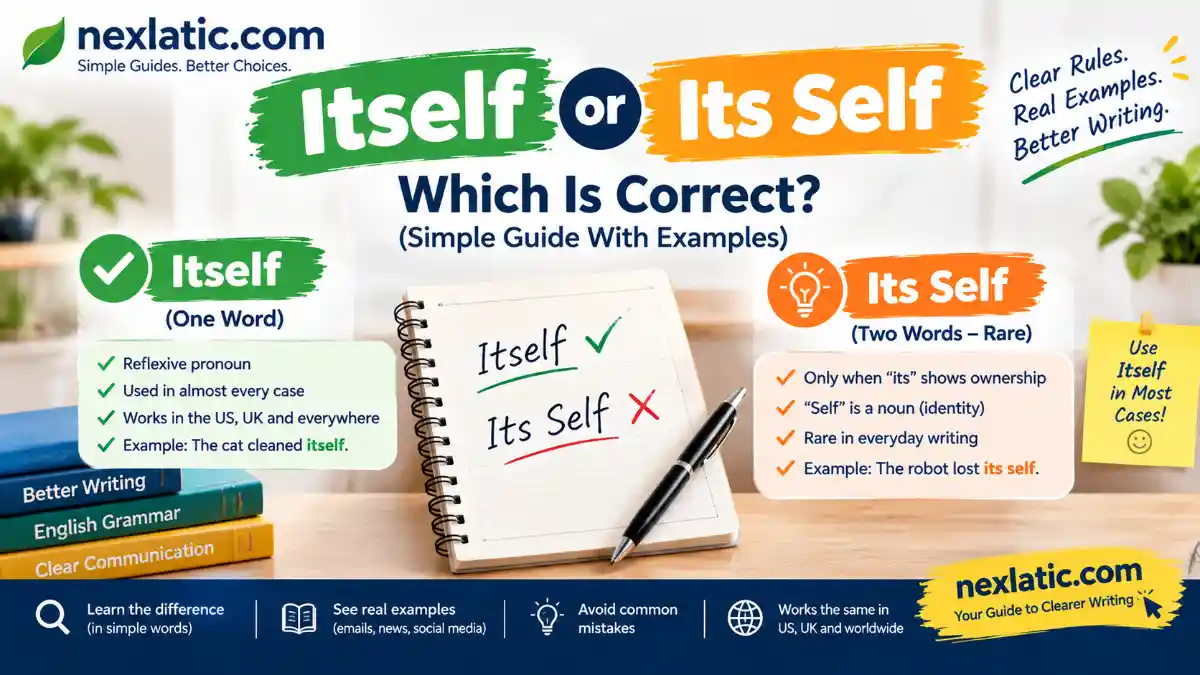
Use “itself.” It is one word. It is the right choice in nearly every sentence.
“Itself” points back to a thing, an animal, a group, or an idea.
- The cat cleaned itself.
- The company said the plan would pay for itself.
- The door closed by itself.
- The problem itself is small.
“Its self” is two words. It is only correct when “its” shows ownership and “self” is a real noun.
- The robot began to lose its self as the memory failed. (its = belongs to the robot, self = identity)
Not sure? Try this test. Replace the word with “himself” or “herself.” If the sentence still works, use itself.
The Origin of Itself
The word is old. In Old English, people said hit self. Hit meant “it,” and self meant “the same one.”
Over time, the two words joined. Writers began to treat them as one word. That is how “itself” became the reflexive pronoun we use today. (A reflexive pronoun points back to the subject of the sentence.)
The word “its” is newer. Long ago, English had no special word for “belongs to it,” so people used “his” for things too. Around the 1600s, “its” became common.
Why do people mix up the spellings?
- “Its” and “self” are both real words, so “its self” looks natural.
- English has other pairs such as my self versus myself. Only the joined form is normal for reflexive use.
- “It’s” (it is) makes the apostrophe confusing.
- Autocorrect sometimes hides the error instead of fixing it.
British English vs American English Spelling
Here is the good news. There is no difference. Both British and American English use “itself.” Both use “its self” in the same rare case.
Many spelling pairs do change by region (color and colour, for example). This one does not.
| Feature | American English | British English |
| Reflexive pronoun | itself | itself |
| Two-word form “its self” | Rare, noun use only | Rare, noun use only |
| Hyphenated “its-self” | Not standard | Not standard |
| Used in formal writing | itself | itself |
| Example | The system fixed itself. | The system fixed itself. |
So you do not need to change your spelling for a US or UK reader.
Which Spelling Should You Use?
The answer is the same for every audience.
- US readers: Use “itself.”
- UK and Commonwealth readers: Use “itself.”
- Global readers: Use “itself.”
Only choose “its self” when both of these are true:
- “Its” shows that something belongs to a thing.
- “Self” means the identity or true nature of that thing.
This use is rare. It shows up mostly in philosophy, psychology, or fiction. For business emails, school work, news, and social media, write itself.
Professional tip: If you can swap the word for “the thing,” you likely need “itself.” If you can swap in “its identity,” you may need “its self.”
Common Mistakes with Itself or Its Self
Mistake 1: Splitting the word without a reason
- Wrong: The team proved its self.
- Right: The team proved itself.
Mistake 2: Mixing up “its” and “it’s”
- Wrong: The dog hurt it’s self.
- Right: The dog hurt itself.
- Remember: it’s always means it is or it has.
For example mistake 3: Writing “itsself”
- Wrong: The machine turned off itsself.
- Right: The machine turned off itself.
Mistake 4: Using a hyphen
- Wrong: The plan explains its-self.
- Right: The plan explains itself.
Mistake 5: Using “itself” when it is not needed
- Wrong: The manager and itself will attend.
- Right: The manager will attend.
Itself in Everyday Examples
Emails
- “The issue resolved itself after the update.”
- “Please note that the offer will not repeat itself.”
News
- “The city said the project would pay for itself in five years.”
- “History often repeats itself.”
Social media
- “This Monday is not going to fix itself.”
- “The internet outdid itself today.”
Formal writing
- “The law itself does not ban the practice.”
- “The committee found that the model itself was flawed.”
Rare “its self” example (noun use)
- “The story shows a machine searching for its self.”
Itself or Its Self – Google Trends and Usage Data
I can’t pull live Google Trends numbers for you here, so the notes below are general patterns, not exact figures. For current numbers, search the keyword on Google Trends and compare regions and dates.
What usually shows up:
- “Itself” is far more common than “its self” in books, news, and web pages.
- “Its self” appears mostly as a mistake or in special philosophy and psychology writing.
- Search interest tends to come from students, writers, and people who learn English as a second language.
- Interest is often higher in English-speaking and English-learning countries such as the US, the UK, India, Canada, Australia, Nigeria, Pakistan, and the Philippines.
- Interest can rise during school terms and exam seasons.
Context of searches: Most people search for a quick rule. Others want help for a paper, a resume, or a business email.
Keyword Variations Side by Side
| Variation | Correct? | Meaning or Use | Example |
| itself | Yes | Reflexive pronoun | The cat washed itself. |
| its self | Rarely | “Its” + noun “self” (identity) | The AI lost its self. |
| it’s self | No | Wrong. “It’s” means “it is.” | ~~The dog hurt it’s self.~~ |
| its-self | No | Not standard | ~~The plan explains its-self.~~ |
| itsself | No | Misspelling | ~~It fixed itsself.~~ |
| itself (emphasis) | Yes | Stresses the thing | The book itself is short. |
FAQs
1. Is it “itself” or “its self”?
Use “itself.” Choose “its self” only when you mean the identity of a thing.
2. Is “its self” ever correct?
Yes, but rarely. It works when “its” shows ownership and “self” is a noun, as in “the machine lost its self.”
3. Is “itself” one word or two?
One word.
4. Is there a difference between British and American English?
No. Both use “itself” the same way.
5. What is the difference between “its” and “it’s”?
“Its” shows ownership. “It’s” means “it is” or “it has.”
6. Can I say “it’s self”?
No. That is always wrong.
7. What kind of word is “itself”?
It is a reflexive pronoun. It can also add emphasis, as in “The idea itself is good.”
8. How can I check fast?
Swap in “himself” or “herself.” If it works, write “itself.”
Conclusion
Here is the short version: write “itself.” The word works in the US, the UK, and everywhere else. It fits naturally in emails, essays, news articles, and social media posts.
“Its self” is real, but rare. Use it only when “its” shows ownership and “self” means identity. Most writers will never need it.
Watch out for the common traps. Do not write “it’s self,” “its-self,” or “itsself.” Remember that “it’s” always means “it is.” If you feel unsure, use the “himself or herself” test.
Also, there is no British and American split here. You do not need to change your spelling for different readers. That makes this an easy rule to learn and keep.
Good writing builds trust. Small details like this show care. When you pick the right word, your message is clear, and your reader can focus on your ideas instead of your errors.
Next time you wonder, “Itself or its self?” you will know the answer in seconds.

Ali Bismal is the founder and writer behind Nexlatic.com, a growing online platform created to provide useful, informative, and easy-to-understand content for everyday readers. Through Nexlatic, Ali shares practical ideas, helpful guides, interesting topics, and engaging articles designed to make information simple and accessible. His goal is to create reliable, reader-focused content that helps people learn something new, find useful answers, and make everyday life a little easier.