You are shopping for car parts online. One site says “tyres.” Another says “tires.” Now you wonder which one is right. Did someone make a mistake?
Good news. Nobody made a mistake. Both spellings are correct. They just belong to different places.
Every day, people search “tyres or tires” for simple reasons. Whether they are writing for a new audience, studying as students, selling car parts abroad, or simply sending an email, people want their words to sound clear and natural. Spelling looks small, but it matters. The wrong choice can make your writing feel odd to readers.
This guide clears up the confusion. You will get a quick answer first. Then you will learn where each word came from. You will see examples, common mistakes, and a simple rule for choosing. You will also find two tables, seven FAQs, and a short summary.
By the end, you will know which spelling to use. You will also know why. Let’s start.
Tyres or Tires – Quick Answer
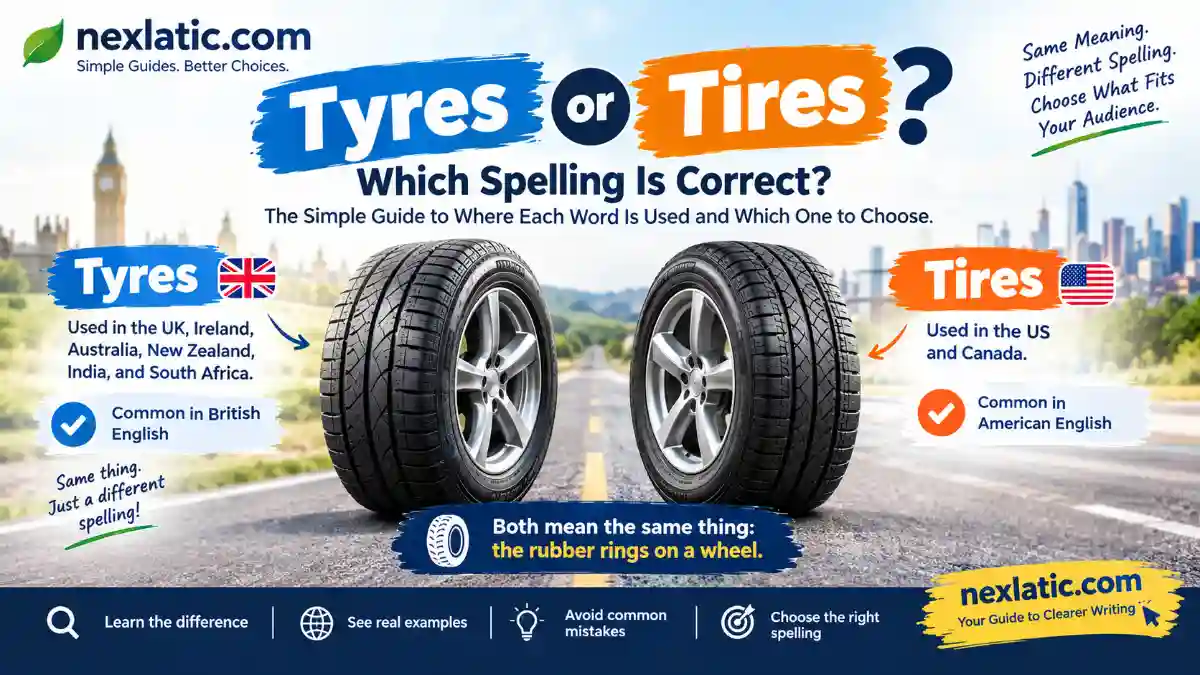
“Tires” is the American spelling. “Tyres” is the British spelling.
Both mean the same thing: the rubber rings on a wheel.
- US and Canada: “I need new tires for my truck.”
- UK, Ireland, Australia, New Zealand, India, South Africa: “I need new tyres for my van.”
Pick one and use it all the way through your text. Do not mix them.
The Origin of Tyres or Tires
The word is old. Many language experts think it came from “attire.” Long ago, a wheel wore an iron band. The band “dressed” the wheel. So it was called a tire.
For a long time, “tire” was the normal spelling in Britain too. Then, in the 1800s, things changed. Rubber tyres and air-filled tyres became common. Around then, British writers began to prefer “tyre.” The new spelling stuck in Britain.
America did not follow. Americans kept the old form, “tire.”
So who changed? In a way, Britain did. The American spelling is the older one.
Why do spelling gaps like this exist? Before dictionaries, spelling was loose. Later, writers and publishers picked one form and kept it. In the US, Noah Webster pushed simpler spellings. In Britain, printers and publishers went their own way. Two paths grew apart.
British English vs American English Spelling
Both versions follow their own habits. Neither one is “better.”
| Feature | British English | American English |
| Spelling for wheel covering | tyre / tyres | tire / tires |
| Verb “to become weary” | tire (same) | tire (same) |
| Example sentence | “The tyre is flat.” | “The tire is flat.” |
| Used in | UK, Ireland, Australia, NZ, India, South Africa | US, Canada |
| Also seen | colour, centre, grey | color, center, gray |
Notice one thing. The verb “to tire” (to get tired) is spelled the same in both. “I tire easily” is correct everywhere. Only the wheel word changes.
Other British and American pairs work the same way:
- colour / color
- centre / center
- grey / gray
- kerb / curb
Which Spelling Should You Use?
Think about your reader first.
Writing for a US audience? Use tires.
Writing for the UK, Ireland, Australia, New Zealand, India, or South Africa? Use tyres.
Writing for Canada? Use tires. Canadians follow the American form here.
Writing for the whole world? Choose one and stay with it. Many global brands pick the spelling of their biggest market. If your main readers are in the US, go with “tires.” If they are mostly in the UK or Commonwealth, go with “tyres.”
Not sure? Check your other words. If you write “color” and “center,” use “tires.” If you write “colour” and “centre,” use “tyres.”
For websites and SEO: Match the spelling your customers type into search. If you sell in both regions, make two pages, one for each spelling.
Common Mistakes with Tyres or Tires
Mistake 1: Mixing both in one text.
Wrong: “Check your tyres. Old tires can be unsafe.”
Right: “Check your tires. Old tires can be unsafe.”
Mistake 2: Mixing styles.
Wrong: “The color of the tyres is black.”
Right: “The colour of the tyres is black.” (or “The color of the tires is black.”)
Mistake 3: Thinking one is a typo.
Neither is. Do not “correct” a UK writer’s “tyres” in a UK text.
Mistake 4: Using “tyre” for the verb.
Wrong: “I tyre quickly on long walks.”
Right: “I tire quickly on long walks.”
Mistake 5: Writing “tier” or “tyer.”
“Tier” means a level. It is not a wheel word.
Mistake 6: Trusting spellcheck blindly.
Set your tool to the right language, US or UK. Then it will help instead of confuse.
Tyres or Tires in Everyday Examples
Email (US):
“Hi Sam, your new tires arrive Friday. Please book a time for fitting.”
Email (UK):
“Hi Sam, your new tyres arrive Friday. Please book a time for fitting.”
News headline (US):
“Tire Prices Rise as Rubber Costs Climb”
News headline (UK):
“Tyre Prices Rise as Rubber Costs Climb”
Social media (US):
“Flat tire on the highway. Worst Monday ever. #roadtrip”
Social media (Australia):
“Flat tyre on the highway. Worst Monday ever. #roadtrip”
Formal writing (US):
“All vehicles must have tires with a safe tread depth.”
Formal writing (UK):
“All vehicles must have tyres with a safe tread depth.”
The meaning never changes. Only the spelling does.
Tyres or Tires – Google Trends & Usage Data
Google Trends shows how often people search a word. It does not give exact counts. It shows interest on a scale from 0 to 100. You can check the current numbers yourself at trends.google.com.
Here is the pattern you will usually see:
- “Tires” is searched more overall. The US has far more people than the UK. So the American spelling leads in world totals.
- “Tyres” is strong in the UK, Ireland, Australia, New Zealand, India, and South Africa.
- Canada leans toward “tires.”
- Shopping searches like “buy tyres” or “tire deals” follow the local spelling.
- Seasonal spikes happen in autumn and winter. People look for winter and snow tyres or tires.
Tip: Use the “Compare” tool in Google Trends. Type “tyres” and “tires” side by side. Then filter by country. You will see the split clearly.
Here is a simple side-by-side look at the variations:
| Search Term | Where It Is Strong | Typical Context |
| tires | US, Canada | Shops, news, car guides |
| tyres | UK, Australia, NZ, India, South Africa | Garages, motoring sites, adverts |
| tire vs tyre | Global | Spelling and grammar questions |
| tyres or tires | Global | Learners, writers, marketers |
| tire (verb) | Everywhere | “I tire easily” |
FAQs
1. Is it tyres or tires?
Both are right. “Tires” is American. “Tyres” is British.
2. Which spelling is older?
“Tire” is older. Britain moved to “tyre” later. America kept “tire.”
3. Do Canadians use tyre or tire?
Most Canadians use “tire.” Think of the store name Canadian Tire.
4. Do Australians use tyres or tires?
Australians use “tyres.”
5. Is “tyre” a typo?
No. It is the standard spelling in British English.
6. Does the verb “to tire” change in the UK?
No. “Tire” (to get tired) is spelled the same everywhere.
7. Which spelling is best for SEO?
Use the one your audience types. US readers type “tires.” UK and Commonwealth readers type “tyres.” If you serve both, make a page for each.
8. Can I use both on one website?
Yes, if you keep them on separate pages for separate audiences. Do not mix them in the same text.
Conclusion
So, tyres or tires? Now you know the answer. Both are correct. The difference is about place, not right or wrong.
Here are the key points to remember:
- Tires is the American and Canadian spelling.
- Tyres is the British, Irish, Australian, New Zealand, Indian, and South African spelling.
- “Tire” is the older form. Britain changed its spelling in the 1800s.
- The verb “to tire” is spelled the same everywhere.
- Never mix both spellings in one text.
The best advice is simple. Know your reader. Choose the spelling they use. Then stay with it from the first line to the last. Keep your other words in the same style too, like color or colour.
If you write for a global audience, pick your main market. Or build two pages, one for each spelling. This helps readers trust you, and it helps search engines match your page to the right people.
Small details make writing look sharp. Now you have the facts to get this one right every time.

Ali Bismal is the founder and writer behind Nexlatic.com, a growing online platform created to provide useful, informative, and easy-to-understand content for everyday readers. Through Nexlatic, Ali shares practical ideas, helpful guides, interesting topics, and engaging articles designed to make information simple and accessible. His goal is to create reliable, reader-focused content that helps people learn something new, find useful answers, and make everyday life a little easier.