You stand in the store. Two dryers look almost the same. One costs less. One runs on gas. Which one is right for you?
Millions of people search “electric or gas dryer” every year. They want a fast answer. They also want to avoid a costly mistake. A dryer can last 10 to 13 years, so this choice matters.
The confusion is easy to understand. Some homes have a gas line. Some do not. Prices, power bills, and safety rules all change the answer. Even the names change. Some people say “dryer.” Others say “tumble dryer.” Some write “drier.”
This guide clears it all up. You get a quick answer first. Then you see the history, the UK and US differences, common mistakes, real examples, and FAQs. Every part uses plain words. No jargon. No sales talk.
By the end, you will know which dryer fits your home, your budget, and your habits. Read on and choose with confidence.
Electric or Gas Dryer – Quick Answer
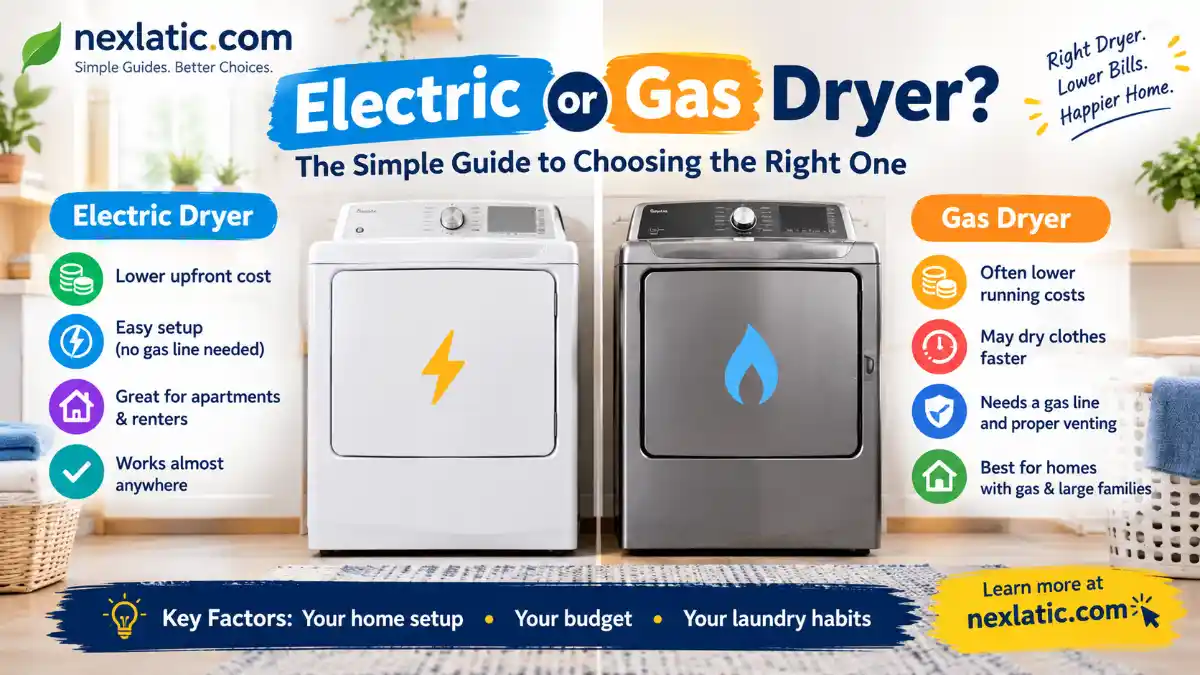
Pick electric if your home has no gas line, you rent, or you want the lowest price up front.
Pick gas if your home already has a gas line, gas is cheap where you live, and you do a lot of laundry.
Here are two examples:
- Sam lives in an apartment with no gas. He needs an electric dryer.
- Maria has a big family and a gas line in the laundry room. A gas dryer will likely save her money over time.
Both types dry clothes well. The real difference is cost, setup, and safety.
The Origin of the Electric and Gas Dryer
People first dried clothes on lines and racks. In the 1800s, inventors built hand-cranked drums over a fire. They worked, but they were not safe.
Gas and electric dryers came in the early 1900s. Gas dryers came first in many homes because gas was cheap. Electric models grew popular as more homes got a strong power supply. By the 1950s, home dryers were common in the US.
Why do the words differ? Language followed the machines.
- Dryer is the common US spelling and word.
- Drier is an older spelling. It can also mean “more dry.” Some UK writers still use it.
- Tumble dryer is the common UK term. It names the tumbling drum.
Both spellings are correct. Each one just fits a different place and habit.
British English vs American English: Dryer Words and Habits
The UK and the US do not shop for dryers the same way. Gas dryers are rare in the UK. Most UK homes use electric. Many now choose heat pump dryers, which save power.
| Topic | American English | British English |
| Common name | Clothes dryer | Tumble dryer |
| Common spelling | Dryer | Dryer or drier |
| Most common type | Electric or gas | Electric (vented, condenser, heat pump) |
| Gas dryer availability | Common | Very rare |
| Power plug | Large 240V outlet | Standard 13-amp plug |
| Where kept | Laundry room | Kitchen, utility room, or garage |
Tip: In the UK, “gas dryer” is not a popular search. In the US, it is.
Which Should You Use? Advice by Audience
In the US: Check your laundry room first. Is there a gas hookup? If yes, compare both types. If no, choose electric. Adding a gas line can cost hundreds of dollars.
In the UK and Commonwealth: Choose electric. Then pick the kind: vented, condenser, or heat pump. Heat pump models cost more up front but use much less power.
For a global reader: Look at three things. First, what fuel is cheap where you live? Second, what hookups does your home have? Third, how much laundry do you do? Those three answers decide it.
| Factor | Electric Dryer | Gas Dryer |
| Price to buy | Lower | Often higher |
| Running cost | Often higher | Often lower |
| Setup | Needs a 240V outlet | Needs a gas line and a vent |
| Drying speed | Good | Often a bit faster |
| Safety needs | Vent cleaning | Vent cleaning and a gas check |
| Best for | Apartments, renters | Homes with gas, big families |
Common Mistakes with the Electric or Gas Dryer Choice
Mistake 1: Buying before checking the hookup. A gas dryer will not work without a gas line. An electric dryer will not work without the right outlet. Check first.
Mistake 2: Looking only at price. A cheap dryer can cost more over ten years. Think about running costs, too.
Mistake 3: Skipping the vent. Every vented dryer needs a clean vent to the outside. A blocked vent can cause fires. Gas dryers can also release dangerous gas if the vent is bad.
Mistake 4: Never cleaning the lint trap. Clean it after every load.
Mistake 5: Mixing up the words. “Dryer” and “drier” are not always the same. Use “dryer” for the machine and you will be safe.
Mistake 6: Guessing your gas type. Some gas dryers use natural gas. Others use propane. Check before you buy.
Electric or Gas Dryer in Everyday Examples
Email to a landlord:
“Hi, does the unit have a gas line, or should I buy an electric dryer?”
News headline:
“Why more families are picking electric over gas dryers this year.”
Social media:
“Just moved in. Do I need an electric or gas dryer? Help!”
Formal writing (product guide):
“Customers should confirm their home’s fuel supply before choosing an electric or gas dryer.”
Store chat:
“Is the gas dryer worth the extra money?”
You can see the phrase is flexible. It appears in questions, guides, and headlines.
Electric or Gas Dryer – Google Trends and Usage Data
I can’t pull live Google Trends numbers here, so use the tool yourself for exact figures. It is free at trends.google.com. Here is what people usually see when they check this kind of search:
- US: Interest is strong. Many US homes have both options.
- UK: Interest is lower for “gas dryer.” Searches lean toward “tumble dryer” and “heat pump dryer.”
- Timing: Searches often rise around moving season, holiday sales, and when an old dryer breaks.
- Context: People search this phrase when they compare prices, worry about bills, or plan a home upgrade.
For your own research, try comparing “electric dryer,” “gas dryer,” and “tumble dryer” in Google Trends by country.
Keyword Variations Side by Side
| Search Phrase | Common In | What the Person Wants |
| Electric or gas dryer | US, global | A quick pick |
| Gas vs electric dryer | US | A comparison |
| Electric dryer vs gas dryer cost | US | Price and bill facts |
| Tumble dryer types | UK | Vented, condenser, or heat pump |
| Dryer or drier | UK, global | The right spelling |
FAQs
1. Is a gas dryer cheaper to run than an electric dryer?
Often, yes. Gas is cheaper than power in many places. Check your local prices.
2. Which dryer is faster?
Gas dryers often heat up faster. The gap is usually small.
3. Is a gas dryer safe?
Yes, if it is installed right and vented outside. Clean the vent every year.
4. Can I switch from electric to gas?
Only if you have a gas line nearby. Adding one can cost extra. Ask a licensed pro.
5. Which lasts longer?
Both last about the same. Good care matters more than fuel type.
6. Is it “dryer” or “drier”?
For the machine, “dryer” is the safest word. It works in both US and UK writing.
7. What should renters buy?
Renters should check the hookups first. Electric is usually the easy choice.
Conclusion
So, electric or gas dryer? The answer depends on your home, not on a rule.
Choose an electric dryer if you have no gas line, want a lower price, or live in an apartment. It is simple to set up and works almost anywhere. Choose a gas dryer if your home already has gas and you do lots of laundry. It often costs less to run, and it may dry a little faster.
Remember the big points. Check your hookups first. Think about ten years of use, not just today’s price. Keep the lint trap and vent clean. Vent your dryer outside. Use “dryer” as your spelling and you will be understood everywhere.
In the UK and most of the Commonwealth, electric is the normal choice. Heat pump models are worth a look for lower bills. In the US, you get both options, so compare the cost of gas and power in your area.
When in doubt, ask a licensed installer to look at your laundry space. A short visit can save you money and stress. Now you know what to check and what to avoid. Go pick the dryer that fits your life.

Ali Bismal is the founder and writer behind Nexlatic.com, a growing online platform created to provide useful, informative, and easy-to-understand content for everyday readers. Through Nexlatic, Ali shares practical ideas, helpful guides, interesting topics, and engaging articles designed to make information simple and accessible. His goal is to create reliable, reader-focused content that helps people learn something new, find useful answers, and make everyday life a little easier.