Have you ever stopped mid-sentence and thought, “Is it millennia or millennium?” You are not alone. Many people pause at this word. It looks long. It sounds fancy. And it has two forms that look almost the same.
People search for this keyword for a simple reason. They want to write the right word. You may be writing an email, a school essay, or a caption about ancient history. You do not want a spelling mistake.
Here is the good news. The answer is easy. Millennium means one thousand years. Millennia means more than one thousand-year period. One is single. The other is plural.
This article clears up the confusion. Learn the quick answer, discover where the words came from, and see how to use each one correctly. You’ll also find common mistakes and simple ways to fix them. By the end, you will never mix them up again. Let’s begin.
Millennia or Millennium – Quick Answer
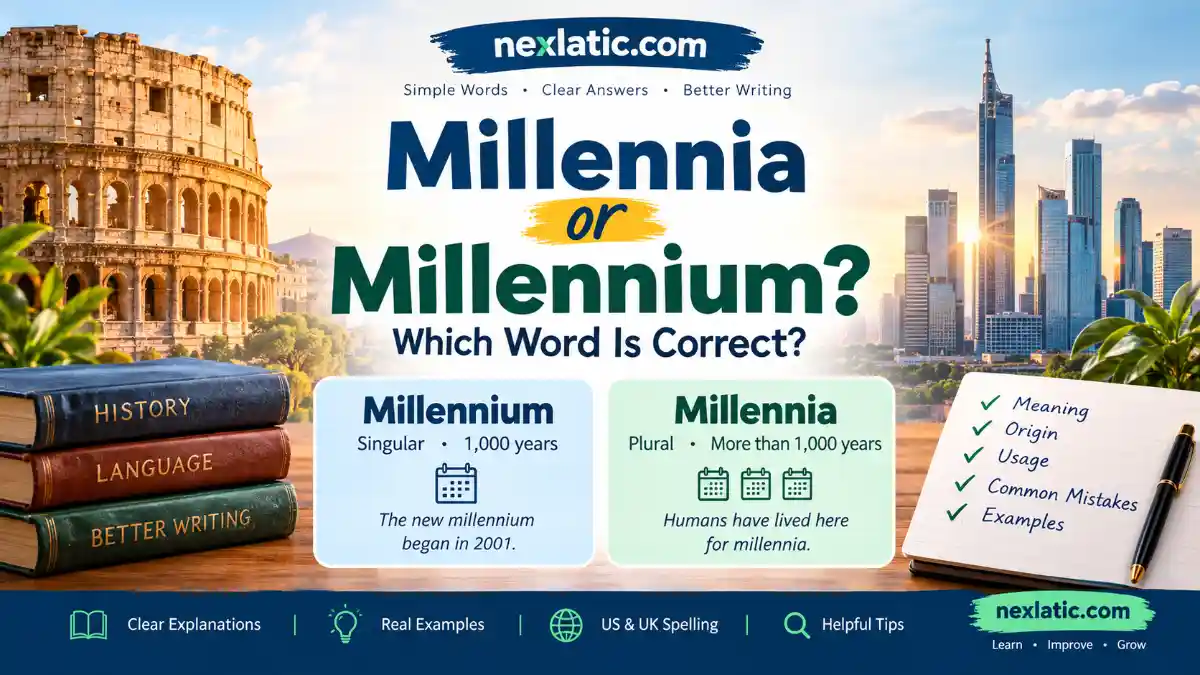
Millennium is singular. It means one period of 1,000 years.
Millennia is plural. It means two or more periods of 1,000 years.
Here is an easy way to remember it. Millennium ends in “-um.” Millennia ends in “-a.” Think of medium and media. Or bacterium and bacteria. Same pattern.
Examples:
- The new millennium began in the year 2001.
- Humans have farmed for millennia.
- Ancient Egypt lasted for three millennia.
- We live in the third millennium.
Rule of thumb: one thousand years, use millennium. Many thousands of years, use millennia.
The Origin of Millennium and Millennia
Both words come from Latin. Latin is an old language from ancient Rome.
The word is built from two parts:
- mille means “thousand”
- annus means “year”
Put them together and you get “thousand years.” Latin made it millennium.
Why two Ns? Because annus has two Ns. The double N came along into the English word. Why two Ls? Because mille has two Ls. That is why the spelling feels so long.
Now the plural. In Latin, words ending in “-um” often become “-a” in the plural. So millennium became millennia. English kept this rule for many Latin words. That is why we say millennia and not millenniums in careful writing.
Spelling differences come up because people say the word fast. They hear “mil-en-ee-um” and drop a letter. That leads to errors like milenium.
British English vs American English Spelling
Here is a surprise. There is no difference. British and American English use the same spelling. Both say millennium and millennia.
Many people expect a difference. They think of words like color and colour. But this word is not one of those. It follows the same Latin rule everywhere.
| Feature | American English | British English |
| Singular | millennium | millennium |
| Plural (standard) | millennia | millennia |
| Plural (casual) | millenniums | millenniums |
| Double L | Yes | Yes |
| Double N | Yes | Yes |
The only small note is about “millenniums.” It is a valid plural. Some writers use it in casual writing. But millennia is the better choice in most cases.
Which Spelling Should You Use?
The good news is that your choice is simple. Use these tips for your audience.
For US readers: Use millennium and millennia. Both are standard. You may see millenniums in news, but millennia looks more polished.
For UK and Commonwealth readers: Use millennium and millennia. Same words. Same spelling.
For a global audience: Use millennium and millennia. Everyone understands them. This is the safest choice.
For school, work, or formal writing: Pick millennia for the plural. It looks more professional.
One rule works everywhere: singular is millennium. Plural is millennia. Keep it simple.
Common Mistakes with Millennia or Millennium
Here are the errors people make most often.
1. Wrong plural
- Wrong: Humans have lived here for many millennium.
- Right: Humans have lived here for many millennia.
2. Using “millennia” for one thousand years
- Wrong: The millennia began in 2001.
- Right: The millennium began in 2001.
3. Missing a letter
- Wrong: millenium, milenium, millennuim
- Right: millennium
4. Missing an N in the plural
- Wrong: millenia
- Right: millennia
5. Saying “a millennia”
- Wrong: It happened a millennia ago.
- Right: It happened a millennium ago.
- Also right: It happened millennia ago.
6. Mixing it up with “millennial”
- Millennial is a person born in a certain generation. It is not the same as millennium.
Tip: Count the letters. Millennium has two Ls and two Ns.
Millennia or Millennium in Everyday Examples
Let’s see the words in real life.
In an email:
- “Our company has grown a lot since the start of the new millennium.”
- “This tradition has lasted for millennia.”
In news writing:
- “Scientists found tools that are millennia old.”
- “The city marks its first millennium this year.”
On social media:
- “Coffee has been loved for millennia. No wonder I need three cups.”
- “Happy 1st day of the new millennium! (Still remember Y2K.)”
In formal writing:
- “The Roman Empire influenced law for two millennia.”
- “The turn of the millennium brought major changes to technology.”
Notice the pattern. When the sentence points to one period, we use millennium. When it points to many, we use millennia.
Millennia or Millennium – Google Trends & Usage Data
Exact numbers on Google Trends change over time. So here are the general patterns, and you can check the live chart yourself.
Overall popularity: Millennium is searched far more than millennia. It is the base word, and it shows up in many names and topics.
Peak times: Search interest rose sharply around the year 2000. That was the big “new millennium” moment. Interest also lifts each New Year.
By country: English-speaking countries such as the US, UK, Canada, Australia, and India search these words often. Students and writers drive much of the interest.
By context:
- Millennium appears in history, holidays, and brand names.
- Millennia appears in science, archaeology, and nature writing.
- Spelling searches like “millennium spelling” show that many people struggle with the double letters.
Tip: Open Google Trends, type both words, and compare them. Try different countries and dates.
Side-by-Side Comparison
| Word | Correct? | Meaning | Example |
| millennium | Yes (singular) | 1,000 years | The new millennium started in 2001. |
| millennia | Yes (plural) | Many 1,000-year periods | People have used fire for millennia. |
| millenniums | Yes (casual plural) | Many 1,000-year periods | Two millenniums have passed. |
| millennial | Yes (different word) | A person from a generation | She is a millennial. |
| millenium | No | Misspelling | — |
| millenia | No | Misspelling | — |
FAQs
1. Is it millennia or millennium?
Both are correct. Millennium is singular. Millennia is plural.
2. What does millennium mean?
It means a period of 1,000 years.
3. What is the plural of millennium?
The plural is millennia. You may also see millenniums.
4. Is “millenniums” correct?
Yes. It is a valid plural. But millennia is more common in formal writing.
5. How do I spell millennium?
M-I-L-L-E-N-N-I-U-M. Two Ls. Two Ns.
6. Can I say “a millennia”?
No. Use “a millennium” for one. Use “millennia” for many.
7. Is spelling different in the US and UK?
No. Both use millennium and millennia.
8. What is the difference between millennium and millennial?
Millennium is a time period. Millennial is a person from a certain generation.
Conclusion
Now you know the answer. Millennium is one thousand years. Millennia is many thousand-year periods. That is the whole rule.
Remember where the word comes from. It starts with Latin. Mille means thousand. Annus means year. That is why it has two Ls and two Ns. It is also why the plural ends in “-a.”
There is no British or American split here. Both spell it the same way. So you can write with confidence in any country.
Watch out for the common errors. Avoid common spelling mistakes such as millenium and millenia. Also, do not use the phrase “a millennia.” And do not confuse millennium with millennial.
For formal writing, use millennia as the plural. It looks clean and sharp. In casual writing, millenniums is fine, but it is rare.
Here is your quick memory trick. Think medium and media. Then think millennium and millennia. One is single. One is plural.
Use these tips in your emails, essays, posts, and reports. You will look sharp every time.

Ali Bismal is the founder and writer behind Nexlatic.com, a growing online platform created to provide useful, informative, and easy-to-understand content for everyday readers. Through Nexlatic, Ali shares practical ideas, helpful guides, interesting topics, and engaging articles designed to make information simple and accessible. His goal is to create reliable, reader-focused content that helps people learn something new, find useful answers, and make everyday life a little easier.