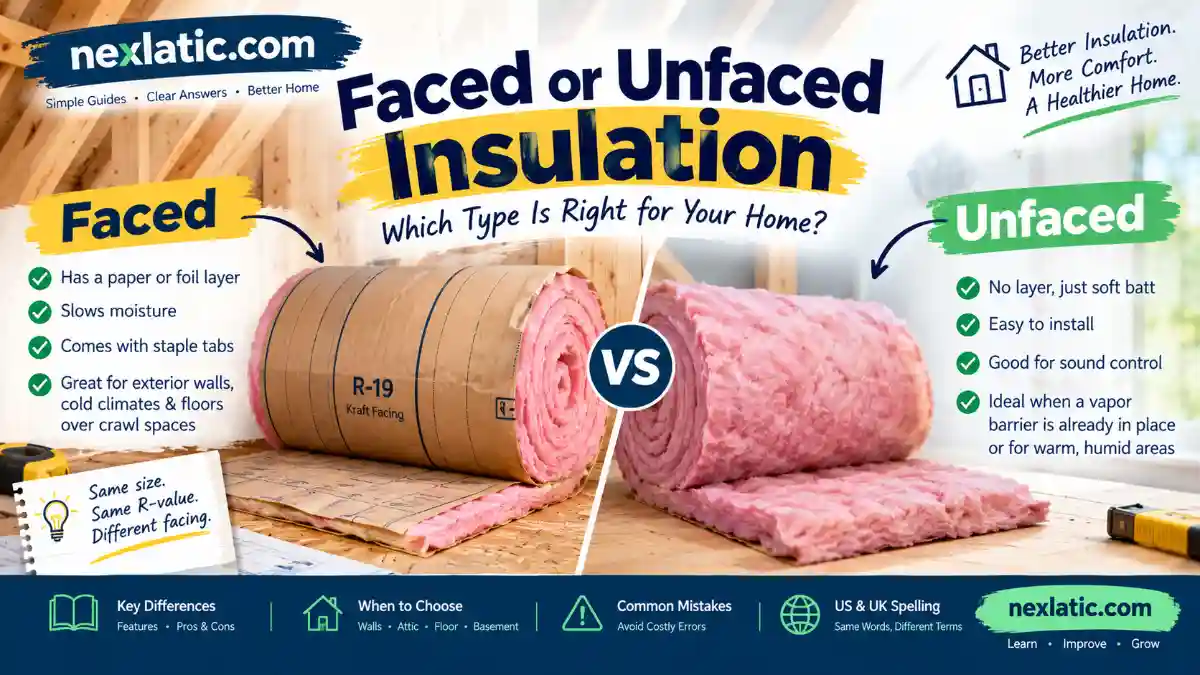
You stand in the hardware store. Two rolls of insulation sit side by side. One has a paper layer. The other does not. Which one do you buy?
Many people ask this each month. That is why “faced or unfaced insulation” is such a common search. The names sound simple, but the wrong pick can cause real trouble. It can trap water in your wall, waste your money, and even cause a building inspection to fail.
The confusion is easy to understand. Both types keep your home warm in winter and cool in summer. They come in the same sizes and offer the same R-value at the same thickness. So what is the difference? It is the facing. The facing is a thin layer of paper or foil on one side. It helps slow moisture.
This guide clears it up. You will get a quick answer first. Then you will learn the history, common mistakes, real examples, and a side-by-side table. By the end, you will know which type fits your wall, attic, floor, or basement.
Faced or Unfaced Insulation – Quick Answer
Faced insulation has a paper or foil layer on one side. The layer slows moisture. It also has flat tabs. You staple the tabs to the wall studs.
Unfaced insulation has no layer. It is a plain soft batt. You press it between studs, joists, or rafters.
Choose faced when:
- The wall needs a vapor retarder and has none.
- You are insulating exterior walls in a cold climate.
- You are insulating a floor over a crawl space.
Choose unfaced when:
- A vapor retarder is already in place.
- You are adding a second layer over old insulation.
- You are insulating inside walls to block sound.
- You live in a hot, humid place.
Example 1: You are insulating a bare outside wall in Minnesota. Pick faced.
Example 2: You are adding more insulation in an attic that already has some. Pick unfaced.
The Origin of Faced or Unfaced Insulation
The word “face” comes from the Latin word facies. It reached English through Old French. It means the front or surface of a thing. So “faced” means “has a front layer.” The prefix “un-” means “not.” So “unfaced” means “has no front layer.”
People have insulated homes for a very long time. Early builders used straw, sawdust, and wool. Later, makers built mineral wool and glass fiber. Fiberglass batts became common in homes in the mid-1900s.
Builders soon met two problems. First, batts were hard to hold in place. Second, warm indoor air carries moisture into walls. So makers glued a paper layer to one side. The paper gave builders tabs to staple. It also slowed moisture. Faced insulation became a standard product.
Unfaced insulation stayed on the shelf for jobs that did not need a facing. Today, stores sell both.
Why do spelling differences exist? The words “faced” and “unfaced” are spelled the same in every English-speaking country. The differences show up in nearby words, such as “fiberglass” and “vapor.” American English dropped extra letters over time. British English kept the older French-style spellings. You will see both in product names and guides.
British English vs American English Spelling
“Faced” and “unfaced” never change. But words around them do. Here is a simple guide.
| American English | British English | Meaning |
| Faced insulation | Faced insulation | Same in both |
| Unfaced insulation | Unfaced insulation | Same in both |
| Fiberglass | Fibreglass | Glass fiber used in batts |
| Vapor barrier | Vapour barrier | Layer that slows moisture |
| Gray | Grey | A common batt color |
| Attic | Loft | Space under the roof |
| Insulation batt | Insulation roll / quilt | Soft blanket of insulation |
Spelling rule: American English often uses “-or” and “-er.” British English often uses “-our” and “-re.” So “vapor” becomes “vapour,” and “fiber” becomes “fibre.”
Tip: In the UK, people often say “loft insulation” instead of “attic insulation.” They also use “mineral wool” and “glass wool” often.
Which Spelling Should You Use?
Match the spelling to your reader.
- United States: Write “fiberglass” and “vapor barrier.” Use “faced or unfaced insulation.”
- Canada: Both styles appear. Many writers use “fibreglass” and “vapour barrier.” Match your audience.
- UK, Ireland, Australia, and New Zealand: Write “fibreglass” and “vapour barrier.” Say “loft” where it fits.
- Global readers: American spelling is the most common online. It is a safe choice. Or pick one style and keep it.
Rule of thumb: Do not mix styles in one article. Pick one and stay with it.
Common Mistakes with Faced or Unfaced Insulation
1. Using faced insulation in both layers.
Two facings can trap moisture between them. Use unfaced for the second layer.
2. Putting the facing on the wrong side.
In cold climates, the facing goes toward the warm side of the wall. That is usually the inside of the house.
3. Using faced insulation in hot, humid areas.
An inside facing can trap moisture there. Check local code first.
4. Leaving paper facing exposed.
Kraft paper can burn. If the insulation will stay visible, such as in a crawl space, use a fire-rated facing. Or cover it with drywall.
5. Thinking facing adds R-value.
It does not. Same thickness means same R-value.
6. Skipping air sealing.
Facing is not an air barrier. Seal gaps and cracks first.
7. Ignoring local code.
Rules change by region. Always check yours.
Faced or Unfaced Insulation in Everyday Examples
Email to a contractor:
“Hi Sam, should we use faced or unfaced insulation in the second-floor walls? They are inside walls, and we want less noise.”
(Good answer: unfaced.)
News or home blog:
“Experts say faced insulation works well in cold-climate outside walls. Unfaced is better for attic top-ups.”
Social media post:
“Finished the garage walls today. Used faced insulation. Stapling the tabs was slow, but it looks clean! #DIY #homeimprovement”
Store listing:
“R-13 Unfaced Fiberglass Batt. Fits 2×4 walls. Great for walls, floors, and attics.”
Formal writing (project plan):
“Exterior walls shall use kraft-faced batts. Attic upgrades shall use unfaced batts over existing insulation.”
Faced or Unfaced Insulation – Google Trends & Usage Data
I can’t pull live search numbers, so I won’t invent any. Here is what you can usually expect, and how to check it yourself.
By country:
- Interest is often highest in the United States and Canada. Paper-faced batts are very common there.
- Interest is often lower in the UK and Australia. People there tend to search “loft insulation” or “wall insulation.”
By context:
- Home owners search this for DIY jobs.
- Builders search it to compare products and check code.
- Shoppers often add an R-value, like “R-19 faced or unfaced.”
How to check: Open Google Trends. Type “faced or unfaced insulation.” Compare it with “faced insulation” and “unfaced insulation.” Filter by country and date to see real numbers.
Faced vs Unfaced Insulation – Side-by-Side Comparison
| Feature | Faced Insulation | Unfaced Insulation |
| Outer layer | Kraft paper or foil | None |
| Vapor retarder | Yes | No |
| R-value (same thickness) | Same | Same |
| Installation | Staple tabs to studs | Press-fit between studs |
| Best for | Exterior walls, floors, cold climates | Second layers, inside walls, hot-humid climates |
| Typical cost | Slightly higher | Usually lower |
| Fire note | Paper can burn if exposed | No paper, but cover per code |
| Sound control | Good | Good |
| Cutting | Slightly harder | Easier |
FAQs
1. What is the main difference between faced and unfaced insulation?
Faced insulation has a paper or foil layer that slows moisture. Unfaced insulation has no layer.
2. Which is better, faced or unfaced?
Neither wins every time. It depends on where you install it and your climate.
3. Which way does the facing go?
In cold climates, the facing goes toward the warm side of the house. That is usually the inside.
4. Can I use unfaced insulation in outside walls?
Yes, if the wall has a separate vapor retarder. That can be a special paint or a sheet layer. Local code may allow other options.
5. Should I use faced insulation in an attic?
Use faced for the first layer only if the attic needs a vapor retarder. For a second layer, use unfaced.
6. Does faced insulation have a higher R-value?
No. R-value depends on thickness and material, not facing.
7. Is faced insulation a fire risk?
Kraft paper can burn. Do not leave it exposed. Cover it with drywall or use a fire-rated facing.
8. What is best in a hot, humid climate?
Unfaced is often the better pick. An inside facing can trap moisture. Check local code.
Conclusion
Choosing between faced and unfaced insulation is easier than it looks. The only real difference is the facing. That thin layer slows moisture and gives you tabs to staple. It does not add R-value.
Here are the key points:
- Use faced insulation in outside walls, floors, and cold climates that need a vapor retarder.
- Use unfaced insulation for second layers, inside walls, sound control, and hot, humid places.
- Never stack two facings. They can trap moisture.
- In cold climates, face the paper toward the warm side.
- Cover exposed paper or use a fire-rated product.
- “Faced” and “unfaced” are spelled the same everywhere. Related words like “fiberglass” and “vapor” change by country.
- Always check your local building code before you buy.
When in doubt, ask a local contractor or your building office. A short chat can save you from a costly fix. Pick the right type once, and your home will stay comfortable for years.

Ali Bismal is the founder and writer behind Nexlatic.com, a growing online platform created to provide useful, informative, and easy-to-understand content for everyday readers. Through Nexlatic, Ali shares practical ideas, helpful guides, interesting topics, and engaging articles designed to make information simple and accessible. His goal is to create reliable, reader-focused content that helps people learn something new, find useful answers, and make everyday life a little easier.