You are studying cells. You see the word chloroplast. Then a question pops up: is it prokaryotic or eukaryotic?
You are not alone. Many students search for this every school term. The question sounds easy, but it is tricky. Chloroplasts look a lot like tiny bacteria. They have their own DNA. They can make copies of themselves. So many people guess they are prokaryotic. Others say they are eukaryotic because they live inside plant cells. Which side is right?
This article clears up the confusion. You will get a quick answer first. Then you will learn where the word comes from and how chloroplasts began. You will also see why people mix up these two terms. We will look at common mistakes, real-life examples, and answers to popular questions. Whether you are a student, a teacher, or just curious, this guide gives you the facts in plain words. Let’s start.
Chloroplast Prokaryotic or Eukaryotic – Quick Answer
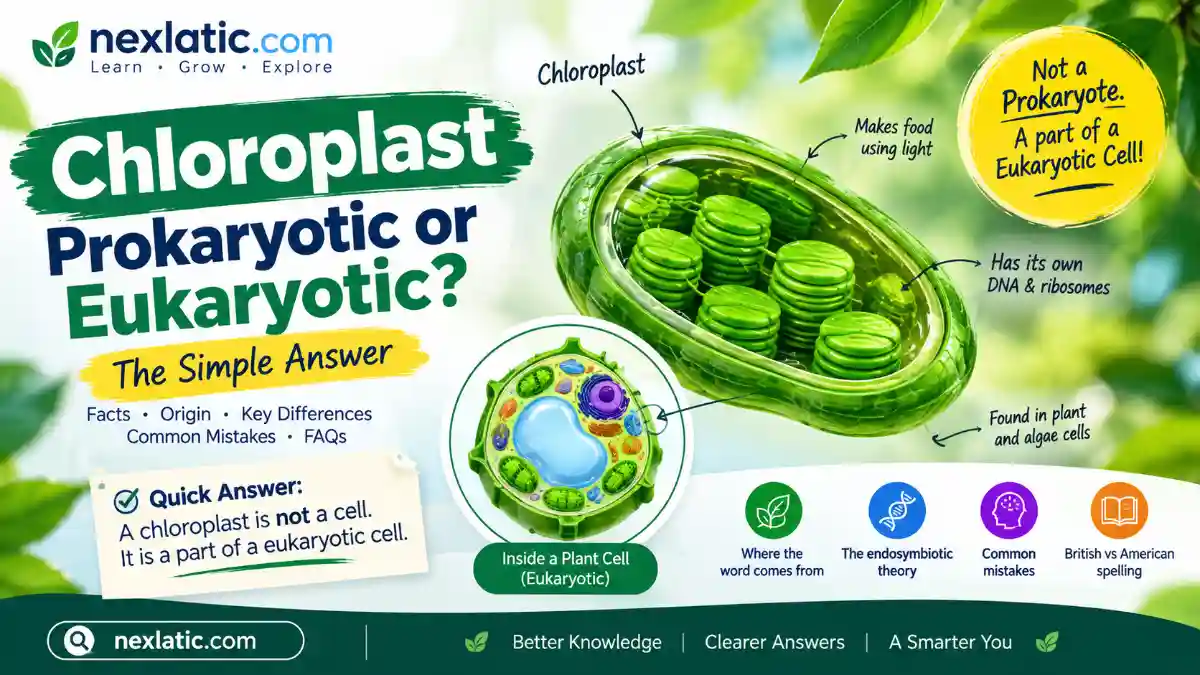
A chloroplast is not a cell. It is a part of a eukaryotic cell.
Here is the key idea. The words “prokaryotic” and “eukaryotic” describe whole cells. A chloroplast is a small part inside a cell. We call that kind of part an organelle.
So the best answer is this: chloroplasts are found in eukaryotic cells. You find them in plants and algae.
Some examples:
- A leaf cell from a rose has chloroplasts. It is a eukaryotic cell.
- A cell from green algae has chloroplasts. It is a eukaryotic cell.
- A bacterium has no chloroplasts. It is a prokaryotic cell.
One more fact helps. Long ago, chloroplasts came from free-living bacteria. That is why they act a bit like prokaryotes. But today, they are organelles inside eukaryotic cells.
The Origin of Chloroplast Prokaryotic or Eukaryotic
Where the words come from
These words come from Greek.
- Chloroplast: chloros means “green.” Plastos means “formed” or “shaped.” So a chloroplast is a “green shaped thing.”
- Prokaryotic: pro means “before.” Karyon means “kernel” or “nut,” which stands for the nucleus. So it means “before the nucleus.”
- Eukaryotic: eu means “true.” So it means “true nucleus.”
Prokaryotic cells have no nucleus. Eukaryotic cells do.
The history
In the 1800s, scientists saw green bodies inside plant cells. The name “chloroplast” came into use in 1883.
In 1905, a Russian scientist named Konstantin Mereschkowsky shared a bold idea. He said chloroplasts began as tiny living things that moved into bigger cells. Many people laughed at it.
Then, in 1967, biologist Lynn Margulis brought the idea back. Later, DNA tests backed it up. Today, it is called the endosymbiotic theory. It says an ancient cell swallowed a bacterium that could make food from light. Instead of eating it, the cell kept it. Over time, that bacterium became the chloroplast.
Why the confusion exists
The confusion comes from this history. A chloroplast has:
- Its own circular DNA, like bacteria
- Its own small ribosomes, like bacteria
- Two outer membranes
- The power to split and make more of itself
These bacteria-like traits make people ask if it is prokaryotic. The true answer: it came from a prokaryote, but it now lives as an organelle in a eukaryotic cell.
Why spelling differences exist
Good news: the word “chloroplast” has one spelling everywhere. But the words around it have changed over time. Older books wrote “procaryotic” and “eucaryotic” with a c. Modern science uses the k spelling, which comes from the Greek letter kappa.
British English vs American English Spelling
The keyword words are spelled the same in both kinds of English. Still, some words you will see nearby are different. Here is a quick look.
| Word | American English | British English | Notes |
| Chloroplast | chloroplast | chloroplast | Same |
| Prokaryotic | prokaryotic | prokaryotic | Same |
| Eukaryotic | eukaryotic | eukaryotic | Same |
| Old spelling | procaryotic / eucaryotic | procaryotic / eucaryotic | Rare today |
| Make food from light | photosynthesize | photosynthesise | -ize vs -ise |
| Study a sample | analyze | analyse | -yze vs -yse |
| Group of parts | organization | organisation | -ize vs -ise |
Simple rule: Americans use -ize. Britons often use -ise. The science words themselves stay the same.
Which Spelling Should You Use?
For the keyword words, you do not need to choose. They look the same in every country. Pick based on your reader for the words around them.
- US readers: Use photosynthesize, analyze, and organization.
- UK, Australia, India, and most Commonwealth readers: Use photosynthesise, analyse, and organisation. Note that some British science journals also accept -ize.
- A global audience: Pick one style and keep it the same through the whole text. Being steady matters most.
Always use the k spelling: prokaryotic and eukaryotic. Use procaryotic only if you quote an old book.
Common Mistakes with Chloroplast Prokaryotic or Eukaryotic
Mistake 1: “A chloroplast is a prokaryotic cell.”
Fix: A chloroplast is an organelle, not a cell. It sits inside eukaryotic cells.
Mistake 2: “Prokaryotes have chloroplasts.”
Fix: They do not. Bacteria like cyanobacteria make food from light, but they use pigments on their membranes. They have no chloroplasts.
Mistake 3: “Chloroplasts came from the nucleus.”
Fix: They came from ancient bacteria, not from the nucleus.
Mistake 4: “All eukaryotic cells have chloroplasts.”
Fix: Only plant cells and algae do. Animal and fungal cells do not.
Mistake 5: Mixing up chloroplasts and mitochondria.
Fix: Chloroplasts make food using light. Mitochondria release energy from food.
Mistake 6: Spelling it “choloroplast” or “chlorplast.”
Fix: The right spelling is chloroplast.
Chloroplast Prokaryotic or Eukaryotic in Everyday Examples
In an email from a student to a teacher:
“Hello Ms. Khan, is a chloroplast prokaryotic or eukaryotic? I am confused about my homework.”
In a school quiz:
“True or false: Chloroplasts are found in eukaryotic cells.”
Answer: True.
In a news story:
“Scientists studied how chloroplasts in eukaryotic algae adapt to low light.”
On social media:
“Mind blown. Chloroplasts used to be bacteria. Now they live inside plant cells!”
In formal writing:
“The chloroplast is a double-membrane organelle found in eukaryotic cells. It is thought to have come from a cyanobacterial ancestor.”
Chloroplast Prokaryotic or Eukaryotic – Google Trends & Usage Data
Search data for this keyword follows school life. Interest tends to rise when students study cell biology and prepare for exams. It tends to dip during long school breaks.
Here is what you can expect in general:
- By country: Interest is strong in English-speaking countries with large student groups, such as the United States, the United Kingdom, India, Pakistan, Canada, Australia, the Philippines, and Nigeria.
- By context: Most searches come from homework help, exam review, and online classes.
- Related searches: People also look up “chloroplast structure,” “chloroplast function,” “mitochondria prokaryotic or eukaryotic,” and “endosymbiotic theory.”
For exact numbers, open Google Trends and type in the keyword. You can compare countries, time ranges, and related searches. Check it from time to time, since search habits change.
Keyword variations side by side
| Search phrase | What the person wants | Best short answer |
| Chloroplast prokaryotic or eukaryotic | Which cell type has it | Eukaryotic |
| Is chloroplast prokaryotic | A yes or no | No, it is an organelle in eukaryotes |
| Is chloroplast eukaryotic | A yes or no | It lives in eukaryotic cells |
| Chloroplast eukaryote or prokaryote | Same question, other order | Eukaryote |
| Chloroplast vs mitochondria | A comparison | Both are organelles; one makes food, one releases energy |
| Do prokaryotes have chloroplasts | A yes or no | No |
FAQs
1. Is a chloroplast prokaryotic or eukaryotic?
It is neither as a cell, since it is an organelle. It is found in eukaryotic cells.
2. Do prokaryotic cells have chloroplasts?
No. Prokaryotic cells have no membrane-bound organelles.
3. Why do chloroplasts have their own DNA?
They came from ancient bacteria. They kept some of their own DNA.
4. What is the endosymbiotic theory?
It says a large cell swallowed a small bacterium, and the two began to live together. The small one became an organelle.
5. Which cells have chloroplasts?
Plant cells and algae cells. Animal cells and fungal cells do not.
6. What do chloroplasts do?
They use sunlight, water, and carbon dioxide to make sugar and oxygen. This is called photosynthesis.
7. Are mitochondria also prokaryotic or eukaryotic?
Like chloroplasts, mitochondria are organelles in eukaryotic cells. They also came from ancient bacteria.
8. Is the spelling different in British and American English?
No. “Chloroplast,” “prokaryotic,” and “eukaryotic” are spelled the same.
Conclusion
Let’s sum it up. The question “chloroplast prokaryotic or eukaryotic” has a clear answer. A chloroplast is not a cell. It is an organelle. It lives inside eukaryotic cells, such as plant and algae cells.
The mix-up happens for a good reason. Chloroplasts began as free-living bacteria long ago. They still keep bacteria-like traits, such as their own circular DNA and small ribosomes. But today they are part of a bigger eukaryotic cell.
Remember these key points:
- “Prokaryotic” and “eukaryotic” describe whole cells.
- Chloroplasts are found only in plants and algae.
- Prokaryotes have no chloroplasts.
- The spelling is the same in British and American English.
- Use the k spelling: prokaryotic and eukaryotic.
When you write about this topic, keep your spelling style steady. Use -ize or -ise the same way throughout. If you are ever unsure, say it simply: “Chloroplasts are organelles in eukaryotic cells.” That sentence is correct, clear, and easy to remember.

Ali Bismal is the founder and writer behind Nexlatic.com, a growing online platform created to provide useful, informative, and easy-to-understand content for everyday readers. Through Nexlatic, Ali shares practical ideas, helpful guides, interesting topics, and engaging articles designed to make information simple and accessible. His goal is to create reliable, reader-focused content that helps people learn something new, find useful answers, and make everyday life a little easier.