Is endocytosis passive or active? Students type this question into Google every day. It sounds easy, but the answer trips up many people.
Here is why. Some transport in cells needs no energy. Some needs a lot. Endocytosis looks like it just “happens.” The cell membrane folds in and pulls things inside. It seems effortless, so people guess it is passive.
That guess is wrong. Endocytosis is active transport. The cell must spend energy to do it.
This article clears up the confusion. You will get the quick answer first. Then you will learn how endocytosis works, why it needs energy, and how it differs from other types of transport. You will also see common mistakes, real examples, and a short FAQ.
If you are studying for a biology test, this guide is for you. If you are a teacher, a parent, or just curious, it is for you too. Let’s make it simple.
Endocytosis Passive or Active – Quick Answer
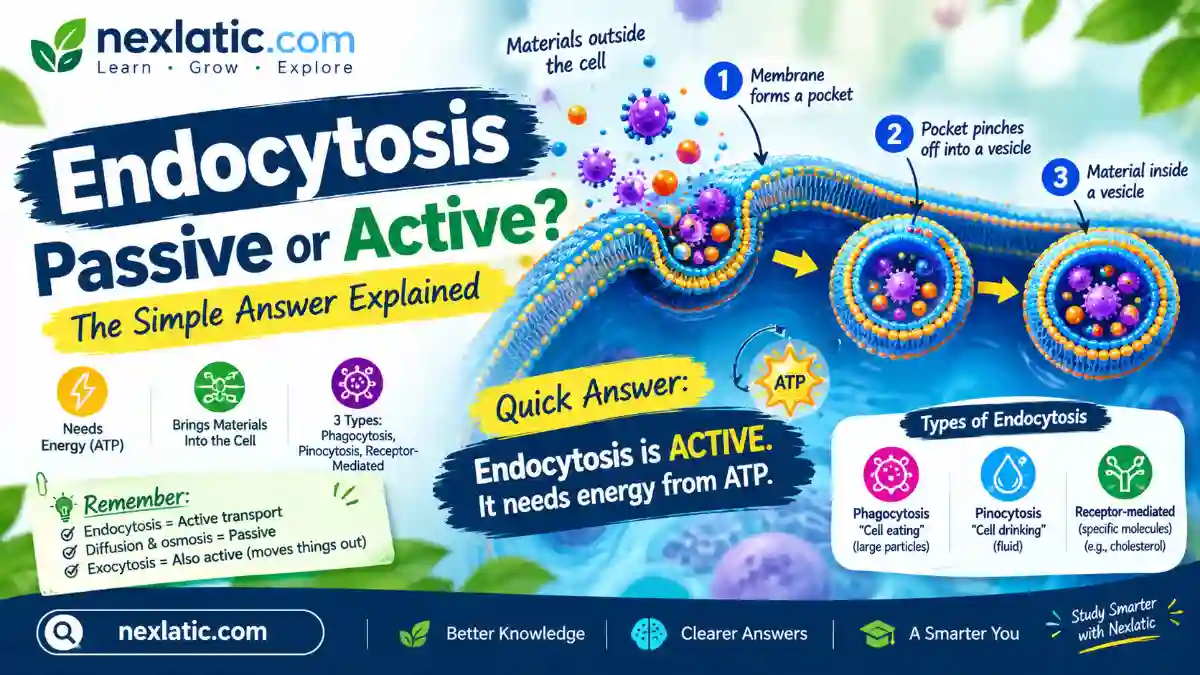
Endocytosis is active. It needs energy from the cell. That energy comes from ATP.
Why does it need energy? The cell must bend its membrane. It must form a pocket. It must pinch that pocket off into a small bubble called a vesicle. All of that is hard work.
Here are three types of endocytosis:
- Phagocytosis – “cell eating.” The cell swallows large particles. A white blood cell eating a germ is one example.
- Pinocytosis – “cell drinking.” The cell takes in drops of fluid.
- Receptor-mediated endocytosis – The cell takes in specific items. Cholesterol enters cells this way.
Remember this: passive transport needs no energy. Endocytosis does. So it is active.
The Origin of Endocytosis
The word comes from Greek. It has three parts:
- endo means “inside”
- kytos means “cell” or “hollow vessel”
- -osis means “process”
So endocytosis means “the process of going into the cell.”
A scientist named Christian de Duve coined the term in 1963. He later won a Nobel Prize for his work on cell structure. Before that, scientists already saw cells swallow particles. Élie Metchnikoff described phagocytosis in the 1880s. He watched cells eat tiny objects under a microscope.
Spelling is not an issue with this word. It is a scientific term, and science keeps the same Greek roots in every country. Confusion comes from the idea, not the spelling. People mix up “passive or active” because the process looks smooth and natural.
British English vs American English Spelling
Good news: “endocytosis” is spelled the same in British and American English. Nothing changes.
Other words in biology do change. Look at this table.
| Term | American English | British English |
| Cell process | Endocytosis | Endocytosis |
| Opposite process | Exocytosis | Exocytosis |
| Blood protein | Hemoglobin | Haemoglobin |
| Food pipe | Esophagus | Oesophagus |
| Fat | Fetus-related: Fetal | Foetal |
| Body fluid study | Edema | Oedema |
| Unit of length | Micrometer | Micrometre |
The pattern is simple. British English often keeps “ae” and “oe.” American English often uses “e.” But scientific words like endocytosis stay the same.
Which Spelling Should You Use?
For this keyword, use “endocytosis.” There is only one correct spelling.
Here is advice by audience:
- US readers: Use American spelling for nearby words, such as “hemoglobin” and “micrometer.”
- UK and Commonwealth readers: Use British spelling for nearby words, such as “haemoglobin” and “micrometre.”
- Global readers: Pick one style and stay with it. Do not mix styles in one article.
If you are writing for exams, follow your exam board. Most boards accept both styles. They want consistency.
Common Mistakes with Endocytosis
Mistake 1: Calling endocytosis passive.
Wrong: “Endocytosis is passive because things just flow in.”
Right: Endocytosis is active. It uses ATP.
Mistake 2: Mixing up endocytosis and exocytosis.
Endocytosis brings things in. Exocytosis sends things out. Both need energy.
Mistake 3: Thinking it is the same as diffusion.
Diffusion moves tiny molecules down a gradient. It needs no energy. Endocytosis moves big items using vesicles.
Mistake 4: Misspelling the word.
Common errors include “endocitosis,” “endocytocis,” and “endosytosis.” The right spelling is e-n-d-o-c-y-t-o-s-i-s.
Mistake 5: Saying only large things use endocytosis.
Cells also use it for fluids and for specific molecules. Size is not the only rule.
Endocytosis in Everyday Examples
You may not use this word daily. But you may see it in many places.
In an email (teacher to student):
“Please review endocytosis before Friday. Remember, it is active transport.”
In the news:
“Researchers study how viruses use endocytosis to enter human cells.”
On social media:
“Reminder for my bio students: endocytosis is ACTIVE, not passive. It needs ATP! 🧬”
In formal writing:
“Receptor-mediated endocytosis is an energy-dependent process. It allows cells to import specific molecules.”
Notice how the meaning stays the same. Only the tone changes.
Endocytosis Passive or Active – Google Trends and Usage Data
I can’t pull live Google Trends numbers here, so I won’t invent any. Check Google Trends for exact, current figures. Here is the general pattern for this type of keyword.
- When people search: Searches usually rise during school terms and exam seasons. They often drop during long holidays.
- Who searches: Interest tends to be strong in countries with many biology students. These include India, Pakistan, the Philippines, Nigeria, the United States, and the United Kingdom.
- Why they search: Most people want a quick yes-or-no answer. Many want a simple way to remember it for a test.
- Related searches: People also look up “exocytosis,” “active vs passive transport,” and “types of endocytosis.”
To check the data yourself, type the keyword into Google Trends. Compare it with “active transport” and “passive transport.” Then filter by country and date.
Comparison Table: Endocytosis vs Related Terms
| Term | Active or Passive? | Energy Needed? | What It Does | Example |
| Endocytosis | Active | Yes (ATP) | Brings materials into the cell | White blood cell eats a germ |
| Exocytosis | Active | Yes (ATP) | Sends materials out of the cell | Cell releases insulin |
| Diffusion | Passive | No | Moves small molecules down a gradient | Oxygen entering a cell |
| Osmosis | Passive | No | Moves water across a membrane | Water entering root cells |
| Facilitated diffusion | Passive | No | Uses protein channels | Glucose moving through a channel |
| Active transport (pumps) | Active | Yes (ATP) | Moves ions against a gradient | Sodium-potassium pump |
FAQs
1. Is endocytosis passive or active?
It is active. The cell uses ATP to form vesicles and bring materials inside.
2. Why does endocytosis need energy?
The cell must bend its membrane, form a pocket, and pinch it off. Proteins do this work, and they need ATP.
3. What are the three types of endocytosis?
They are phagocytosis, pinocytosis, and receptor-mediated endocytosis.
4. Is exocytosis active or passive?
Exocytosis is also active. It uses energy to push materials out of the cell.
5. What is the difference between endocytosis and diffusion?
Diffusion is passive and moves small molecules. Endocytosis is active and uses vesicles to move larger items.
6. Can a cell survive without endocytosis?
Not well. Cells need it to take in nutrients, defend against germs, and manage their membranes.
7. Does endocytosis happen in plant cells?
Yes. It is harder because of the cell wall, but plant cells do use endocytosis.
8. Is there a UK and US spelling difference for endocytosis?
No. Both use the same spelling: endocytosis.
Conclusion
Let’s sum it up. Endocytosis is active. It is not passive. The cell spends ATP to fold its membrane, make a vesicle, and pull materials inside.
Many people get this wrong because the process looks smooth. But looks can fool you. The cell is working hard.
Here are the key points to remember:
- Endocytosis is active transport.
- It has three main types: phagocytosis, pinocytosis, and receptor-mediated endocytosis.
- Exocytosis is also active, but it moves things out.
- Diffusion and osmosis are passive. They need no energy.
- The spelling is the same in British and American English.
Here is a trick for tests. Ask one question: “Does the cell build a vesicle?” If yes, it uses energy. If it uses energy, it is active.
Use this guide as a quick review. Share it with a classmate. And next time someone asks, “Endocytosis passive or active?” you will know the answer right away.

Ali Bismal is the founder and writer behind Nexlatic.com, a growing online platform created to provide useful, informative, and easy-to-understand content for everyday readers. Through Nexlatic, Ali shares practical ideas, helpful guides, interesting topics, and engaging articles designed to make information simple and accessible. His goal is to create reliable, reader-focused content that helps people learn something new, find useful answers, and make everyday life a little easier.