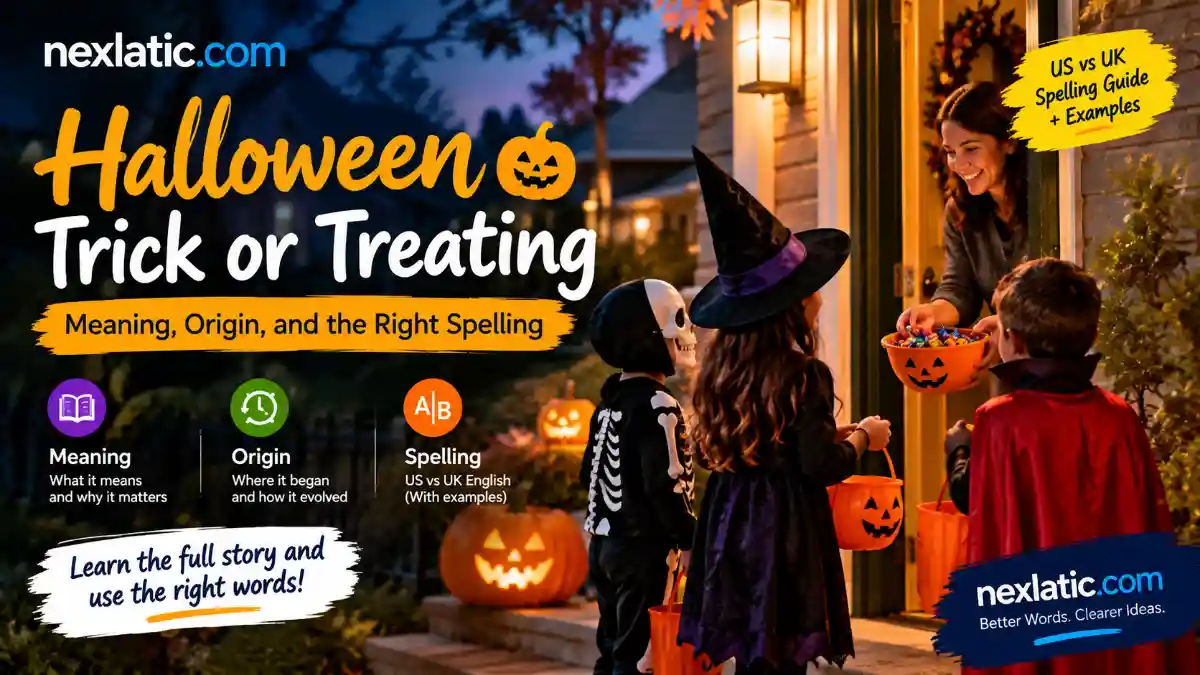
Every October 31, kids knock on doors, hold out bags, and shout the same words. But how do you write them? Is it “trick or treating” or “trick-or-treating”? Is it “trick or treat” or “trick or treats”?
Millions of people search for Halloween trick or treating every year. Some want the meaning. Some want the history. Others just need the right spelling for a school flyer, a blog post, or a text to a neighbor.
The confusion is real. English has no strict rule here. Dictionaries, news sites, and style guides do not always agree. In parts of the UK, some people say “guising” instead.
This guide clears it up fast. You get a short answer first. Then you learn where the words came from, how US and UK writing differ, and which form to use. You will also see real examples, common mistakes, and answers to the top questions.
Let’s start.
Halloween Trick or Treating – Quick Answer
Halloween trick or treating is a custom where children dress up on October 31 and go door to door. They say “trick or treat!” and neighbors give them candy.
- Trick or treat is what kids say. It is a phrase.
- Trick-or-treating is the activity. It is a noun or verb.
- Trick-or-treater is the person doing it.
Examples:
- “The kids shouted, ‘Trick or treat!'”
- “We go trick-or-treating at 6 p.m.”
- “Every trick-or-treater got a chocolate bar.”
Most style guides prefer the hyphenated form for the activity: trick-or-treating. But “trick or treating” without hyphens is very common online, so you will see both.
The Origin of Halloween Trick or Treating
Halloween comes from “All Hallows’ Eve.” That is the night before All Saints’ Day (November 1). Over time, “All Hallows’ Eve” got shorter and became “Hallowe’en,” then “Halloween.”
The custom has old roots:
- Samhain: An ancient Celtic festival in Ireland and Scotland. People wore costumes to scare away spirits.
- Souling: In medieval Britain and Ireland, poor people went door to door on All Souls’ Day. They sang prayers for the dead and got “soul cakes.”
- Guising: In Scotland and Ireland, children dressed up and performed a song, joke, or poem for treats.
Irish and Scottish families brought these customs to North America in the 1800s. By the 1920s and 1930s, “trick or treat” appeared in print in the US and Canada. It became popular after World War II, when candy was easy to buy again.
Why do spelling differences exist? The phrase grew out of speech, not rules. People said it long before anyone agreed how to write it. Hyphens in English often come and go over time. Also, “Hallowe’en” with an apostrophe was common in older British writing. Today most people drop it.
British English vs American English Spelling
Good news: there is no big spelling split for this phrase. “Trick or treat” is the same in both. The differences are small and about style, not grammar.
| Feature | American English | British English |
| Phrase kids say | Trick or treat | Trick or treat |
| The activity | Trick-or-treating | Trick-or-treating (or “trick or treating”) |
| Person | Trick-or-treater | Trick-or-treater |
| Holiday name | Halloween | Halloween (older: Hallowe’en) |
| Other local word | None common | Guising (Scotland), souling (England) |
| Hyphen use | Usually hyphenated | Hyphens used less often |
| Candy word | Candy | Sweets |
Notice the last row. The biggest difference is not spelling. It is vocabulary. Americans say “candy.” Brits say “sweets.”
Which Spelling Should You Use?
Pick based on your reader.
US readers: Use trick-or-treating with hyphens. Use “candy.” This is the safest choice for blogs, schools, and news.
UK and Commonwealth readers: Use trick-or-treating. Both hyphenated and unhyphenated forms are accepted, so stay consistent. Use “sweets” if it fits. In Scotland, you may mention “guising.”
Global audience: Use trick-or-treating and say “candy or sweets” once. It works everywhere.
Pro tip: Pick one form and use it the whole way through. Changing back and forth looks careless. For SEO, you can use the unhyphenated phrase once in a heading or in the first paragraph, since many people search that way.
Common Mistakes with Halloween Trick or Treating
| Mistake | Correct form | Why |
| Trick or treats | Trick or treat | The phrase stays singular |
| Tricker treating | Trick-or-treating | Wrong word |
| Trick or treater | Trick-or-treater | Hyphens join the noun |
| Trick-or-Treating (capitals) | trick-or-treating | It is not a proper noun |
| Halloween’s trick or treating | Halloween trick-or-treating | No apostrophe needed |
| Trick and treat | Trick or treat | It is “or,” not “and” |
| Hallowe’en (in US writing) | Halloween | Old British style |
A quick rule: if it is something kids say, keep it as three separate words. If it is something people do, add hyphens.
Halloween Trick or Treating in Everyday Examples
Email:
“Hi neighbors, trick-or-treating starts at 5 p.m. on Friday. Please leave your porch light on.”
News headline:
“Police Share Safety Tips for Halloween Trick-or-Treating”
Social media:
“Best part of Halloween trick or treating? Sorting the candy after. 🎃 #halloween”
Formal writing:
“The city council has set trick-or-treating hours from 4 p.m. to 8 p.m.”
School notice:
“Students may wear costumes. Trick-or-treating is not allowed on school grounds.”
UK example:
“The kids are off trick-or-treating, and I’m in charge of the sweets.”
Social media is relaxed, so hyphens often disappear there. For anything formal, keep them.
Halloween Trick or Treating – Google Trends & Usage Data
Search interest in this topic follows a clear pattern. It is very low most of the year. It starts to rise in early October and peaks in the last week of October, right before Halloween. Then it drops fast on November 1.
By country:
- United States and Canada: Highest interest. Trick-or-treating is a major tradition. People search for hours, safety tips, and ideas.
- United Kingdom and Ireland: Strong interest, and growing over the past decades. People often search for meaning and history, plus words like “guising.”
- Australia and New Zealand: Moderate interest. Many people ask if the custom is “American.”
- Other countries: Smaller but rising, often linked to costumes and parties.
By context:
- Parents search for safety, timing, and costume ideas.
- Students and writers search for spelling and meaning.
- Bloggers and teachers search for history and origin.
For the latest numbers, check Google Trends yourself. Compare “trick or treating,” “trick-or-treating,” and “trick or treat” over the past five years. The pattern repeats each year, but the exact levels change.
Keyword Variations Side by Side
| Variation | Type | Best use | Example |
| Trick or treat | Phrase | What kids say | “Trick or treat!” |
| Trick-or-treat | Verb/adjective | Describing the act | “They trick-or-treat every year.” |
| Trick-or-treating | Noun/verb (hyphenated) | Formal and news writing | “Trick-or-treating ends at 8.” |
| Trick or treating | Noun/verb (no hyphens) | Casual, social, and search | “Trick or treating was fun.” |
| Trick-or-treater | Noun | The person | “A tiny trick-or-treater knocked.” |
| Halloween trick or treating | Search phrase | Titles, SEO | “Halloween trick or treating tips” |
| Guising | Regional noun | Scotland and Ireland | “We went guising as kids.” |
FAQs
1. Is it “trick or treating” or “trick-or-treating”?
Both appear, but trick-or-treating with hyphens is the preferred form in most style guides. The unhyphenated form is common in casual writing.
2. What does trick or treat mean?
It is a playful threat. The child says “trick or treat.” The adult gives a treat, or the child might play a trick. Today, the trick almost never happens.
3. Where did trick or treating start?
It grew from old Celtic, Irish, and Scottish customs like Samhain, souling, and guising. It became popular in North America in the early 1900s.
4. Is trick or treating only American?
No. It is most popular in the US and Canada. But it is now common in the UK, Ireland, Australia, and other countries.
5. What is the difference between guising and trick or treating?
Guising is the older Scottish and Irish custom. Children perform a song, joke, or poem to earn a treat. Trick or treating only needs the phrase.
6. Is “Halloween” always capitalized?
Yes. It is the name of a holiday. But “trick-or-treating” is not capitalized unless it starts a sentence.
7. What age is trick or treating for?
There is no fixed age. Many families say it suits young children best, and many communities welcome teens too. Local customs differ.
8. What is the plural of trick-or-treater?
Add an “s”: trick-or-treaters.
Conclusion
Halloween trick or treating is simple fun, but the writing can feel tricky. Here are the key points to remember.
“Trick or treat” is what kids say. “Trick-or-treating” is what they do. Use hyphens for the activity in formal writing. Casual posts may skip them, and that is fine.
American and British English agree on most of it. The real difference is in word choice, like “candy” and “sweets,” and local words like “guising.”
The custom comes from old Celtic and Christian traditions. It grew in North America and then spread across the world.
Avoid common slips. Do not write “trick or treats.” Do not capitalize “trick-or-treating.” Keep the same form throughout the article.
When in doubt, pick trick-or-treating, keep it consistent, and think about your reader. If your readers are in the US, use “candy.” For UK readers, use “sweets.” For a global audience, mention both terms.
Now you can write it with confidence. Happy Halloween!

Ali Bismal is the founder and writer behind Nexlatic.com, a growing online platform created to provide useful, informative, and easy-to-understand content for everyday readers. Through Nexlatic, Ali shares practical ideas, helpful guides, interesting topics, and engaging articles designed to make information simple and accessible. His goal is to create reliable, reader-focused content that helps people learn something new, find useful answers, and make everyday life a little easier.