You typed “faught” and your spellchecker underlined it in red. Now you are unsure. Is it faught or fought? You are not alone this is one of the most common spelling traps in English, and even strong writers fall into it.
People search for this keyword because “faught” looks right. It follows the pattern of taught, caught, and bought. Your brain sees the pattern and fills in the wrong vowel. Students writing essays, job seekers polishing resumes, and non-native speakers all hit the same wall. That is exactly why the confusion exists.
This article solves it once and for all. You will learn which spelling is correct, why the wrong one feels so natural, and how to never mix them up again. No grammar jargon, no long lectures just a clear answer with proof. By the end, you will write “fought” with full confidence in emails, essays, and everyday messages.
Faught or Fought – Quick Answer
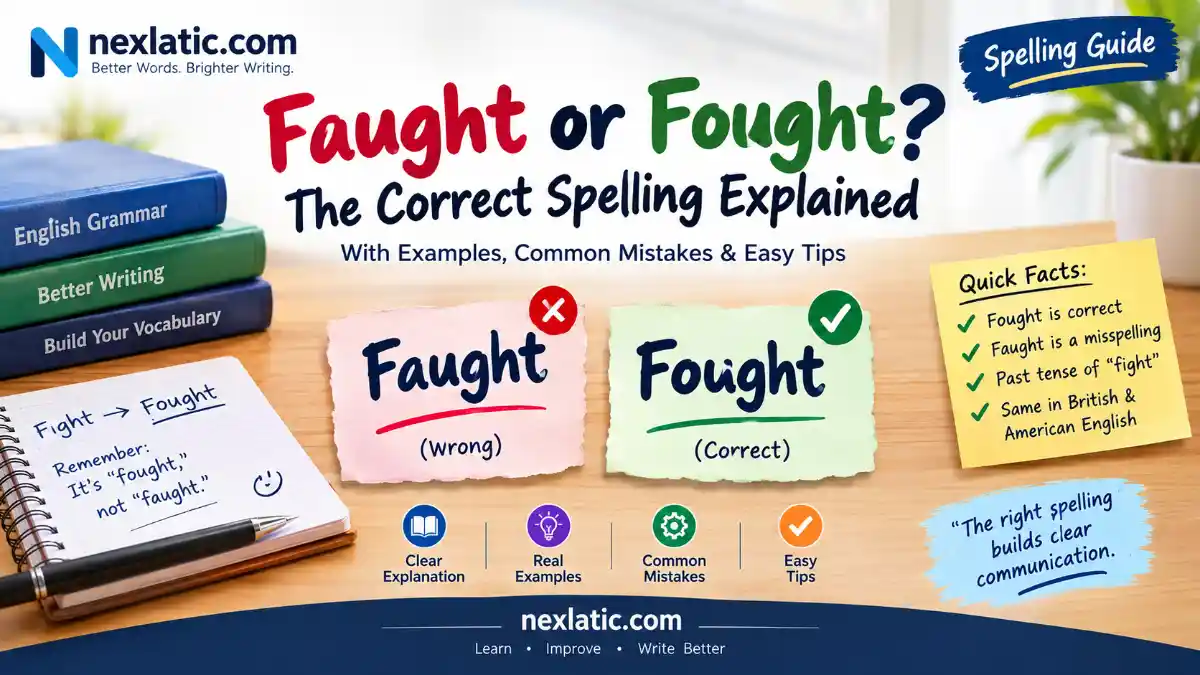
Fought is correct. Faught is a misspelling and is not a word in standard English.
Fought is the past tense of the verb “fight.” Use it every time you talk about a fight that already happened.
- Correct: “They fought bravely in the final match.”
- Correct: “She fought for her rights.”
- Correct: “We have fought many battles together.” (past participle)
- Wrong: “They faught bravely.” (Never use this.)
The Origin of Faught or Fought
The verb “fight” comes from the Old English word “feohtan,” which meant to fight or to struggle. Its past tense developed over centuries into the Middle English “foughte,” and finally the modern “fought.”
So why does “faught” feel right? Because English has a whole family of “-aught” words: taught (from teach), caught (from catch), and bought (from buy). Your brain applies that pattern to “fight” and produces “faught.” It is a logical guess but English irregular verbs do not all follow the same pattern, and “fight” belongs to the “-ought” family instead.
The “-ought” family is actually quite big. Think of “thought” (from think), “bought” (from buy), and “brought” (from bring). All of them shifted their vowel to “ou” in the past tense. “Fight” simply joined this group centuries ago and never left. Once you see “fought” sitting beside “thought” and “bought,” the spelling starts to feel natural instead of strange.
British English vs American English Spelling
There is no difference here. Fought is the standard spelling in both British and American English. “Faught” is wrong in every variety of English.
| Point | British English | American English |
| Correct past tense of “fight” | fought | fought |
| Is “faught” accepted? | No | No |
| Example | “They fought hard.” | “They fought hard.” |
Unlike words such as “colour/color” or “organise/organize,” this pair has no regional split. The answer is the same worldwide.
Which Spelling Should You Use?
Always use “fought” no matter who your audience is.
- US audience: Write “fought.” Every American dictionary lists only “fought.”
- UK/Commonwealth audience: Write “fought.” British dictionaries agree completely.
- Global/international writing: Write “fought.” It is the single global standard.
There is no context formal or casual, American or British where “faught” is correct. If you see “faught” in print, it is a typo.
Common Mistakes with Faught or Fought
- Writing “faught” by analogy. People copy the pattern of “taught” and “caught.” Fix: remember that “fight” pairs with “fought,” not “faught.”
- Writing “fighted.” Some learners add “-ed” to make the past tense. Fix: “fight” is irregular the past tense is “fought,” never “fighted.”
- Mixing up “fought” and “thought.” They look similar. Fix: “thought” comes from “think,” and “fought” comes from “fight.” Check which verb you mean.
- Trusting autocorrect blindly. Some keyboards accept odd spellings. Fix: if in doubt, check a dictionary “faught” will not be there.
- Using “fought” as a noun. “Fought” is only a verb form. Fix: do not write “the fought was long” write “the fight was long” or “the battle was long.”
Faught or Fought in Everyday Examples
Email (work):
“Our team fought hard to meet the deadline, and we delivered on time.”
“He fought the urge to reply angrily and wrote a calm response instead.”
News:
“The two boxers fought twelve rounds before the judges announced the winner.”
“Firefighters fought the blaze for six hours before bringing it under control.”
Social media:
“She fought through every injury this season. What a champion!”
“They fought for this win all season nobody can take it from them.”
Formal writing:
“The nations fought for independence, and their struggle shaped the country’s future.”
“The lawyer fought the case with skill, and the jury ruled in her favor.”
In every case, the spelling is “fought.” Notice how natural it looks once you stop second-guessing it.
Faught or Fought – Google Trends & Usage Data
I did not pull live Google Trends data for this article, so I will not invent country rankings or search spikes. Here is what is solid and verifiable: “fought” is the only form listed in every major dictionary (Oxford, Cambridge, Merriam-Webster), and “faught” appears in published books and corpora only as a rare typo.
In practical terms, searches for “faught or fought” come from writers double-checking a spelling doubt students, job seekers, and non-native speakers. The intent is simple: confirm the right form fast. That is why the quick answer (“fought”) matters most, and why every style guide on both sides of the Atlantic gives the same answer.
Faught vs Fought Side-by-Side Comparison
| Feature | Faught | Fought |
| Is it a real word? | No | Yes |
| Part of speech | Verb (past tense of “fight”) | |
| Correct usage | Never | “They fought well.” |
| British English | Wrong | Correct |
| American English | Wrong | Correct |
| Why people use it | Confusion with “taught/caught” | It is the true past tense |
FAQs
Is “faught” a word?
No. “Faught” is not listed in any standard English dictionary. It is a common misspelling of “fought.”
Why do so many people write “faught”?
Because of words like “taught” and “caught.” The brain copies the “-aught” pattern onto “fight,” but “fight” belongs to the “-ought” family instead.
What is the past tense of “fight”?
The past tense and the past participle of “fight” is “fought.” Example: “They fought yesterday” and “They have fought before.”
Is there a British vs American difference?
No. Both British and American English use “fought.” There is no regional variation for this word.
How can I remember the spelling?
Think “fight → fought,” and remind yourself it is the odd one out next to “taught” and “caught.” The “ou” stays from “fight” you just change the ending.
Can I use “faught” in Scrabble or formal writing?
No. It will be rejected in Scrabble and marked wrong in exams, resumes, and professional writing. Always write “fought.”
Is “fighted” ever correct?
No. “Fight” is an irregular verb, so “fighted” is also wrong. The only correct past form is “fought.”
Conclusion
The answer is simple and final: the correct spelling is “fought,” and “faught” is always a mistake. This confusion exists for a good reason English is full of “-aught” words like “taught” and “caught” that trick your brain into writing “faught.” But “fight” follows its own path, and its past tense has been “fought” since Middle English.
The good news is that there is nothing regional or complicated to memorize. British and American English agree completely, formal and casual writing agree completely, and every dictionary gives the same answer. You only need to remember one rule: fight becomes fought, every time, everywhere.
Next time your fingers want to type “faught,” pause and picture the word “fight” inside it the “ou” stays, the ending changes. Write “fought” with confidence in your emails, essays, posts, and reports. One small spelling, fixed forever, makes your writing look sharper and more professional. That is the whole battle and now you have already fought it and won.

Ali Bismal is the founder and writer behind Nexlatic.com, a growing online platform created to provide useful, informative, and easy-to-understand content for everyday readers. Through Nexlatic, Ali shares practical ideas, helpful guides, interesting topics, and engaging articles designed to make information simple and accessible. His goal is to create reliable, reader-focused content that helps people learn something new, find useful answers, and make everyday life a little easier.