You are writing a wedding story. You type “they stood at the alter.” Then you stop. Something looks wrong. Is it “altar” or “alter”?
People search for “Altar or Alter” because the two words sound exactly the same. Writers, students, and job seekers want to pick the right one. Using the wrong form can change the whole meaning of a sentence.
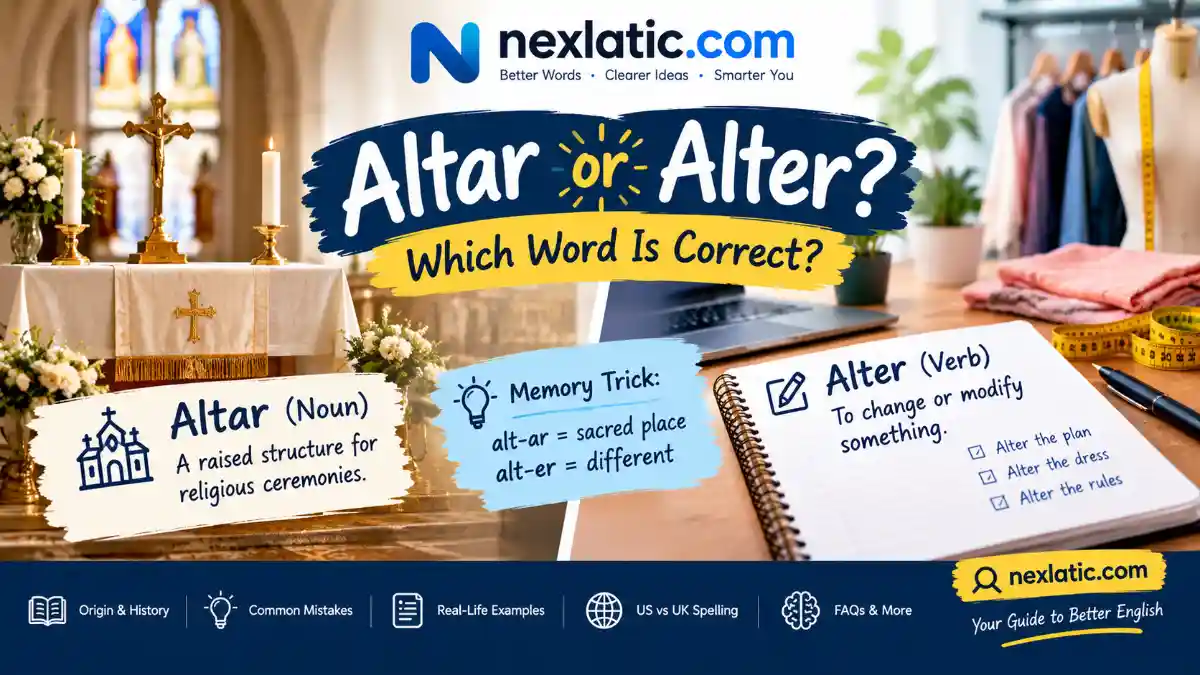
Here is the quick answer. Altar (noun) is a raised structure used for religious rites. Alter (verb) means to change or modify something.
This guide solves the confusion. You will learn the quick answer, the word origins, common mistakes, memory tricks, and real-life examples. By the end, you will always choose the right word.
Altar or Alter – Quick Answer
- Altar = noun. A table or platform for religious ceremonies.
- Alter = verb. To change or adjust something.
Examples:
- The couple stood at the altar. (noun: the structure)
- She had to alter the dress. (verb: to change it)
- Flowers covered the church altar. (noun)
- The new law will alter the rules. (verb)
The memory trick: alt-ar like the sacred place, alt-er like differ-ent.
The Origin of Altar or Alter
The two words come from different Latin roots. “Altar” comes from altus, meaning “high.” It describes a raised place for worship and sacrifice. “Alter” comes from alter, meaning “other.” It describes making something different.
The confusion exists because they are homophones. They sound the same but have different spellings and meanings. Only one letter differs, so writers mix them up in writing even though speech is never a problem.
The two words are never interchangeable. “Altar” is only ever a noun. “Alter” is a verb.
British English vs American English Spelling
There is no British vs American difference. Both regions use “altar” for the noun and “alter” for the verb. The confusion is about meaning, not spelling.
| Feature | Altar | Alter |
| Part of speech | Noun | Verb |
| Meaning | Religious structure | To change |
| Example | They met at the altar. | They altered the plan. |
| Used in US | Yes | Yes |
| Used in UK | Yes | Yes |
| Latin root | altus (high) | alter (other) |
| Sentence | Correct Word | Why |
| She left him at the __. | altar | Noun = the place |
| She __ her travel plans. | altered | Verb = changed |
| Flowers decorated the __. | altar | Noun = the structure |
| We must __ our approach. | alter | Verb = change |
Which Spelling Should You Use?
Writing for a US audience? Use “altar” for the religious structure and “alter” for change. Same rule everywhere.
Writing for a UK or Commonwealth audience? Same rule. There is no regional split.
Writing for a global audience? Follow the meaning. Place of worship = altar. To change = alter.
Formal writing? Be careful. Exams often test this pair. Remember: altar is a thing, alter is an action.
The simple test: ask if you mean a thing or an action. A thing you stand at = altar. An action of changing = alter.
Common Mistakes with Altar or Alter
Mistake 1: Writing “alter” for the church structure.
Wrong: “They married at the alter.”
Right: “They married at the altar.”
Mistake 2: Writing “altar” for the verb “change.”
Wrong: “We need to altar the schedule.”
Right: “We need to alter the schedule.”
Mistake 3: Using “altar” as a verb.
It cannot be a verb. “Altar” is strictly a noun.
Mistake 4: Thinking one form is always wrong.
Both are correct words. They just mean different things.
Mistake 5: Relying on spellcheck alone.
Spellcheck will not catch this. Both words are spelled correctly. Only meaning tells you which is right.
Altar or Alter in Everyday Examples
In emails:
“Please alter the meeting time.” (verb)
“The venue has a beautiful altar.” (noun)
In news:
“The council voted to alter the plan.” (verb)
“Ancient altar found at the site.” (noun)
In social media:
“Alter your mindset, change your life.” (verb)
“That wedding altar was stunning.” (noun)
In formal writing:
“The tailor altered the suit.” (verb)
“Offerings were placed on the altar.” (noun)
Altar or Alter – Google Trends & Usage Data
Exact Google Trends numbers change daily, so treat this as a general pattern, not measured data.
“Alter” gets more searches than “altar.” It is a common verb used in business, fashion, and tech. “Alter” also appears in phrases like “alter ego.”
“Altar” gets steady searches around wedding season and religious holidays. People look it up when writing about ceremonies.
“Altar vs alter” as a search pair spikes during exam seasons. Students in the US, UK, and India check it before tests. There is no country split in usage.
FAQs
What is the difference?
“Altar” is a noun meaning a religious structure. “Alter” is a verb meaning to change.
Are they homophones?
Yes. They sound the same but have different spellings and meanings.
Can “altar” be a verb?
No. “Altar” is strictly a noun and cannot be used as a verb.
How can I remember the difference?
Think alt-ar like the sacred place, and alt-er like differ-ent.
Is there a British vs American difference?
No. Both British and American English use the same forms with the same meanings.
What are the Latin roots?
“Altar” comes from altus (high). “Alter” comes from alter (other).
Which mistake is more common?
Writing “alter” when you mean the church structure. Always check: thing = altar, action = alter.
Conclusion
The “Altar or Alter” question is about meaning, not right vs wrong. Altar is the noun. It names the raised structure for worship. Alter is the verb. It means to change or modify.
The Latin roots explain the split. “Altar” comes from altus, meaning high. “Alter” comes from alter, meaning other. One letter changes the whole meaning.
For daily use, the test is simple. Do you mean a thing? Write “altar.” Do you mean an action? Write “alter.” The memory trick helps: alt-ar for the sacred place, alt-er for differ-ent.
Now you know the rule and the reason behind it. You will pick the right word every time.

David Wilson is a writer and contributor at Nexlatic.com, where he writes about useful topics, everyday questions, and practical ideas. He enjoys turning information into simple, clear, and easy-to-read articles that readers can actually use. Through his work at Nexlatic, David aims to share helpful content that answers common questions, explains confusing topics, and gives readers something useful to take away from every article.