You wrote “bolder” in a sentence about a rock, or “boulder” in a sentence about a brave decision, and something felt off. Welcome to one of English’s sneakiest homophone traps: bolder or boulder?
People search for this keyword because the two words sound exactly the same. Say them out loud: “bolder,” “boulder.” No difference. But their meanings are worlds apart: one describes courage, the other describes a giant stone. Students, professionals, and bloggers all hit this wall, because spellcheck stays silent when both words are real. Mixing them up can flip your whole sentence upside down.
This article clears it up fast. You will learn what each word means, where each one comes from, and a simple trick to never confuse them again. One quick test, and the doubt is gone for good. By the end, you will pick the right word every time, in texts, emails, essays, and anywhere else you write.
Bolder or Boulder – Quick Answer
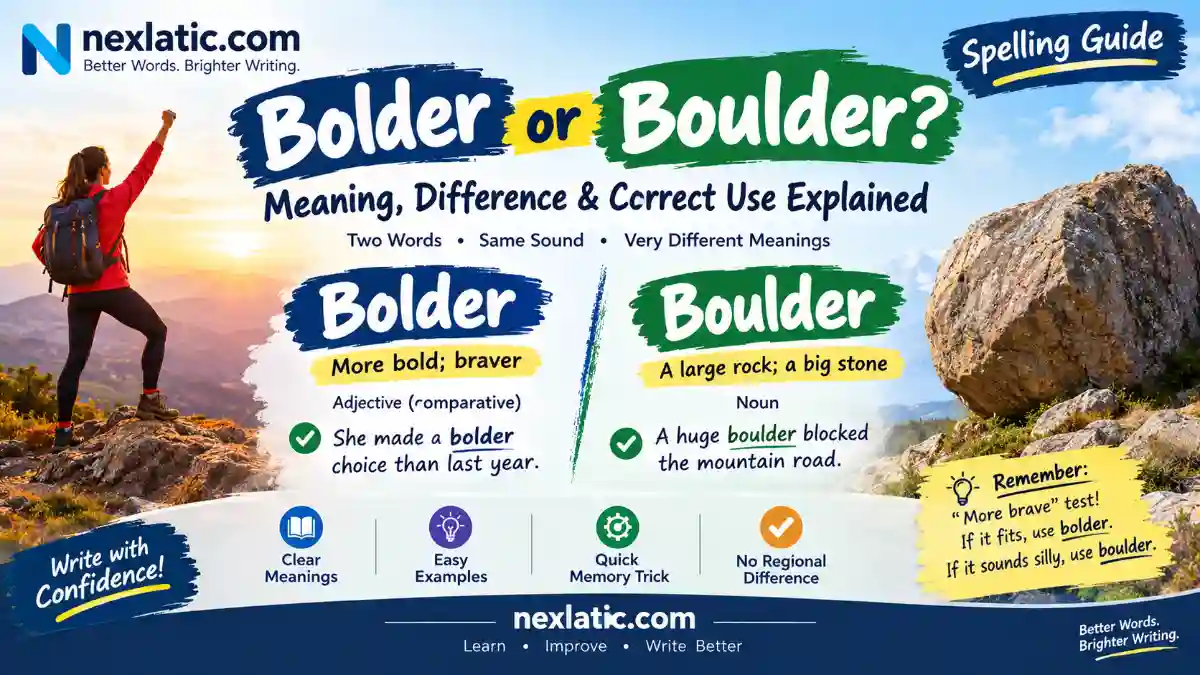
Bolder (with one “u” missing) means more bold: braver, more daring. It is the comparative form of the adjective “bold.”
Boulder (with “ou”) means a large rock: a big stone, often rounded by weather.
- Correct: “She made a bolder choice than last year.” (braver)
- Correct: “A huge boulder blocked the mountain road.” (rock)
- Wrong: “She made a boulder choice.” (Unless she chose a rock!)
The Origin of Bolder or Boulder
These two words come from completely different roots, which is why they only meet by accident of sound.
Boulder comes from the Middle English “bulderston,” meaning a large stone. It likely arrived through Scandinavian languages spoken by Viking settlers in England. For centuries it meant exactly what it means today: a big, rounded rock, often left behind by glaciers or found on hillsides.
Bolder is much simpler. It is just “bold” plus “-er.” “Bold” comes from the Old English “beald,” meaning brave or confident. Add the comparative ending and you get “bolder”: more bold. The same pattern gives us “colder” from “cold” and “older” from “old.”
The confusion exists for one reason only: over centuries of sound change, “bolder” and “boulder” ended up pronounced identically. English spelling kept their different histories, but our ears cannot tell them apart. That is why this pair traps even native speakers.
British English vs American English Spelling
Good news: there is no regional split here. Both words are spelled the same in British and American English.
| Point | British English | American English |
| “More bold” | bolder | boulder |
| “Large rock” | boulder | boulder |
| Pronunciation | identical | identical |
| Example | “a bolder plan” / “a huge boulder” | “a bolder plan” / “a huge boulder” |
Unlike “colour/color” or “travelling/traveling,” this pair never changes across regions. The only question is meaning, not geography.
Which Spelling Should You Use?
Choose based on meaning, not audience:
- Talking about courage or daring? Use bolder. “We need a bolder strategy.”
- Talking about rocks or stones? Use boulder. “The boulder rolled down the hill.”
- US audience: Same rule. “Bolder” for brave, “boulder” for rock.
- UK/Commonwealth audience: Same rule. No difference at all.
- Global writing: Same rule everywhere in the world.
Quick test before you hit send: replace the word with “more brave.” If the sentence still works, write “bolder.” If it sounds silly (“a more brave blocked the road”), you need “boulder.”
Common Mistakes with Bolder or Boulder
- Writing “boulder” for a brave act. “That was a boulder move” is wrong unless someone literally moved a rock. Fix: “That was a bolder move.”
- Writing “bolder” for a rock. “A bolder fell from the cliff” is wrong. Fix: “A boulder fell from the cliff.”
- Forgetting the comparative. Some writers use “more bold” every time. That is not wrong, but “bolder” is shorter and more natural. Fix: prefer “bolder” in most sentences.
- Trusting spellcheck alone. Both words are real, so no red underline appears. Fix: spellcheck cannot save you here, so check the meaning yourself with the “more brave” test.
- Mixing up “boulder” and “builder.” In fast typing, the words blur. Fix: slow down on this pair; one letter changes the whole meaning.
Bolder or Boulder in Everyday Examples
Email (work):
“Let’s take a bolder approach with this client. The safe plan is not working.”
“The site survey found a boulder near the foundation that must be removed.”
News:
“The mayor promised bolder action on housing before the next election.”
“Hikers were rescued after a boulder blocked the mountain trail.”
Social media:
“New year, bolder me. No more playing small!”
“Found this giant boulder on today’s hike. Nature is unreal!”
Formal writing:
“The committee adopted a bolder policy toward renewable energy.”
“Glacial boulders scattered across the valley show where the ice once reached.”
Read each pair back and feel the difference. “Bolder” always points to courage; “boulder” always points to stone.
Bolder or Boulder – Google Trends & Usage Data
I did not pull live Google Trends data for this article, so I will not invent country rankings or search spikes. What is verifiable: both words are standard in every major dictionary, and searches for “bolder or boulder” come from writers checking which homophone fits: students, professionals, and anyone burned by autocorrect before.
In real usage, “bolder” appears more in business, marketing, and motivational writing (“bolder decisions,” “bolder future”), while “boulder” dominates in travel, geography, and news about landslides or hiking. The search intent is always the same: tell the two apart in ten seconds. That is why the “more brave” test above is the most useful tool on this page.
Bolder vs Boulder: Side-by-Side Comparison
| Feature | Bolder | Boulder |
| Meaning | More bold; braver | A large rock or stone |
| Part of speech | Adjective (comparative) | Noun |
| Pronunciation | /ˈboʊldər/ | /ˈboʊldər/ (identical) |
| Example | “a bolder idea” | “a huge boulder” |
| British English | bolder | boulder |
| American English | bolder | boulder |
| Memory trick | “more brave” test works | “more brave” test fails |
FAQs
Are “bolder” and “boulder” pronounced the same?
Yes. In standard English they are perfect homophones. Both sound like “BOHL-der.” That is exactly why people mix them up in writing.
Which one means “brave”?
“Bolder” means more brave. It is the comparative of “bold”: bold → bolder → boldest. Example: “She grew bolder with each speech.”
Can “boulder” ever mean brave?
No. “Boulder” only means a large rock. If you write “a boulder decision,” readers will picture a stone, not courage.
Is there a UK vs US spelling difference?
No. Both words keep the same spelling in British and American English. The confusion is about meaning, never about region.
How do I remember which is which?
Use the “more brave” test. Swap in “more brave.” If the sentence still makes sense, write “bolder.” If it sounds silly, write “boulder.”
What is the superlative of “bold”?
“Boldest.” The full chain is bold (brave) → bolder (braver) → boldest (bravest). Example: “That was his boldest move yet.”
Do spellcheckers catch this mistake?
Usually not, because both are real words. This is a meaning error, not a spelling error. Only you (or a careful reader) can catch it.
Conclusion
“Bolder” and “boulder” sound identical but live in different worlds. “Bolder” means more brave. It is simply “bold” with a comparative ending, built for courage, risk, and daring choices. “Boulder” means a large rock: an old Viking-era word built for mountains, trails, and geology. One letter, the “u,” carries the entire difference.
There is no British-versus-American twist to memorize and no formal-versus-casual exception. The rule is the same for every audience on earth: meaning decides. Before you finalize any sentence, run the “more brave” test. If “more brave” fits, write “bolder.” If it sounds absurd, write “boulder.” Ten seconds of checking saves you from a sentence that says the opposite of what you meant.
Keep this pair on your personal watch list alongside other homophone traps. The words that sound alike but mean different things are the ones spellcheck will never catch, and the ones that quietly shape how professional your writing looks. Master this pair, and one more common error disappears from your writing for good.

David Wilson is a writer and contributor at Nexlatic.com, where he writes about useful topics, everyday questions, and practical ideas. He enjoys turning information into simple, clear, and easy-to-read articles that readers can actually use. Through his work at Nexlatic, David aims to share helpful content that answers common questions, explains confusing topics, and gives readers something useful to take away from every article.