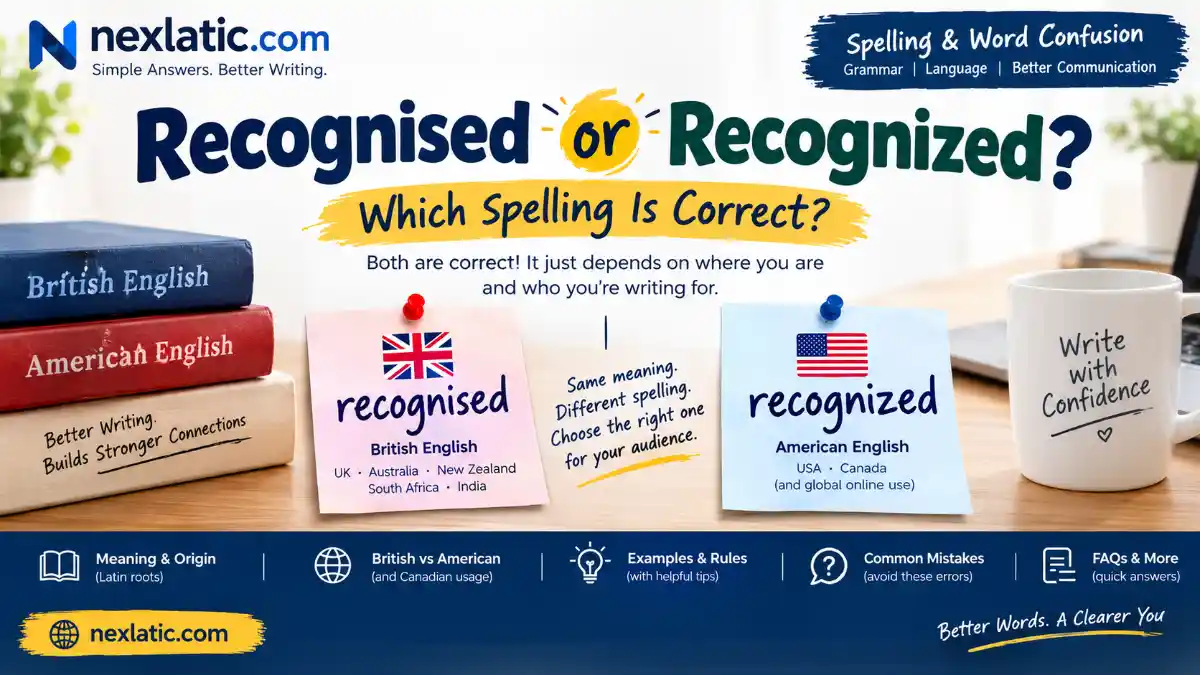
Type “recognised” in a document and your spell checker might flag it. Type “recognized” and a British reader might raise an eyebrow. So which one is right? The short truth is that both are correct. The difference is not about right or wrong. It is about where you are and who you are writing for.
People search for this keyword because the two spellings look equally familiar. You see “recognized” in American movies and US news. You see “recognised” in British books and UK websites. This split causes real confusion, especially for students, job seekers, and anyone writing for a global audience.
This article clears up the confusion once and for all. You will learn the quick answer, the history behind the two spellings, and exactly which one to use in your own writing.
Recognised or Recognized – Quick Answer
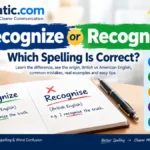
Recognized is the American English spelling. Recognised is the British English spelling. Both mean the same thing: to know someone or something from before, or to accept something as true or official.
- American: The award recognized her hard work.
- British: The award recognised her hard work.
Pick one spelling and stick with it in a single document. Mixing both looks careless.
The Origin of Recognised and Recognized
The story starts with Latin. The word comes from recognoscere, which joins re- (again) with cognoscere (to know). It literally meant “to know again.” Old French carried it into English as reconoistre around the 14th century.
The spelling split came much later. The -ize ending follows the Greek -izein pattern, which reached English through Latin -izare. The -ise ending came through French influence. In 1828, Noah Webster’s American Dictionary pushed -ize forms in the United States to make spelling simpler and more consistent. Britain kept -ise for most everyday words.
Here is a twist many people miss. The Oxford English Dictionary actually prefers -ize spellings, even in British English. Oxford University Press uses “recognize” in its own books. So -ize is not purely American. It is the older, Greek-rooted form, while -ise is the French-influenced British standard.
British English vs American English Spelling
In standard British English, used in the UK, Australia, New Zealand, South Africa, and India, the -ise spelling is the norm: recognised, organise, realise. In American English, -ize is standard: recognized, organize, realize.
Canada sits in the middle. Canadian style guides often accept both forms, though -ize is common in formal and academic writing.
| British English | American English | |
| Past tense | recognised | recognized |
| Present tense | recognise | recognize |
| Adjective | recognisable | recognizable |
| Noun | recognition | recognition |
| Example sentence | She was recognised for bravery. | She was recognized for bravery. |
Note that the noun “recognition” is spelled exactly the same in both regions. Only the verb and adjective forms change.
Which Spelling Should You Use?
Match your reader. Writing for an American company, school, or audience? Use recognized. Writing for a British, Australian, or Commonwealth audience? Use recognised.
Writing for the whole world online? The American spelling is the safer default. Most web content uses US spelling, and search engines treat both forms as the same word. But if your brand or publication already uses British spelling, stay consistent with it.
The golden rule never changes: never mix both spellings in one document. Pick one and use it everywhere, from the title to the last line.
Students should follow their exam board. British exams like GCSE and A-level expect “recognised.” American tests like the SAT expect “recognized.” When a teacher or editor has already chosen a style, follow it without question.
Common Mistakes with Recognised or Recognized
- Mixing both spellings in one text: “The team was recognized, then later recognised.” Pick one form and keep it.
- Writing “recogniced”: wrong. The letter c never appears in this word.
- Misspelling the noun: “recognision” is wrong. It is always “recognition” in every region.
- Using the verb as a noun: “give him recognize” is wrong. Say “give him recognition.”
- Assuming -ise is always British: Oxford style uses -ize, so check your style guide before you decide.
- Forgetting the adjective follows the same rule: recognisable (UK) and recognizable (US), not a mix of both.
- Trusting autocorrect blindly: phone keyboards often switch to the other region’s spelling. Always proofread the final text yourself.
Recognised or Recognized in Everyday Examples
Email (to a US client): “We recognized the error in the invoice and fixed it this morning.”
Email (to a UK client): “We recognised the error in the invoice and fixed it this morning.”
News headline (US): “Mayor recognized volunteers at the city ceremony.”
News headline (UK): “Mayor recognised volunteers at the city ceremony.”
Social media: “Finally getting recognized for all those late nights!” This casual post uses the American form, which dominates on global platforms.
Formal writing: “The committee recognised the need for stronger safety rules.” Formal British reports, academic papers, and government documents keep the -ise form throughout.
Text message: “They finally recognized my work!” Short daily messages usually follow the writer’s home spelling without thinking about it.
Recognised or Recognized – Google Trends & Usage Data
Exact live search numbers change daily, and this article does not pull live Trends data. But the broad pattern is stable and well known. The American spelling “recognized” leads in global online use because the United States produces a huge share of web content, books, and films.
In the UK, Ireland, Australia, and New Zealand, “recognised” is the standard in schools, newspapers, and government writing. Canada and many international organizations accept both forms. Context matters more than raw counts. A CV sent to London should use “recognised,” while one sent to New York should use “recognized.” Match the country, and you will always look correct.
Frequently Asked Questions
1. Which is correct, recognised or recognized?
Both are correct. Recognized is American English and recognised is British English. Neither is a misspelling.
2. Is “recognized” wrong in the UK?
No, but it looks out of place. British schools, newspapers, and publishers expect “recognised.” Use the local standard.
3. Why do the two spellings exist?
The -ize form follows Greek roots and was promoted in America by Noah Webster in 1828. The -ise form came through French influence and stayed standard in Britain.
4. Does Google treat both spellings as the same word?
Yes. Search engines normalize spelling variants, so “recognised” and “recognized” return the same results. Your readers, however, will notice the difference.
5. Which spelling should I use on my CV?
Match the employer’s country. Use “recognized” for American employers and “recognised” for British and Commonwealth employers.
6. Is it “recognisable” or “recognizable”?
The same rule applies. Use “recognisable” in British English and “recognizable” in American English.
7. Is the noun spelled differently too?
No. “Recognition” is spelled the same everywhere. Only the verb and adjective change.
Conclusion
Both spellings are correct. Recognized belongs to American English and recognised belongs to British English. The split comes from history: the Greek-rooted -ize form was kept alive in America by Webster, while the French-rooted -ise form stayed standard in Britain.
For your own writing, match your audience and stay consistent. When in doubt online, the American form is the safer global default. Remember that the noun “recognition” never changes, and never mix both forms in one document.
Get these two habits right and this spelling question will never trouble you again. Your readers will see a writer who knows the rules and respects their version of English.

Ali Bismal is the founder and writer behind Nexlatic.com, a growing online platform created to provide useful, informative, and easy-to-understand content for everyday readers. Through Nexlatic, Ali shares practical ideas, helpful guides, interesting topics, and engaging articles designed to make information simple and accessible. His goal is to create reliable, reader-focused content that helps people learn something new, find useful answers, and make everyday life a little easier.