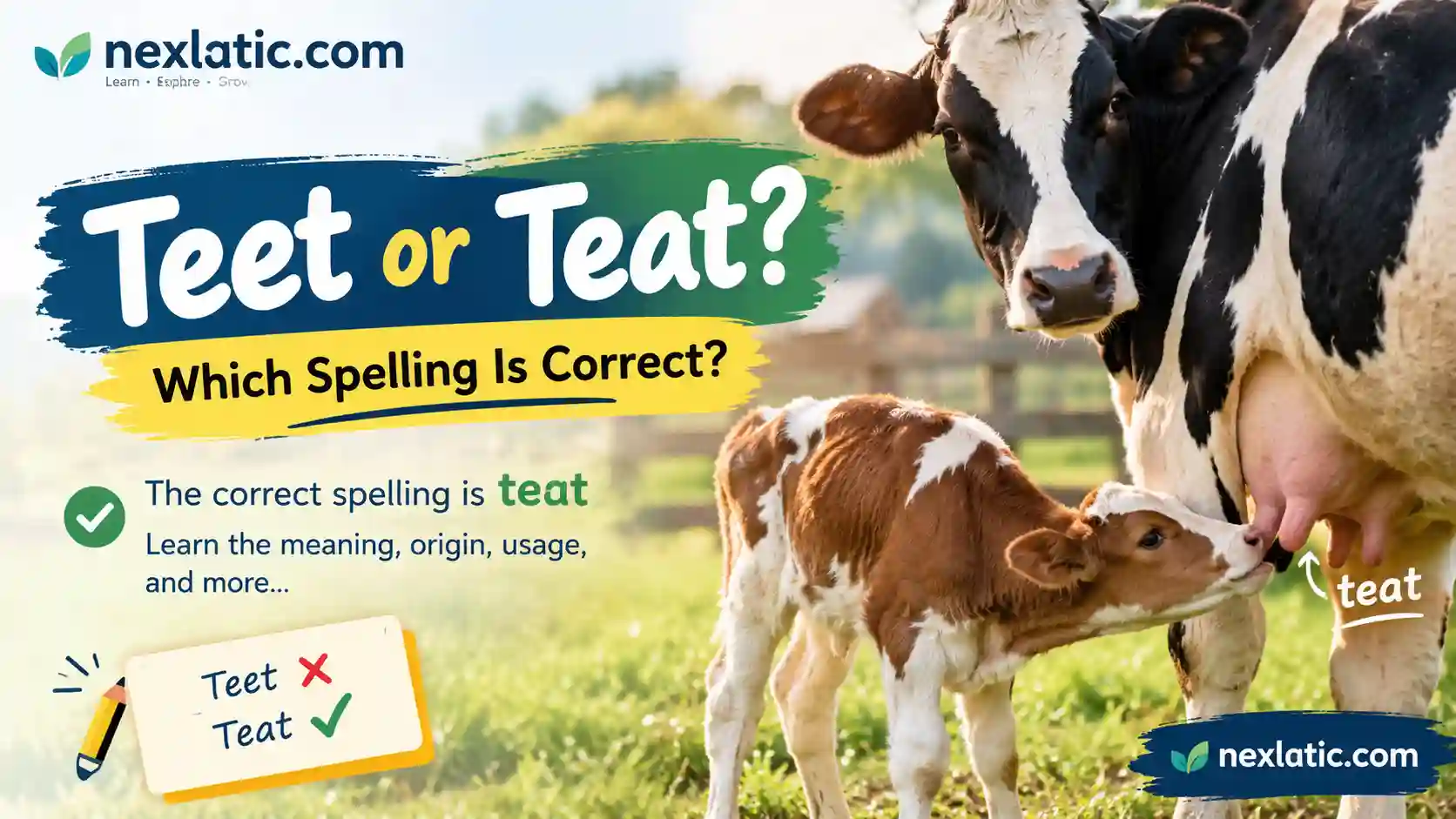
“Teet or teat” is a common spelling question because the two words look and sound very similar. If you are writing an email, article, school assignment, or social media post, choosing the right spelling matters. A small spelling change can also change the meaning of a word.
The correct spelling for the anatomical word is teat. It refers to the nipple of a female mammal, especially an animal such as a cow, goat, or sheep. Teet is generally not the standard spelling of this word, although you may see it as a typo or in some names and informal uses.
People often search for this phrase because they hear the word spoken and are unsure whether it should be written with “ea” or “ee.” The good news is that the standard English spelling is simple: use teat when you mean an animal’s nipple.
This guide explains the difference between teet or teat, their origins, regional English usage, common mistakes, and examples so you can confidently choose the right word.
Teet or Teat Quick Answer
The correct standard English spelling is teat when you mean the nipple of a female mammal.
Teat: the nipple of an animal such as a cow, goat, sheep, or cat.
Example:
“The farmer checked the cow’s teat before milking it.”
Teet: not the standard spelling for this meaning. It is usually a misspelling of teat.
So, if you are asking “teet or teat, which is correct?”, choose teat.
Quick comparison
| Spelling | Standard word? | Meaning |
|---|---|---|
| Teat | Yes | Nipple of a female mammal |
| Teet | No, for this meaning | Usually a spelling mistake |
| Teats | Yes | Plural of teat |
| Teated | Rare | Having teats |
The word teat is used in veterinary, farming, animal care, and general writing.
The Origin of Teet or Teat
The standard word teat has a long history in English. It comes from older forms of English and is related to words used for the breast or nipple.
Over time, English spelling changed in different regions and periods. However, teat remained the accepted modern spelling.
The spelling teet is often created because English pronunciation can make the vowel sound unclear. When people hear the word rather than see it written, they may guess that it uses “ee.” This can lead to the incorrect spelling “teet.”
Another reason for confusion is that English contains many words where “ea” and “ee” can produce similar sounds. For example, words such as see and sea sound alike but have different spellings and meanings.
The same basic idea applies here. The spelling may look unusual to someone who has only heard the word, but standard dictionaries use teat.
The plural form is teats, not “teets.”
British English vs American English Spelling
There is no major British American spelling difference for this word.
Both British English and American English use teat for the nipple of a female mammal. The spelling does not normally change to “teet” in either variety.
| Usage | British English | American English |
|---|---|---|
| Singular | teat | teat |
| Plural | teats | teats |
| Incorrect form | teet | teet |
| Example | The cow has four teats. | The cow has four teats. |
This is important because some English words do change between regions. For example, British English commonly uses colour, while American English uses color. But teat is not one of those words.
If you are writing for readers in the UK, US, Canada, Australia, or other English speaking regions, teat is the safe standard spelling.
Which Spelling Should You Use?
Use teat whenever you mean the nipple of a female mammal.
For US readers, use teat, as this is the standard American English spelling. For UK readers, teat is also correct and commonly used. The same spelling applies in Canadian and Australian English, while teat is the best choice for a global audience because it is widely recognized across English-speaking regions.
If you are writing a scientific, veterinary, agricultural, or educational article, it is especially important to use the standard spelling. Search engines, dictionaries, and professional readers will expect teat.
If you accidentally write “teet,” readers will usually understand what you mean from context, but it can still look like a spelling error.
Teet or Teat: Comparison Table
| Word | Correct? | Meaning | Example |
|---|---|---|---|
| Teat | ✓ | Nipple of a female mammal | The calf found the cow’s teat. |
| Teats | ✓ | More than one teat | The goat has two visible teats. |
| Teet | ✗ | Usually a misspelling | Avoid this spelling in standard writing. |
| Teets | ✗ | Usually a misspelling | Use teats instead. |
Common Mistakes with Teet or Teat
The most common mistake is replacing ea with ee.
Mistake 1: Writing “teet”
Incorrect: The calf was feeding from the cow’s teet.
Correct: The calf was feeding from the cow’s teat.
Mistake 2: Using “teets” as the plural
Incorrect: The farmer checked the cow’s teets.
Correct: The farmer checked the cow’s teats.
Mistake 3: Assuming pronunciation decides spelling
Hearing a word does not always tell you how it is spelled. English has many words with similar sounds but different spellings.
For this reason, remember the written form rather than trying to spell the word from sound.
Mistake 4: Using the wrong word in professional writing
A spelling mistake may be especially noticeable in veterinary or agricultural content. Always proofread technical terms before publishing.
Teat in Everyday Examples
The word teat appears most often in writing about animals, farming, veterinary care, and animal health.
In an email
“Please check the cow’s teat for any signs of irritation before milking.”
In a news article
“The veterinarian examined the animal’s teat during the routine health check.”
On social media
“Learning more about proper dairy animal care and teat health today.”
formal writing
“Regular examination of the teat can help identify possible health problems at an early stage.”
In an educational sentence
“A young mammal may feed from its mother’s teat.”
In farming content
“Farm workers should keep the animal’s teats clean before and after milking.”
These examples show why teat is the correct spelling in practical and professional contexts.
Teet or Teat Google Trends & Usage Data
Search interest for “teet or teat” comes mainly from people who are unsure about the spelling. This type of search is often called a spelling or word choice query.
Search behavior can vary by country and over time. Google Trends can show relative interest in terms, but it does not provide exact total search volume. Results can also change depending on the selected country, date range, language, and search category.
The spelling teat has a clear advantage in standard English because it is the accepted dictionary form for this meaning. Searches for teet may still appear because people commonly search for words they are unsure how to spell.
Context also matters. Searches for teat may be connected with:
- Animal care
- Dairy farming
- Veterinary medicine
- Agriculture
- Biology
- Animal health
- Spelling questions
If you are researching the keyword for SEO, it is useful to target the full phrase “teet or teat” because it directly matches the question users are asking. Then give the answer quickly before providing the deeper explanation.
FAQs
Is “teat” the correct spelling?
Yes. Teat is the standard English spelling for the nipple of a female mammal.
Is “teet” a word?
“Teet” can appear in some proper names or specialized contexts, but it is not the standard spelling for an animal’s nipple. For that meaning, use teat.
What is the plural of teat?
The plural is teats.
Example: “The cow has four teats.”
Do British people spell it “teat” or “teet”?
British English uses teat. There is no standard British spelling change to “teet.”
Do Americans spell it “teat” or “teet”?
American English also uses teat. “Teet” is normally an incorrect spelling when referring to an animal’s nipple.
Why do people spell teat as teet?
The main reason is pronunciation. Someone who hears the word may guess that the vowel should be written with ee. The standard written form, however, is teat.
How do you remember the spelling of teat?
A simple way is to remember that the standard spelling contains “ea”: TEAT. The plural is TEATS.
Conclusion
When choosing between teet or teat, the answer is clear: teat is the correct standard spelling when you mean the nipple of a female mammal. The word is commonly used in farming, veterinary medicine, animal care, biology, and educational writing.
The spelling teet is usually a mistake caused by hearing the word and guessing its spelling. British English and American English both use teat, so you do not need to change the spelling based on your audience.
Remember the simple forms: teat for one and teats for more than one. If you are writing an article, email, report, or social media post, using these forms will keep your writing clear and professional.
So, the next time you wonder teet or teat, choose teat. It is the standard spelling recognized across modern English, and it is the safest choice for both everyday and professional writing.

David Wilson is a writer and contributor at Nexlatic.com, where he writes about useful topics, everyday questions, and practical ideas. He enjoys turning information into simple, clear, and easy-to-read articles that readers can actually use. Through his work at Nexlatic, David aims to share helpful content that answers common questions, explains confusing topics, and gives readers something useful to take away from every article.