You are writing an email. You type the word. Then you stop. Is it “focused” or “focussed”? Both look right. Both look wrong. You are not alone.
This is one of the most common spelling mix ups in English. People search for it every day. Students search it before turning in an essay. Writers search it before hitting publish. Business owners search it before sending a client email. The confusion is simple: English has two main versions. One comes from America. One comes from Britain. Neither is a typo. Both are correct, depending on where you are.
This article gives you the quick answer first. Then it explains the history. It explains the spelling rules in a simple way and gives real examples from emails, news articles, and social media. You can also see what the data shows about which spelling people use most often. By the end, you will never have to guess again.
Let’s clear up the confusion for good.
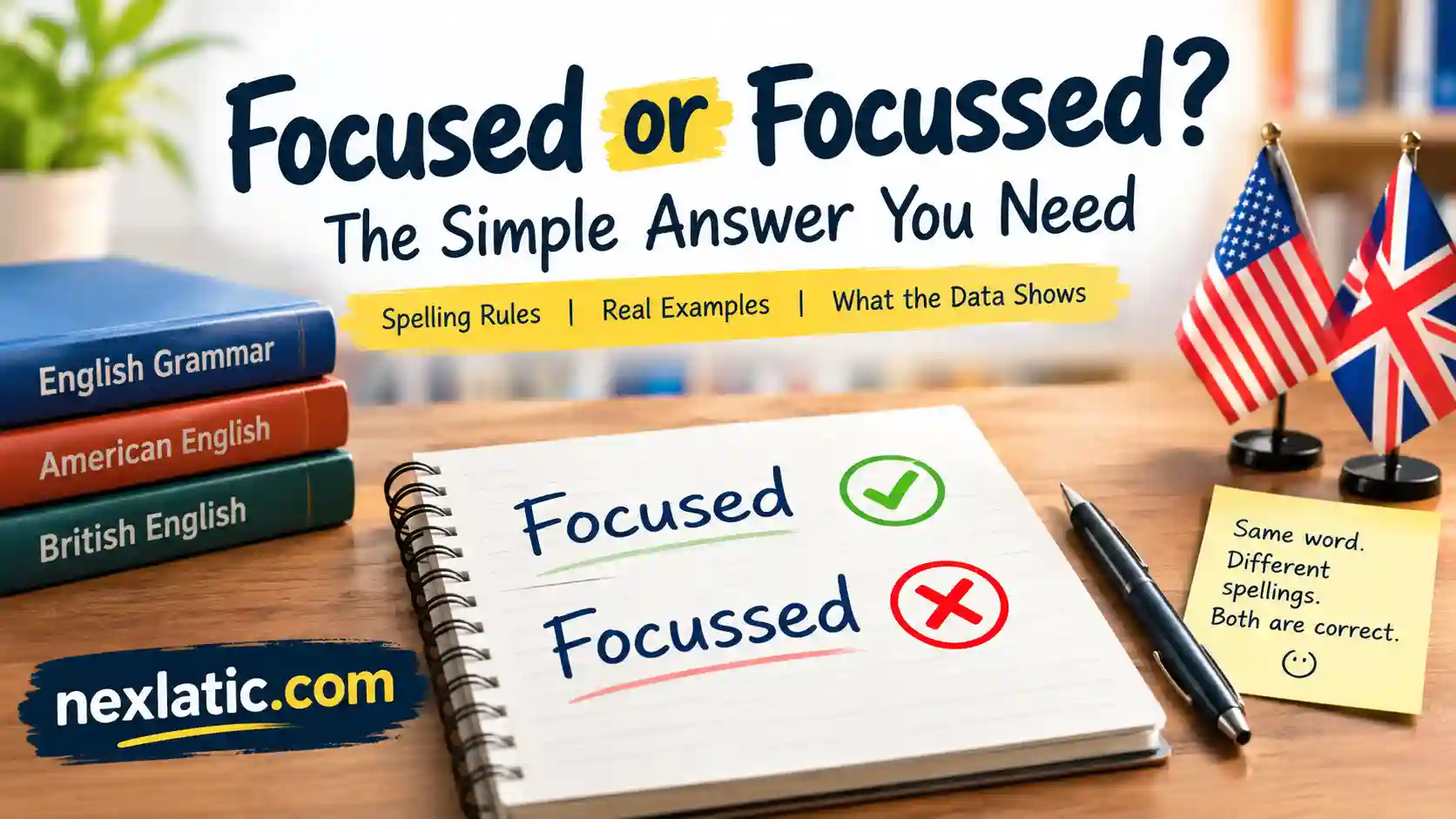
Focused or Focussed Quick Answer
Here is the short version.
- Focused is the standard spelling in American English.
- Focussed is an older, less common spelling used mostly in British English.
- Most modern British writers now use focused too.
Example sentences:
- “She stayed focused during the exam.” (American style, and now common everywhere)
- “He remained focussed on the goal.” (Older British style, less common today)
If you are unsure, use focused. It is correct almost everywhere in the world today.
The Origin of Focused or Focussed
The word “focus” comes from Latin. It originally meant “hearth” or “fireplace.” Over time, it came to mean a central point, like the focus of a lens or the focus of attention.
The confusion starts with the verb form. In English, when you add “ed” to a word ending in a single consonant, spelling rules can go two ways:
- Keep one consonant: focus + ed = focused
- Double the consonant: focus + ed = focussed
Both patterns exist in English. Words like “travel” become “traveled” (American) or “travelled” (British) by doubling the “l”. For a while, some British writers applied the same doubling rule to “focus,” creating “focussed.” But this rule was never fully standard, even in Britain.
Over the past few decades, “focused” has become the dominant spelling almost everywhere, including in the UK. Major British dictionaries and news outlets now list “focused” as the preferred spelling.
British English vs American English Spelling
English spelling splits into two main systems: American English and British English. Many word pairs follow clear patterns, like “color” vs “colour” or “organize” vs “organise.” But “focused” vs “focussed” does not follow a strict national rule anymore. It is more about trend and preference.
Here is a clear comparison:
| Feature | Focused | Focussed |
| Region | American English (also standard in modern British English) | Older British English (rare today) |
| Common in dictionaries | Yes, primary spelling worldwide | Listed as a variant, less preferred |
| Used in news media | Yes, dominant | Rare |
| Used in academic writing | Yes | Rarely, mostly older texts |
| Trend over time | Increasing | Decreasing |
| Recommended for global use | Yes | No |
The pattern here is different from words like “colour” or “organise.” With “focused,” even British style guides now lean toward the singles spelling.
Which Spelling Should You Use?
Your choice depends on your audience.
American audience: Choose “focused.” This is the only correct form in US English. Style guides like AP and Chicago confirm this.
British or Commonwealth audience: Go with “focused” here too. While “focussed” was once common, most UK style guides, including Oxford, now recommend “focused” as the standard spelling.
Global audience: Stick with “focused.” It is understood everywhere and looks modern and correct in any country.
When might “focussed” still appear? You may see it in older books, some formal legal documents, or from writers who learned British spelling rules decades ago. It is not wrong, but it is old fashioned.
Simple rule: When in doubt, choose “focused.” It works in every English speaking country today.
Common Mistakes with Focused or Focussed
Here are frequent errors people make, and how to fix them.
1. Mixing spellings in one document Wrong: “She focused on her work, but he stayed focussed on the deadline.” Fix: Pick one spelling and use it throughout the entire document.
2. Assuming “focussed” is always British Wrong belief: “I’m writing for a UK client, so I must use ‘focussed.'” Fix: Modern UK style guides now prefer “focused” too.
3. Doubling other similar words incorrectly Wrong: “He bussed his energy into the project” (confusing with “focussed” pattern) Fix: “Focus” does not need a doubled consonant in modern usage. Neither do most similar words like “bias” (biased, not biassed).
4. Using “focussed” in professional or SEO content A rare spelling in a blog post or resume can look like a typo to most readers. Fix: Use “focused” for wider recognition and a more polished look.
5. Trusting autocorrect blindly Some spell checkers still flag “focused” when set to old British dictionaries. Fix: Check your settings and confirm which style guide you’re following.
Focused or Focussed in Everyday Examples
Emails: “Thank you for staying focused on this project despite the tight deadline.”
News headlines: “Central Bank Stays Focused on Inflation Targets, Officials Say.”
Social media posts: “Staying focused this week. New goals, new energy. 💪 #focused #motivation”
Formal writing (reports, essays): “The research team remained focused on collecting accurate data throughout the six month study.”
Older or formal British texts (rare today): “The committee remained focussed on the matter at hand throughout the proceedings.”
Notice how “focused” appears in almost every modern context. “Focussed” mostly shows up in older or very formal writing.
Focused or Focussed Google Trends & Usage Data
Search and usage data show a clear pattern.
- United States: “Focused” is used almost exclusively. “Focussed” rarely appears in search or writing.
- United Kingdom: “Focused” has overtaken “focussed” in general use, though “focussed” still appears occasionally in older publications.
- Canada and Australia: These countries mostly follow American spelling for this specific word, using “focused.”
- Global searches: People searching “focused or focussed” are usually trying to confirm which spelling is correct, often before submitting written work or professional content.
The overall trend, worldwide, points toward “focused” as the modern standard, regardless of country.
Keyword Variations Comparison Table
| Word Form | Standard Spelling | Alternative Spelling | Common Usage |
| Base verb | Focus | Focus | Universal |
| Past tense | Focused | Focussed | “Focused” preferred globally |
| Present participle | Focusing | Focussing | “Focusing” preferred globally |
| Noun form | Focus | Focus | Universal, no variation |
| Adjective form | Focused (e.g., “a focused mind”) | Focussed | “Focused” preferred globally |
FAQS
1. Is “focussed” a real word? Yes. It is a real, older spelling variant, mostly seen in older British English texts. It is not commonly used today.
2. Is “focused” British or American English? “Focused” is standard in American English and is now also the preferred spelling in modern British English.
3. Which spelling should I use in a resume or cover letter? Use “focused.” It is the globally recognized, modern spelling and looks more professional.
4. Does Microsoft Word or Google Docs flag “focussed” as wrong? Most spell checkers set to standard English (US or modern UK) will flag “focussed” as incorrect or unusual. Only older British dictionary settings may accept it.
5. Why do some words double the consonant and others don’t? English spelling rules for doubling consonants before “ed” are inconsistent. Some words follow British doubling patterns (like “travelled”), but “focused” has moved away from this pattern over time.
6. Is one spelling more “correct” than the other? Neither spelling is grammatically wrong, but “focused” is the modern, globally accepted standard. “Focussed” is considered outdated.
7. Can I use both spellings in the same piece of writing? No. Always stay consistent. Pick one spelling and use it throughout your entire document.
Conclusion
The debate between “focused” and “focussed” comes down to one simple fact: “focused” is the modern, correct choice almost everywhere in the world today. While “focussed” once appeared in British English, most UK style guides, news outlets, and dictionaries now favor the singles spelling too.
If you are writing an email, a resume, a report, or a social media post, choose “focused.” It works well for American and British readers, while also being easy to understand for a global audience. The spelling looks professional and follows the forms supported by modern dictionaries and search data. And it removes any doubt about whether your writing looks polished or outdated.
The key takeaway is simple: when in doubt, use “focused.” Save “focussed” for historical texts or formal legal documents where older spelling conventions may still apply. For everyday writing, business communication, and SEO content, “focused” is the safe, modern, and correct choice every time.
Now you can write with confidence, knowing exactly which spelling to use.

Ali Bismal is the founder and writer behind Nexlatic.com, a growing online platform created to provide useful, informative, and easy-to-understand content for everyday readers. Through Nexlatic, Ali shares practical ideas, helpful guides, interesting topics, and engaging articles designed to make information simple and accessible. His goal is to create reliable, reader-focused content that helps people learn something new, find useful answers, and make everyday life a little easier.