You are writing a job application. You type “propper training.” Then you pause. It looks strange. Is it “propper” or “proper”?
People search for “Propper or Proper” because the two forms sound the same. Students, writers, and job seekers want to get it right. A spelling error in a resume or email can hurt a first impression.
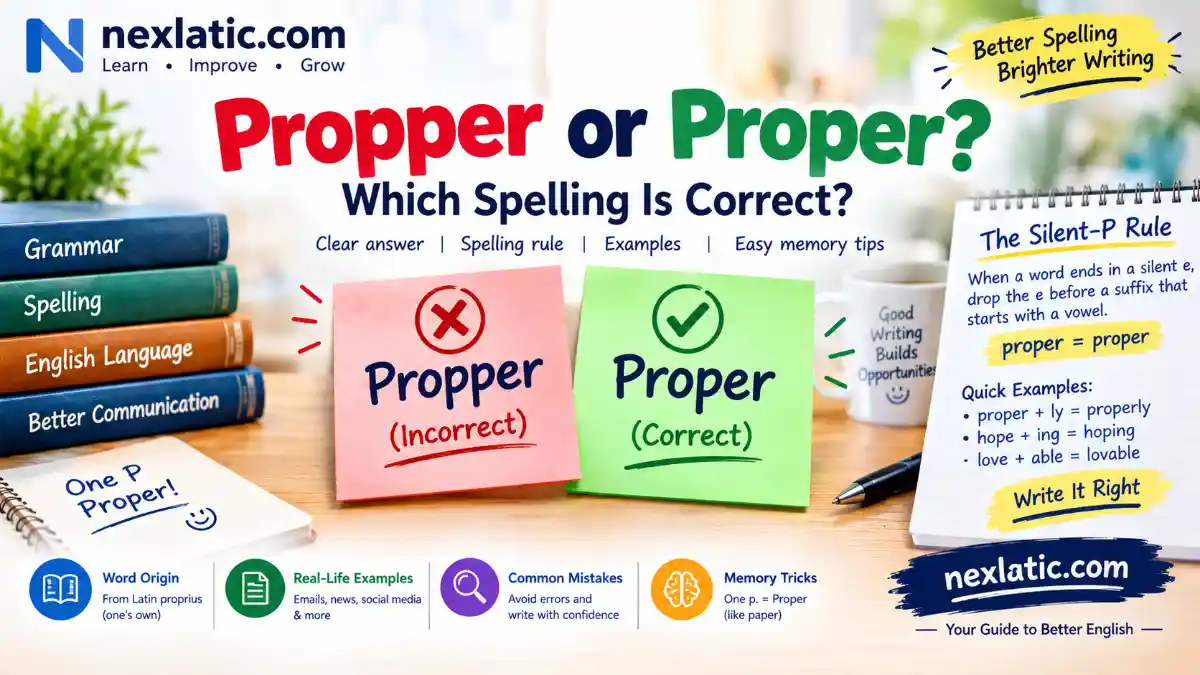
Here is the clear answer. Proper is the correct spelling. Propper is a misspelling when you mean “correct” or “suitable.” There is one small exception: “Propper” can be a surname or a brand name, but it is never the right word for “correct.”
This guide solves the confusion. You will learn the quick answer, the word’s origin, the double-p trap, common mistakes, and real-life examples. By the end, you will always spell it right.
Propper or Proper – Quick Answer
Proper is correct. Propper is wrong as an adjective.
“Proper” means right, suitable, or correct for a situation.
Examples:
- Wear proper shoes for the hike.
- She gave a proper answer to the question.
- We need a proper plan before we start.
The word comes from Old French propre and Latin proprius. Its history shows only one -p-.
The Origin of Propper or Proper
“Proper” comes from the Latin word proprius, which means “one’s own.” It passed through Old French propre and entered English. The single -p- spelling has stayed the same for centuries.
“Propper” with two p’s is not an old variant. It is a modern spelling mistake. People double the p by habit, since many English words double consonants. But the word’s history shows no reason for two p’s.
Note one exception. “Propper” can be a family name or a brand name. In that case, the capital P matters. It is also listed as a rare noun meaning “one who props” (prop + -er). But as an adjective meaning “correct,” always write “proper.”
British English vs American English Spelling
There is no British vs American difference. Both regions spell it “proper.” The double-p form is wrong everywhere.
| Feature | Proper | Propper |
| Correct as adjective | Yes | No |
| Meaning | Right, suitable, correct | Nothing (misspelling) |
| Root | Latin proprius | N/A |
| Used in US | Yes | No |
| Used in UK | Yes | No |
| As surname or brand | No | Yes (e.g., Propper) |
| Used in formal writing | Yes | Never |
| Context | Correct Form |
| Correct behavior | Proper |
| Suitable clothes | Proper |
| Family name | Propper |
| Brand name | Propper |
| School exam | Proper |
Which Spelling Should You Use?
Writing for a US audience? Use “proper.” It is the only correct form.
Writing for a UK or Commonwealth audience? Use “proper.” Same rule everywhere.
Writing for a global audience? Use “proper.” It is correct in every English variety.
Writing a person’s name? Use “Propper” with a capital P if that is their name.
Formal writing? Always “proper.” Resumes, exams, and reports expect the right spelling. “Propper” will be marked wrong.
The simple test: the word has one p in the middle. Proper. If you see two p’s, fix it.
Common Mistakes with Propper or Proper
Mistake 1: Writing “propper” as an adjective.
Wrong: “Eat a propper breakfast.”
Right: “Eat a proper breakfast.”
Mistake 2: Thinking “propper” is the American form.
It is not. American English also uses “proper.”
Mistake 3: Doubling the p like “pepper.”
“Pepper” has two p’s, but “proper” has one. The words are not related.
Mistake 4: Using “propper” in a job application.
Hiring managers check spelling. Write “proper training,” never “propper training.”
Propper or Proper in Everyday Examples
In emails:
“Please use the proper format for the report.”
“Wear proper attire to the meeting.”
In news:
“The team received proper credit for the win.”
“Officials called for a proper review.”
In social media:
“Proper weekend vibes only.”
“Give credit where proper.”
In formal writing:
“Without proper documents, you cannot apply.”
“The machine needs proper care.”
Propper or Proper – Google Trends & Usage Data
Exact Google Trends numbers change daily, so treat this as a general pattern, not measured data.
“Proper” gets huge search volume in all English-speaking countries. It is a basic word used in school, work, and daily life. Searches rise during exam seasons.
“Propper” gets far fewer searches. Most of those searches are about the brand name or the surname, not the adjective. People also search it to check if it is correct.
There is no country split. The US, UK, Canada, and Australia all use “proper.” No region prefers “propper.”
FAQs
Is “propper” ever correct?
Only as a surname or brand name. As an adjective meaning “correct,” it is always wrong.
Why do people write “propper”?
They double the p by habit, like in “pepper.” But the word’s history shows only one p.
What is the origin of “proper”?
It comes from Old French propre and Latin proprius, meaning “one’s own”.
Is there a British vs American difference?
No. Both British and American English spell it “proper.” The rule is the same everywhere.
How can I remember the spelling?
Think: proper has one p, like “paper.” If you see two p’s, it is wrong.
What does “proper” mean?
It means right, suitable, or correct for a situation. Example: “proper manners.”
Can “propper” be a noun?
Rarely. It can mean “one who props,” as in “bar propper.” But this use is very uncommon.
Conclusion
The “Propper or Proper” question has one clear answer. Proper is correct. Propper is a misspelling when you mean “correct” or “suitable.” There is no British vs American split.
The word’s history explains the single p. It comes from Latin proprius through Old French propre. No double p ever existed in its roots. The only time “Propper” is right is as a name or brand.
For daily use, the fix is simple. One p in the middle. Proper. In emails, essays, and job letters, this is the only form that looks professional.
Now you know the rule and the reason behind it. You will spell this word right every time.

David Wilson is a writer and contributor at Nexlatic.com, where he writes about useful topics, everyday questions, and practical ideas. He enjoys turning information into simple, clear, and easy-to-read articles that readers can actually use. Through his work at Nexlatic, David aims to share helpful content that answers common questions, explains confusing topics, and gives readers something useful to take away from every article.