You are writing an important email. You type “a noteable change.” Then you stop and stare at the word. Something looks off. Is it “noteable” or “notable”?
People search for “Noteable or Notable” because the two forms look almost the same. Writers, students, and job seekers want to spell it right. A small spelling error can make a good sentence look careless.
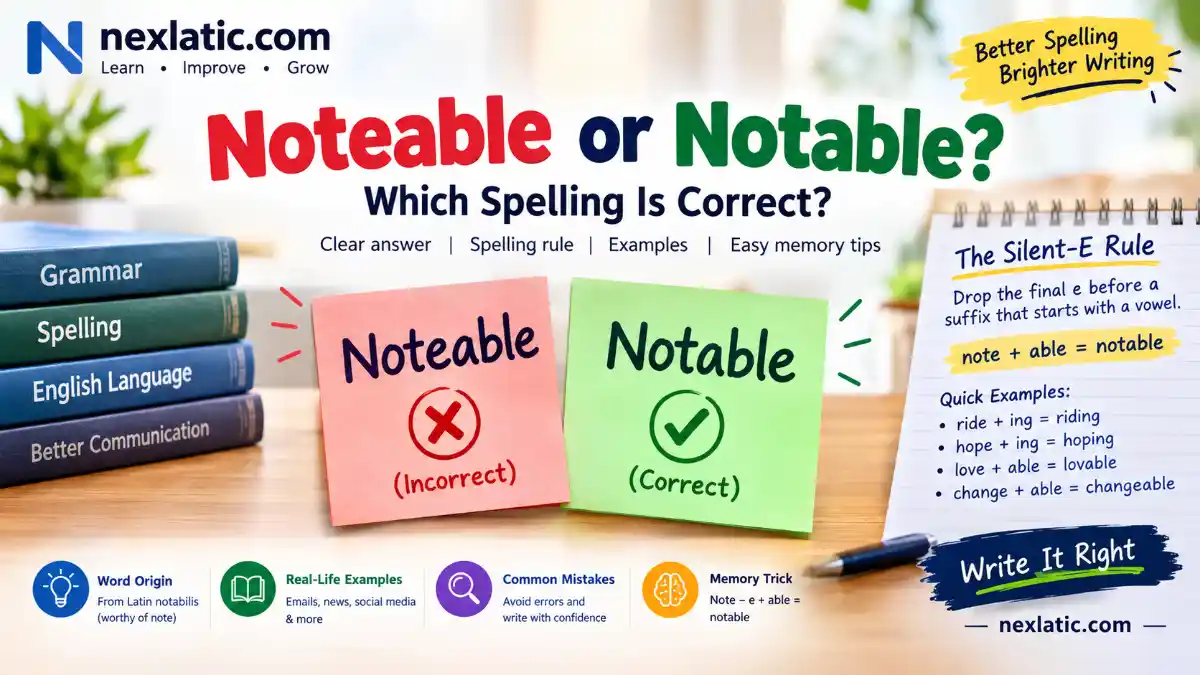
Here is the clear answer. Notable is the correct spelling. Noteable is a common misspelling. There is no case where “noteable” is the right choice in standard English.
This guide solves the confusion. You will learn the quick answer, the spelling rule behind it, the word’s origin, common mistakes, and real-life examples. You will also see why words like “noticeable” keep their e while “notable” drops it. By the end, you will never write “noteable” again.
Noteable or Notable – Quick Answer
Notable is correct. Noteable is wrong.
Use “notable” when you mean famous, important, or worth noticing.
Examples:
- She gave a notable speech at the event.
- The book’s most notable chapter is the last one.
- There was a notable drop in prices.
The rule: when a word ends in a silent e, drop the e before a suffix that starts with a vowel. So “note” + “able” = “notable”.
The Origin of Noteable or Notable
“Notable” comes from the Latin word notabilis, which means “worthy of note.” It passed through Old French notable and entered English centuries ago. The word “note” itself comes from Latin nota, meaning a mark or sign.
The spelling “noteable” is not an old variant. It is simply a modern mistake. People add “-able” to “note” and keep the e by habit. But English spelling rules say to drop it.
One tricky point: “noticeable” keeps its e. That is because “notice” ends in -ce. Dropping the e would make the c sound hard, like a k. So the e stays to keep the soft sound. “Note” has no such problem, so the e drops.
British English vs American English Spelling
There is no British vs American difference here. Both regions use “notable.” The silent-e rule works the same in all English varieties.
| Feature | Notable | Noteable |
| Correct spelling | Yes | No |
| Meaning | Famous, important | Nothing (misspelling) |
| Root | note + able (e dropped) | note + able (e kept by mistake) |
| Used in US | Yes | No |
| Used in UK | Yes | No |
| Used in formal writing | Yes | Never |
| Word Pair | Correct Form | Why |
| note + able | notable | Silent e drops before vowel suffix |
| notice + able | noticeable | Keeps e to protect soft c sound |
| manage + able | manageable | Keeps e to protect soft g sound |
| love + able | lovable | Silent e drops |
| change + able | changeable | Keeps e to protect soft g sound |
Which Spelling Should You Use?
Writing for a US audience? Use “notable.” It is the only correct form.
Writing for a UK or Commonwealth audience? Use “notable.” Same rule everywhere.
Writing for a global audience? Use “notable.” It is correct in every English variety.
Formal writing? Always “notable.” Exams, job letters, and reports expect the correct form. “Noteable” will be marked wrong.
The simple test: say the base word is “note.” Add “-able.” Drop the silent e. You get “notable.” If you see “noteable” in your draft, fix it at once.
Common Mistakes with Noteable or Notable
Mistake 1: Writing “noteable.”
Wrong: “It was a noteable day.”
Right: “It was a notable day.”
Mistake 2: Thinking “noteable” is the British form.
It is not. British English also uses “notable.”
Mistake 3: Confusing it with “noticeable.”
“Noticeable” keeps its e for a sound reason. “Notable” drops it. Do not copy one rule onto the other.
Mistake 4: Adding extra letters.
Some writers type “notabel” or “notible.” The correct ending is “-able.”
Mistake 5: Using “noteable” in a resume.
Hiring managers notice spelling errors. Always write “notable achievement,” never “noteable achievement.”
Noteable or Notable in Everyday Examples
In emails:
“Thank you for your notable work on this project.”
“There has been a notable improvement this month.”
In news:
“The mayor made a notable announcement today.”
“Scientists reported a notable discovery.”
In social media:
“Notable win for our team today!”
“One of the most notable books I have read.”
In formal writing:
“The report lists three notable findings.”
“Her notable career spans twenty years.”
Noteable or Notable – Google Trends & Usage Data
Exact Google Trends numbers change daily, so treat this as a general pattern, not measured data.
“Notable” gets steady searches in all English-speaking countries. It is a common word in news, business, and school writing. Searches rise during exam seasons when students check spelling.
“Noteable” gets far fewer searches. Most of those searches are people asking if it is correct. This shows it is a misspelling people want to fix, not a word they use.
There is no country split. The US, UK, Canada, and Australia all use “notable.” No region prefers “noteable.”
FAQs
Is “noteable” ever correct?
No. “Noteable” is always a misspelling in standard English. Use “notable” in every case.
Why does “noticeable” keep its e but “notable” does not?
“Notice” ends in -ce. Keeping the e protects the soft c sound. “Note” has no such need, so the e drops.
What is the silent-e spelling rule?
Drop the final silent e before a suffix that starts with a vowel. Examples: ride + ing = riding, hope + ing = hoping.
Is there a British vs American difference?
No. Both British and American English use “notable.” The rule is the same everywhere.
How can I remember the spelling?
Think: note minus e plus able. Note − e + able = notable. If you see two e’s in a row, it is wrong.
What does “notable” mean?
It means famous, important, or worth noticing. Example: “a notable leader.”
Can I use “noteable” in casual writing?
No. Even in casual writing, “noteable” looks like an error. Always write “notable.”
Conclusion
The “Noteable or Notable” question has one clear answer. Notable is correct. Noteable is a misspelling. There is no British vs American split and no special case where “noteable” works.
The silent-e rule explains why. When you add a vowel suffix to a word ending in silent e, drop the e. So “note” + “able” becomes “notable.” Words like “noticeable” keep their e only to protect a soft sound. “Note” needs no such help.
For daily use, the fix is easy. If your draft shows “noteable,” delete the extra e. In emails, essays, and resumes, “notable” is the only form that looks professional.
Now you know the rule and the reason behind it. You will spell this word right every time.

Ali Bismal is the founder and writer behind Nexlatic.com, a growing online platform created to provide useful, informative, and easy-to-understand content for everyday readers. Through Nexlatic, Ali shares practical ideas, helpful guides, interesting topics, and engaging articles designed to make information simple and accessible. His goal is to create reliable, reader-focused content that helps people learn something new, find useful answers, and make everyday life a little easier.