You spot a small, dark insect crawling along your windowsill or a pile of discarded wings on the floor near your porch light. Is it an ant? Or is it a termite? This is one of the most common pest-identification questions homeowners search for, and for good reason: ants and termites look remarkably similar at first glance, but the stakes of misidentifying them are very different. A few ants in the kitchen is a minor nuisance. A termite colony in your walls can cause thousands of dollars in structural damage before you ever notice a problem.
The confusion is understandable. Both insects are small, dark or pale, live in colonies, and sometimes grow wings and swarm at the same time of year. But once you know what to look for the shape of the waist, the antennae, the wings, and the behavior telling them apart takes seconds. This article gives you a quick answer first, then walks through the details, common mistakes, real-world examples, and answers to the questions people ask most.
Ant or Termite – Quick Answer
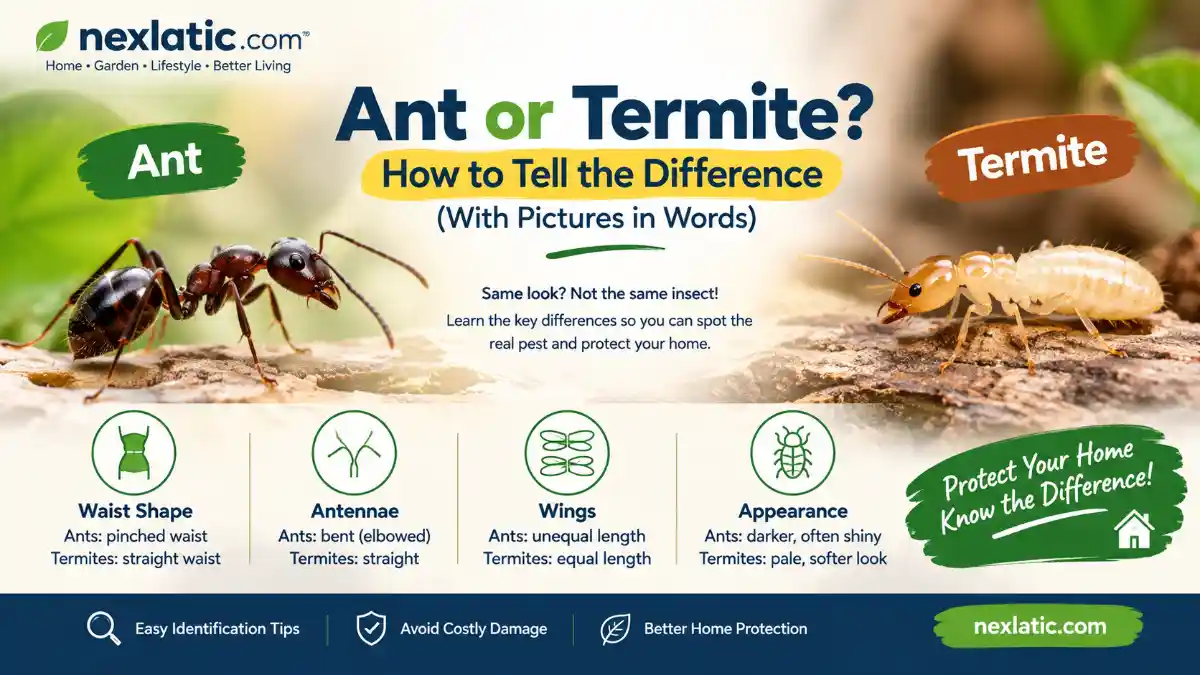
The fastest way to tell them apart: look at the waist, antennae, and wings.
- Ants have a narrow, pinched waist, bent (elbowed) antennae, and two pairs of wings of unequal length (when winged).
- Termites have a thick, straight waist with no pinch, straight (not bent) antennae, and two pairs of wings that are equal in length.
Example: If you see a swarm of winged insects near a light fixture and all four wings look the same size and shape, you’re likely looking at termites, not ants.
The Origin of the Confusion
Ants and termites aren’t related at all ants are more closely related to bees and wasps, while termites are more closely related to cockroaches. The confusion comes from convergent evolution: both insects developed similar lifestyles (living in large underground or wood-based colonies with a queen, workers, and soldiers), so they ended up looking alike on the surface.
The term “white ant” is a big part of the mix-up. For centuries, in many parts of the world, termites were casually called “white ants” because of their pale color and ant-like colony structure. This informal name stuck in everyday language long before entomologists classified the two insects as completely separate species. That’s why, even today, people instinctively lump them together.
Regional Naming: How “Ant” and “Termite” Are Used Around the World
Unlike true spelling variants (such as “color” vs “colour”), there’s no British-versus-American spelling difference for “ant” or “termite” both words are spelled the same everywhere English is spoken. What does differ is regional terminology and familiarity:
| Region | Common Term Used | Notes |
| United States | “Termite,” “Ant” | Clear distinction; termites are a major pest-control industry |
| United Kingdom | “Termite,” “Ant” (rarely “white ant”) | Termites are less common in the UK climate, so ants dominate everyday conversation |
| Australia / South Africa | “Termite” (also “white ant” colloquially) | “White ant” is still used informally due to warm climates and frequent termite issues |
| India / Southeast Asia | “Termite” (also “white ant”) | “White ant” remains widely used in everyday and even commercial contexts |
Which Term Should You Use?
- For US and UK audiences: Use “termite” and “ant” as separate, precise terms. Avoid “white ant” in formal or professional writing (pest control reports, real estate disclosures, blog content) it can read as imprecise.
- For Commonwealth or South Asian audiences: “White ant” is still understood and used colloquially, but “termite” is the scientifically accurate term and is preferred in professional or SEO content, since it matches what people search for globally.
- For global or SEO content: Default to “termite” and “ant” as the primary terms, since they have the highest search volume and the clearest meaning across all English-speaking regions.
Common Mistakes with Ant or Termite Identification
- Assuming all winged insects are “flying ants.” Many people call any swarm of winged insects “flying ants,” even when they’re termites (called “swarmers” or “alates” by pest professionals).
- Ignoring the waist shape. This is the single most reliable visual cue, yet it’s the most overlooked. A pinched waist = ant. A straight, thick waist = termite.
- Confusing discarded wings with the insect itself. Termite swarmers shed their wings almost immediately after landing, so people often find piles of identical wings and assume it’s unrelated to the insect problem.
- Treating for ants when the real problem is termites. Standard ant baits and sprays don’t work on termite colonies, so misidentification can let termite damage continue unchecked.
- Assuming termites are only a “warm climate” problem. While termites are more active in warm regions, many temperate areas including parts of the northern US and UK have termite species too.
Ant or Termite in Everyday Examples
- Email (pest control company to customer): “During our inspection, we found evidence consistent with termite activity, not ants specifically, mud tubes along your foundation.”
- News headline: “Termite Swarms Reported Across the Region as Temperatures Rise”
- Social media post: “Found a pile of wings on my porch this morning… ant or termite?? 😳 #pestcontrol”
- Formal writing (home inspection report): “No visible signs of termite infestation were observed; minor ant activity was noted near the exterior foundation.”
Ant or Termite – Search Trends and Usage Data
Search interest in “ant or termite” and related comparison queries tends to spike seasonally, particularly in spring and early summer, when termite swarming season begins in many regions. Searches are consistently higher in the United States, Australia, and parts of South Asia areas with higher termite activity and larger pest-control markets compared with the UK, where termite presence is much rarer and ant-related searches dominate instead. The keyword also trends alongside real estate activity, since termite inspections are a routine part of home buying in many US states.
Comparison Table: Key Variations at a Glance
| Feature | Ant | Termite |
| Waist | Narrow, pinched | Thick, straight, no pinch |
| Antennae | Bent (elbowed) | Straight, beaded |
| Wings (if present) | Two pairs, unequal length | Two pairs, equal length |
| Color | Black, brown, or red | Pale cream to dark brown |
| Diet | Sugars, proteins, other insects | Wood and cellulose |
| Colony damage | Rarely structural | Can be seriously structural |
| Common informal name | “White ant” (regional) |
FAQs
1. What’s the easiest way to tell an ant from a termite?
Look at the waist. Ants have a narrow, pinched waist; termites have a thick, straight one.
2. Do termites bite or sting like ants?
Most termites don’t bite humans in any meaningful way. Some ants, like fire ants, can bite and sting.
3. Why are termites sometimes called “white ants”?
Because of their pale color and ant-like colony behavior, “white ant” became a common informal name in many regions, even though the two insects aren’t related.
4. If I see wings on the floor, does that mean I have termites?
Not always flying ants also shed wings. Check the wing size: equal-length wings point to termites; unequal-length wings point to ants.
5. Are ants or termites more destructive to a home?
Termites are far more destructive, since they feed on wood and structural materials. Most ants don’t damage buildings, with carpenter ants being a notable exception.
6. Can I use the same treatment for ants and termites?
No. Ant baits and sprays are not effective against termite colonies. Termite treatment usually requires professional inspection and specialized products.
7. Is “termite” spelled differently in British and American English?
No. “Termite” and “ant” have the same spelling in both British and American English there’s no regional variation, unlike words such as “colour/color.”
Conclusion
Telling an ant from a termite doesn’t require an entomology degree just a quick look at three features: the waist, the antennae, and the wings. Ants have a pinched waist, bent antennae, and wings of two different lengths. Termites have a thick, straight waist, straight antennae, and wings that are the same length. The confusion between the two largely comes from history, not biology: termites were long nicknamed “white ants” because of surface-level similarities, even though the two insects belong to entirely different families.
Getting the identification right matters. Ants are usually a minor household nuisance, while termites can cause serious, costly structural damage if left untreated. If you’re ever unsure after a visual check, the safest move is to consult a pest control professional, especially if you’re seeing swarms, discarded wings, or mud tubes near your home’s foundation. When in doubt, look closely the difference is small, but it matters a lot.

Ali Bismal is the founder and writer behind Nexlatic.com, a growing online platform created to provide useful, informative, and easy-to-understand content for everyday readers. Through Nexlatic, Ali shares practical ideas, helpful guides, interesting topics, and engaging articles designed to make information simple and accessible. His goal is to create reliable, reader-focused content that helps people learn something new, find useful answers, and make everyday life a little easier.