You are shopping for a new tennis frame. The box says “racket.” The club sign says “racquet.” Now you are not sure which one is right. This small word causes big confusion.
People search for “Racquet or Racket” every day. They want to write sports articles, school essays, and shopping lists without errors. They also wonder if the two spellings mean different things.
Here is the good news. The answer is simple once you know the rules. “Racket” is the standard spelling in American English for the sports tool. “Racquet” is a variant used in British English for the same sports tool. But “racket” also means a loud noise and a dishonest scheme. “Racquet” never means those things.
This guide solves the confusion step by step. You will get a quick answer, the word history, British and American rules, common mistakes, and real-life examples. By the end, you will know exactly which spelling to use in any situation.
Racquet or Racket – Quick Answer
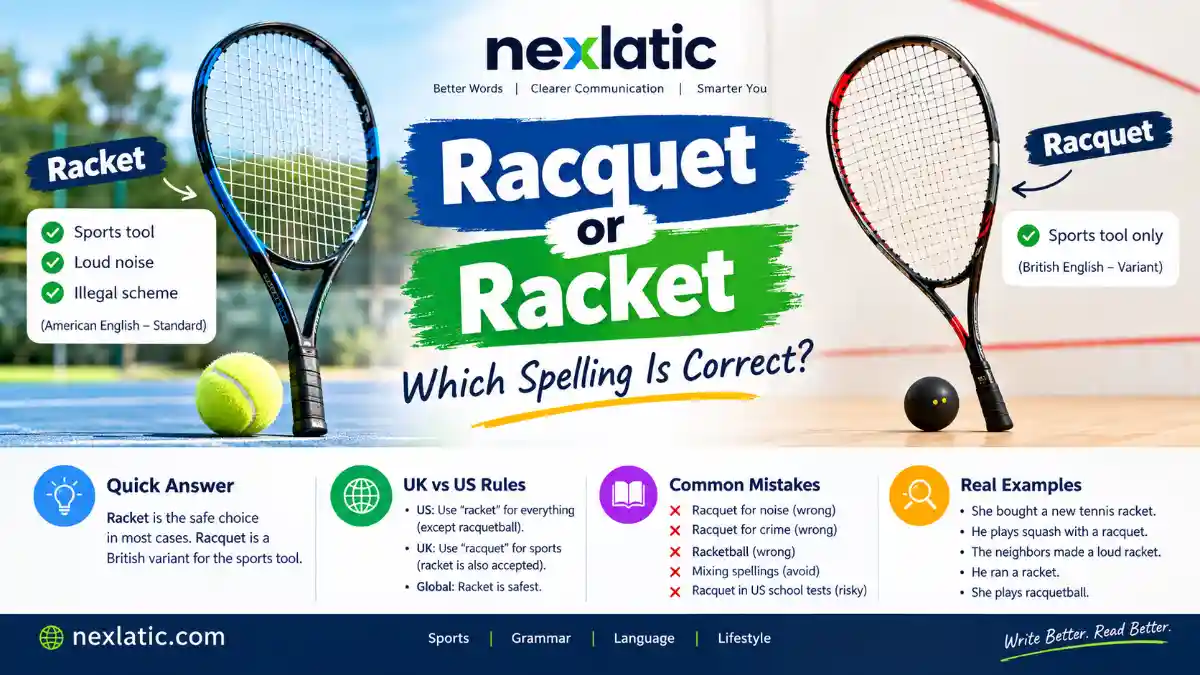
Racket is the safe choice in almost every case. It works in American English and is accepted in British English for the sports tool. Racquet is a variant spelling of the sports tool, used mainly in British English.
Remember this rule:
- Racket = sports tool + loud noise + illegal scheme
- Racquet = sports tool only
Examples:
- She bought a new tennis racket.
- He plays squash with a wooden racquet.
- The neighbors made a loud racket last night.
- The gang ran a money racket.
You can never use “racquet” for noise or crime. That is the key difference.
The Origin of Racquet or Racket
The word came from the French word raquette, which means a netted frame. English took this word centuries ago. The spelling “racket” became the standard form.
“Racquet” started as a misspelling of the French word. It entered English in the 1800s. Over time, British writers used it more and more for sports. Today it looks more French, but it is still just a variant.
Both spellings sound the same: /ˈrakət/. The “-qu-” in “racquet” does not change the sound. It only changes the look of the word.
One special case: racquetball. This sport keeps the “-qu-” spelling in all English varieties, even in America. So always write “racquetball,” never “racketball”.
British English vs American English Spelling
The two regions follow different habits. Here is the full picture.
British English: Use “racquet” for the sports tool. Use “racket” for noise and crime. Many British tennis writers now also accept “racket” for the tool.
American English: Use “racket” for everything. The sports tool, the noise, and the crime are all “racket.” The only exception is “racquetball.”
Canada: Prefers “racket,” like the US.
Australia: Uses both spellings.
| Meaning | British English | American English |
| Sports tool (tennis, badminton, squash) | racquet (also racket) | racket |
| The sport racquetball | racquetball | racquetball |
| Loud noise | racket | racket |
| Dishonest scheme | racket | racket |
| Feature | Racquet | Racket |
| Part of speech | Noun | Noun |
| Pronunciation | /ˈrakət/ | /ˈrakət/ |
| Sports meaning | Yes | Yes |
| Noise meaning | No | Yes |
| Crime meaning | No | Yes |
| Used in US | Rare (except racquetball) | Standard |
| Used in UK | Common for sports | Standard |
Which Spelling Should You Use?
Pick your spelling based on your reader.
Writing for a US audience? Use “racket.” It is always correct in American English. School tests, sports news, and business writing in the US all expect “racket.”
Writing for a UK or Commonwealth audience? Use “racquet” for sports equipment. It feels natural to British readers. For example, a London sports club writes “squash racquet.” But “racket” will also be understood.
Writing for a global audience? Use “racket.” It is understood everywhere and never wrong for sports. This is the safest choice for websites, ads, and product pages.
Writing about racquetball? Always use “racquetball” with “-qu-.” This rule never changes.
Formal writing? Follow one style guide. If you use British style, write “racquet” for sports. If you use American style, write “racket” everywhere.
Common Mistakes with Racquet or Racket
Mistake 1: Using “racquet” for noise.
Wrong: “The kids made a racquet.”
Right: “The kids made a racket.”
Mistake 2: Using “racquet” for a crime scheme.
Wrong: “He ran a racquet.”
Right: “He ran a racket.”
Mistake 3: Writing “racketball.”
Wrong: “She plays racketball.”
Right: “She plays racquetball.”
Mistake 4: Mixing spellings in one document.
Wrong: “He grabbed his racquet. Then he broke his racket.”
Right: Pick one style and stay with it.
Mistake 5: Using “racquet” in American school tests.
US teachers and tests expect “racket.” The “-qu-” form can be marked wrong in strict American tests.
Racquet or Racket in Everyday Examples
In emails:
“Hi Sam, please bring your tennis racket to the court at 5 pm.” (US safe)
“Hi Sam, please bring your tennis racquet to the club at 5 pm.” (UK natural)
In news:
“The player smashed his racket after losing the match.” (Standard in US sports news)
“The squash champion held her racquet high.” (Common in UK sports news)
In social media:
“New racket day! Ready for the season.”
“Morning drills with my favourite racquet.”
In formal writing:
“Each athlete must provide their own racket.” (American style guide)
“Players are asked to bring their own racquets.” (British style guide)
On product pages:
Global shops should use “racket.” It works for all buyers and search engines.
Racquet or Racket – Google Trends & Usage Data
Exact Google Trends numbers change every day, so treat this as a general pattern, not measured data. The pattern is clear and stable.
“Racket” is searched far more often than “racquet” worldwide. This makes sense. The US is a large English market, and Americans use “racket” for every meaning.
“Racquet” gets most of its searches from the UK, Ireland, Australia, and New Zealand. People there search for “squash racquet” and “racquetball.” The word “racquetball” also lifts the numbers, since it keeps the “-qu-” spelling everywhere.
Searches for “racket” spike around big tennis events. Searches for “racquet” spike around squash and racquetball events. Both words trend with sports seasons.
If you write for search engines, “racket” reaches more readers. But “racquet” can help you rank for British sports searches.
FAQs
Are racquet and racket both correct?
Yes. “Racket” is the standard spelling for the sports tool. “Racquet” is an accepted variant, mainly in British English. Both are correct for sports.
Do racquet and racket sound the same?
Yes. Both are pronounced /ˈrakət/. The “-qu-” in “racquet” does not change the sound at all.
Why do two spellings exist?
“Racquet” began as a misspelling of the French word raquette in the 1800s. British writers kept using it, and it became an accepted variant.
Which spelling should I use for tennis?
Use “racket” in the US. Use “racquet” or “racket” in the UK. The International Tennis Federation uses “racket.”
Can “racquet” mean a loud noise?
No. Only “racket” means a loud noise or a dishonest scheme. “Racquet” only means the sports tool.
How do you spell racquetball?
Always “racquetball” with “-qu-.” This is standard in all English varieties, including American English.
Which spelling is better for exams?
In American exams, write “racket.” In British exams, either is fine for sports, but “racket” is never marked wrong.
Conclusion
The “Racquet or Racket” question has a clear answer. “Racket” is the standard spelling for the sports tool in American English and is accepted everywhere. “Racquet” is a British variant for the sports tool only. The two words sound the same but look different.
The most important rule is about meaning. “Racket” covers three ideas: the sports tool, a loud noise, and a dishonest scheme. “Racquet” covers only the sports tool. Never use “racquet” for noise or crime.
For daily use, pick one style and stay with it. American readers expect “racket.” British readers accept “racquet” for sports. Global readers understand “racket” best. And always write “racquetball” with “-qu-.”
Now you can write with confidence. Whether it is an email, an essay, or a product page, you know the right word for the right reader.

Ali Bismal is the founder and writer behind Nexlatic.com, a growing online platform created to provide useful, informative, and easy-to-understand content for everyday readers. Through Nexlatic, Ali shares practical ideas, helpful guides, interesting topics, and engaging articles designed to make information simple and accessible. His goal is to create reliable, reader-focused content that helps people learn something new, find useful answers, and make everyday life a little easier.