Have you ever stopped mid-sentence and wondered: is it “frolick” or “frolic”? You are not alone. This small word causes big doubt. It looks simple, but that final letter tricks many writers. Students, bloggers, and even native speakers pause over it.
People search “Frolick or Frolic” because the answer is not clear at first glance. The word ends in a “k” sound. So adding a “k” feels natural. Also, the forms “frolicking” and “frolicked” do use a “k.” That adds to the confusion. If the verb forms have a “k,” why doesn’t the base word?
This guide clears it all up. You will get a fast answer first. Then you will learn the word’s history and the spelling rule behind it. You will see mistakes to avoid and real examples. By the end, you will spell this word with total confidence. The rule is easy once you see it. Let’s begin with the quick answer.
Frolick or Frolic – Quick Answer
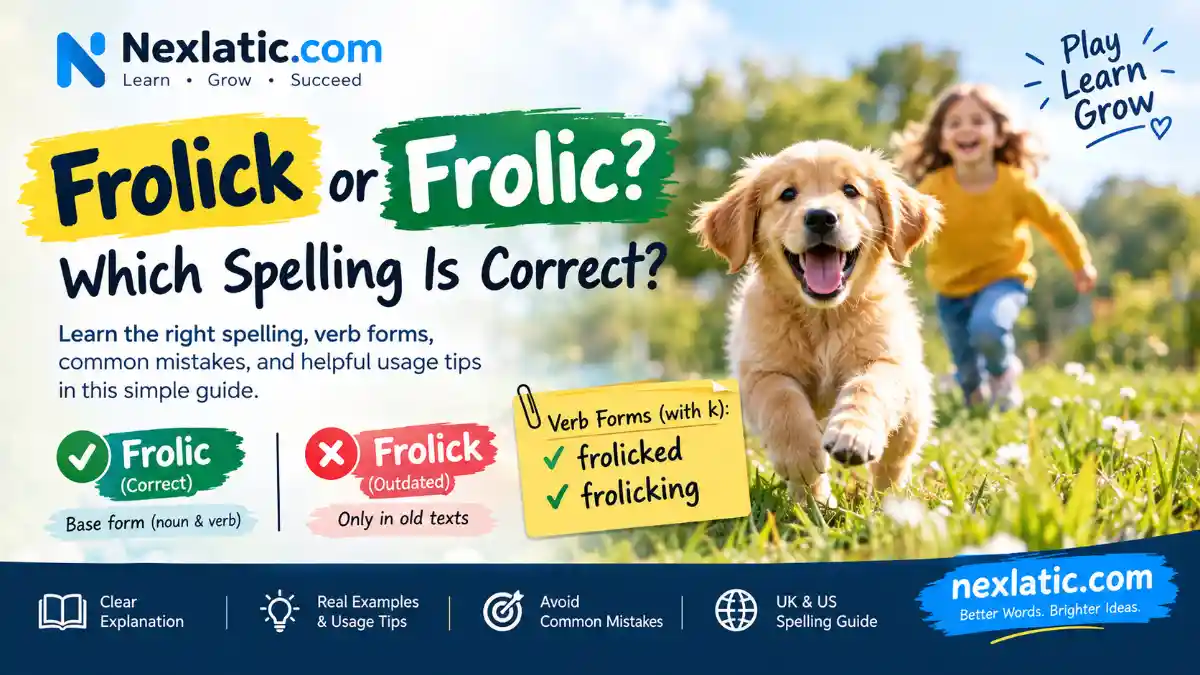
“Frolic” is the correct modern spelling. Use it as both a noun and a verb.
“Frolick” with a “k” is an old, outdated spelling. You may see it in old books, even from the 1800s. Do not use it in modern writing.
But here is the twist. The verb forms do use a “k”: frolicked and frolicking. This is correct and required. The “k” keeps the hard “c” sound. Without it, “froliced” would read like “froh-liced.”
Examples:
- Correct: The kids frolic in the park. (base form, no “k”)
- Correct: They frolicked on the beach yesterday. (past tense, with “k”)
- Correct: The puppy is frolicking in the snow. (present participle, with “k”)
- Wrong: They went for a frolick in the meadow. (never use “k” in the base form)
The Origin of Frolick or Frolic
The word “frolic” comes from the Dutch word vrolijk, which means merry or cheerful. It is related to the German word fröhlich, which means happy. The word entered English in the 1500s.
At first, “frolic” was an adjective meaning full of fun. By the 1600s, it became a noun and a verb too. Writers like Shakespeare used it to describe playful joy.
So why does “frolick” exist at all? In old English, many words ending in “c” added a “k.” People wrote “musick,” “traffick,” and “frolick.” Over time, English dropped the extra “k” from the base forms. “Music,” “traffic,” and “frolic” became standard.
But the “k” survived in the verb endings. “Frolicked” and “frolicking” kept it to protect the hard sound. That is why the confusion lives on today.
British English vs American English Spelling
Good news: there is no difference between British and American spelling here. Both use “frolic.” Both use “frolicked” and “frolicking.”
| Word Form | British English | American English |
| Base form | frolic | frolic |
| Past tense | frolicked | frolicked |
| Present participle | frolicking | frolicking |
| Adjective | frolicsome | frolicsome |
The rule is the same on both sides of the Atlantic. Learn it once, and it works everywhere.
Which Spelling Should You Use?
The advice is simple for every audience:
- US audience: Write “frolic.” Write “frolicked” and “frolicking” for verb forms.
- UK / Commonwealth audience: Exactly the same. No changes needed.
- Students and exam takers: Memorize this pair: frolic (base), frolicked/frolicking (verb forms). Teachers test this often.
- Bloggers and writers: Use “frolic” in all modern content. Never use “frolick” unless you are quoting an old text.
- ESL learners: Think of “picnic” → “picnicked.” The same “k” rule applies. It is a pattern, not a random exception.
Pro tip: If the word stands alone, no “k.” If it ends in “-ed” or “-ing,” add the “k.”
Common Mistakes with Frolick or Frolic
- Writing “frolick” as the base form. Wrong in modern English. Always write “frolic.”
- Writing “froliced” or “frolicing.” Wrong. The single “c” would soften the sound. Always write “frolicked” and “frolicking.”
- Using “frolick” to sound old or fancy. This only works in historical fiction. In normal writing, it looks like a typo.
- Confusing the noun and verb. “Frolic” is both. “A joyful frolic” (noun). “They frolic daily” (verb). Both spell the same.
- Overusing the word in formal writing. “Frolic” is playful and light. In a serious report, use “celebrate” or “enjoy” instead.
- Forgetting the rule applies to similar words. “Traffic” → “trafficked.” “Panic” → “panicked.” Same pattern as “frolic” → “frolicked.”
Frolick or Frolic in Everyday Examples
Email (to a friend):
“Hi Sara, the kids had a wonderful frolic in the garden today. They were frolicking in the leaves for hours!”
News article:
“Tourists frolicked on the beach as the summer festival opened with music and games.”
Social media post:
“Nothing beats a morning frolic with my dog at the park! 🐶 #WeekendFun”
Formal writing (school essay):
“In the poem, the lambs frolic in the meadow, which symbolizes innocence and joy.”
Frolick or Frolic – Google Trends & Usage Data
“Frolic” is a low-frequency word in modern English. It is not an everyday word for most people, and searches for it tend to be steady rather than spiky typical of a spelling question people look up when they need it.
Who searches it? Mainly three groups. Students check the spelling for essays and exams. Writers want to get “frolicking” right in stories. Word lovers look it up out of curiosity after seeing it in a book.
The word appears most in literature, children’s books, and nature writing. It is rare in business or tech writing. As an English spelling question, it draws searches from English-speaking countries such as the US, UK, Canada, and Australia, though exact country-level data was not verified here.
Tip for writers: Because it is a spelling question, answer it in your first paragraph. Readers want the rule fast, then they leave.
Frolic vs Frolick – Side-by-Side Comparison
| Form | Correct? | When to Use |
| frolic | ✅ Yes | Base form, noun and verb: “a frolic,” “they frolic” |
| frolick | ❌ No (modern) | Only in old texts; avoid today |
| frolicked | ✅ Yes | Past tense: “they frolicked yesterday” |
| frolicking | ✅ Yes | Present participle: “she is frolicking now” |
| froliced / frolicing | ❌ No | Never correct; the “k” is required |
FAQs
Which is correct: frolick or frolic?
“Frolic” is correct in modern English. “Frolick” is an outdated spelling from centuries ago and should not be used today.
Why do we write “frolicking” with a k?
The “k” keeps the hard “c” sound before “-ing” and “-ed.” Without it, “frolicing” would be read with a soft “c,” like “icing.”
Is “frolick” ever correct?
Only in historical writing. You may see it in old books, even from the 1800s. In all modern writing, use “frolic.”
What does “frolic” mean?
It means to play and move about happily. Lambs frolic in fields. Children frolic at the beach. It always suggests cheerful fun.
Is “frolic” a noun or a verb?
It is both. As a noun: “a frolic in the park.” As a verb: “they frolic every morning.” The spelling is the same either way.
What is the past tense of “frolic”?
The past tense is “frolicked,” with a “k.” Example: “The puppies frolicked in the garden all afternoon.”
What is the adjective form of “frolic”?
The adjective is “frolicsome,” meaning playful and full of fun. Example: “a frolicsome puppy.”
Conclusion
So, frolick or frolic? The answer is frolic. That is the correct modern spelling for the base word. “Frolick” belongs to history books, not to your essay, email, or blog post.
But remember the twist. When you add “-ed” or “-ing,” the “k” comes back: frolicked and frolicking. This is not random. It protects the hard “k” sound. The same rule gives us “trafficked” and “panicked.” Learn the pattern once, and many words become easy.
Why does this matter? Small spelling errors hurt trust. In school, they cost marks. At work, they weaken your message. Readers may not know the rule, but mistakes still distract them. Clean spelling keeps the focus on your ideas.
The fix is simple. Base word: no “k.” Verb endings: add the “k.” The rule takes seconds to learn. Say it once in your head, and you will never mix them up again. Now go and use “frolic” with confidence.

David Wilson is a writer and contributor at Nexlatic.com, where he writes about useful topics, everyday questions, and practical ideas. He enjoys turning information into simple, clear, and easy-to-read articles that readers can actually use. Through his work at Nexlatic, David aims to share helpful content that answers common questions, explains confusing topics, and gives readers something useful to take away from every article.