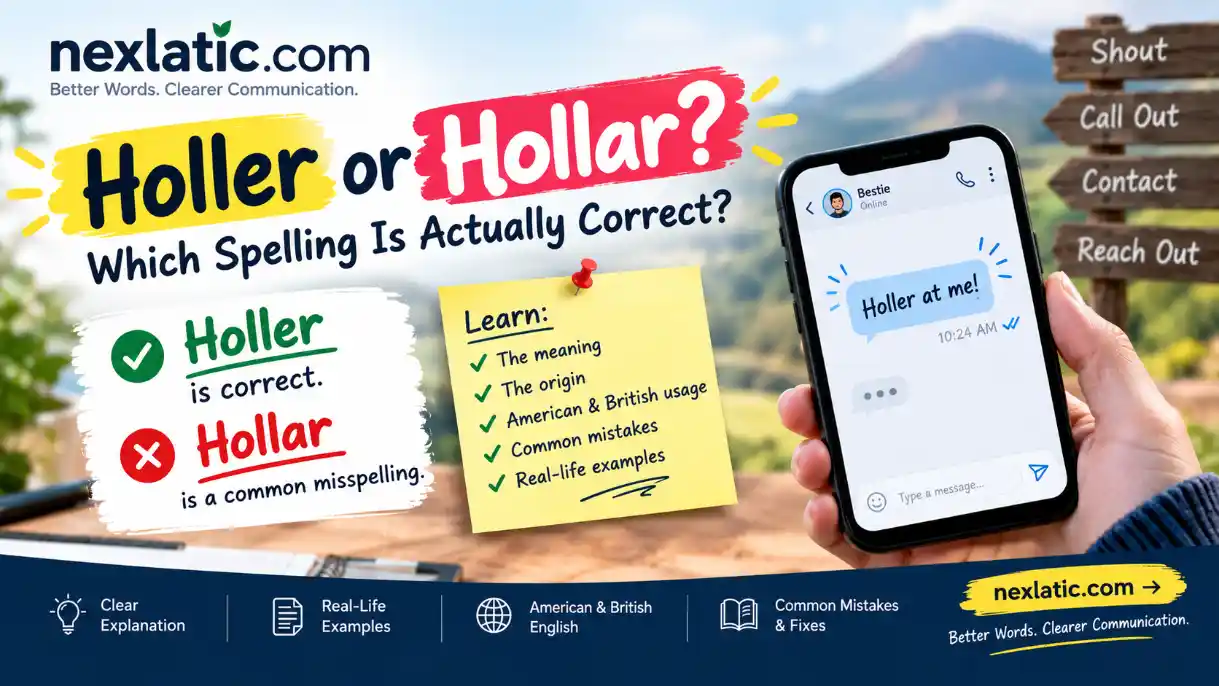
You are texting a friend and want to say “call me” in a casual way. You type “hollar at me,” then stop. Is it hollar or holler? Spellcheck underlines one of them, but which spelling is correct?
This mix-up is more common than most people think. The word sounds simple, but two spellings float around online, in text messages, and even in song lyrics. One version is the real English word. The other is a spelling mistake that spread because of how the word sounds when spoken fast.
People search “hollar or holler” for a few clear reasons. They want to write a text or email without looking careless. They see both spellings used online and don’t know which one is standard. Or they’ve heard the word in music or slang and never seen it written down.
This article gives you the fast answer first, then the full explanation. You’ll learn where the word comes from, how American and British English treat it, and how to avoid the mistake for good.
Hollar or Holler – Quick Answer
Holler is the correct spelling. Hollar is a common misspelling.
- ✅ He gave a loud holler from across the field.
- ✅ Just holler if you need anything.
- ❌ He gave a loud hollar from across the field.
- ❌ Just hollar if you need anything.
“Holler” means to shout or call out loudly. It also works as a noun for a loud shout, and in American regional speech, it can even mean a small valley (more on that below). “Hollar” has no dictionary meaning. It’s simply a spelling error, usually caused by how the word sounds when spoken quickly.
The Origin of Holler
“Holler” comes from the older English word hollow or hollo, a shout used to call attention or greet someone from a distance. Over time, English speakers shortened and reshaped this call into “holler,” and it settled into everyday use by the 1800s, especially in American English.
Why does “hollar” exist at all? It comes down to sound, not history. When people say “holler” out loud, the second syllable often sounds like “-er” or a soft “-ar,” especially in casual or regional speech. Writers who go by ear instead of by memory sometimes spell it the way it sounds rather than the way it’s actually written. This is the same reason people confuse words like “definately” and “definitely,” or “seperate” and “separate.”
Spelling differences like this usually come from three things:
- Regional pronunciation
- Speed of speech blurring vowel sounds
- Lack of exposure to the word in writing
“Holler” also picked up a second meaning in the southern United States, where it refers to a small valley or hollow between hills as in “he lives up in the holler.” This regional use adds to the word’s presence in everyday speech, which increases how often people try to write it down and second-guess the spelling.
British English vs American English Spelling
Both American and British English agree on this one: the correct spelling is holler, not hollar. This isn’t a case like “colour” vs “color,” where regional spelling rules genuinely differ. Here, one spelling is simply standard and the other is not recognized in any major dictionary.
That said, British English uses “holler” less often in daily speech. British speakers are more likely to say “shout,” “yell,” or “call out.” Americans use “holler” casually and frequently, especially in the phrase “holler at me,” meaning “contact me” or “let me know.”
| Feature | American English | British English |
| Correct spelling | Holler | Holler |
| Common usage | Frequent, casual | Less common |
| Typical meaning | Shout / call out / contact someone | Shout / call out |
| Regional extra meaning | Small valley (Southern US) | Not used |
| Casual phrase example | “Holler at me later” | Rarely used this way |
Which Spelling Should You Use?
The answer is the same no matter where you live: use holler. There is no regional version of “hollar” that is considered correct.
- US writers: Use “holler” freely, including in casual writing, texts, and informal business messages (“holler if you need help”). Avoid it in formal reports or academic writing, where “call,” “contact,” or “reach out” sound more professional.
- UK and Commonwealth writers: “Holler” is understood but sounds distinctly American and informal. In everyday British writing, “shout” or “call out” often fits better.
- Global / ESL writers: Learn “holler” as the correct spelling and treat “hollar” as an error to avoid, similar to memorizing “definitely” over “definately.”
In every case, “hollar” should be avoided in writing of any kind, from texts to formal documents.
Common Mistakes with Holler
- Spelling it “hollar” because of pronunciation. Wrong: Don’t hollar at your brother. Right: Don’t holler at your brother.
- Confusing “holler” with “hollow.” These are related in origin but different words today. “Hollow” means empty inside; “holler” means to shout.
- Using “holler” in formal writing. Wrong (in a business email): Please hollar if you have questions. Right: Please reach out if you have questions.
- Assuming “hollar” is a regional British or American spelling. It is not recognized as standard in either. It’s a spelling mistake, not a dialect variation.
- Autocorrect confusion. Some people type “hollar” so often that they no longer notice the red underline, especially on phones where autocorrect can be inconsistent.
Holler in Everyday Examples
- Text message: “Holler at me when you land.”
- Email (casual, internal team): “Holler if you have any last-minute changes before I send this out.”
- Social media: “Big shoutout and a holler to everyone who showed up today!”
- News writing: “Residents could hear him holler for help from across the street.”
- Formal writing (business/legal): Avoided entirely. Formal writing uses “contact,” “notify,” or “call.”
The pattern is clear: “holler” fits casual and conversational writing well but rarely appears in formal documents.
Holler – Google Trends & Usage Data
Search interest in “hollar or holler” reflects a spelling-confusion pattern rather than two competing correct forms. This kind of search behavior is common for words that sound different from how they’re spelled, or where casual speech doesn’t match written norms.
General usage patterns show:
- United States: Highest search volume and everyday use, largely due to the casual phrase “holler at me” in texting and social media.
- United Kingdom and other Commonwealth countries: Lower search volume, since “holler” is used less often in daily speech.
- Global / non-native English speakers: Searches often come from people learning the word through American music, film, or social media, then wanting to confirm the correct spelling before using it in writing.
The consistent finding across regions is the same: people search this term to resolve uncertainty, not because both spellings are valid.
Keyword Variations Comparison Table
| Variation | Correct? | Notes |
| Holler | ✅ Yes | Standard spelling, all English dialects |
| Hollar | ❌ No | Common misspelling |
| Holler at | ✅ Yes | Casual American phrase meaning “contact me” |
| Hollar at | ❌ No | Misspelled version of the phrase |
| Holler back | ✅ Yes | Common phrase, casual tone |
| Hollow | ✅ Yes (different word) | Means empty inside, related origin |
FAQs
Is “hollar” ever correct? No. “Hollar” is not a recognized English word in any dictionary. “Holler” is always the correct spelling.
What does “holler at me” mean? It’s a casual American phrase meaning “contact me” or “let me know,” often used in texting or informal speech.
Is “holler” formal or informal? Informal. Use “call,” “contact,” or “reach out” in formal writing instead.
Does British English use “holler” differently than American English? No, the spelling and meaning are the same. British speakers simply use the word less often, preferring “shout” or “call out.”
Why do people misspell “holler” as “hollar”? Because of pronunciation. The ending sound can resemble “-ar” in casual speech, leading writers to spell it the way it sounds.
Is “holler” related to “hollow”? Yes, both trace back to older English words for a loud call or shout, but today they have separate meanings.
Can “holler” mean something other than shouting? Yes. In parts of the southern United States, “holler” also refers to a small valley between hills, as in “he lives up in the holler.”
Conclusion
The correct spelling is holler, not hollar. This isn’t a case of regional spelling differences like “colour” versus “color” it’s a simple, common misspelling caused by how the word sounds when spoken casually or quickly.
“Holler” means to shout or call out loudly, and in American regional speech, it can also describe a small valley. It shows up often in casual texts, social media, and everyday conversation, especially in the American phrase “holler at me.” It rarely appears in formal writing, where words like “call,” “contact,” or “reach out” fit better.
No matter where you’re writing from the US, the UK, or anywhere else “hollar” is always incorrect. Remembering this one rule solves the confusion for good: if you mean to shout or call out, spell it holler.

Ali Bismal is the founder and writer behind Nexlatic.com, a growing online platform created to provide useful, informative, and easy-to-understand content for everyday readers. Through Nexlatic, Ali shares practical ideas, helpful guides, interesting topics, and engaging articles designed to make information simple and accessible. His goal is to create reliable, reader-focused content that helps people learn something new, find useful answers, and make everyday life a little easier.