Few word pairs cause as much trouble as effect and affect. They sound almost the same. They look almost the same. Even skilled writers pause before choosing one. Pick the wrong word and your sentence quietly says something you did not mean.
People search for “effect or affect” because the rule feels slippery. Most guides say affect is a verb and effect is a noun, and that is a good start. But then exceptions show up. Effect can be a verb too, and affect can be a noun in psychology. No wonder spellcheck cannot save you. Both words are always spelled correctly.
This guide gives you the full picture. You will get the quick rule, the history of both words, and the exceptions that confuse everyone. You will see side by side tables, real life examples, and simple memory tricks. By the end, you will choose with confidence every time.
Effect or Affect – Quick Answer
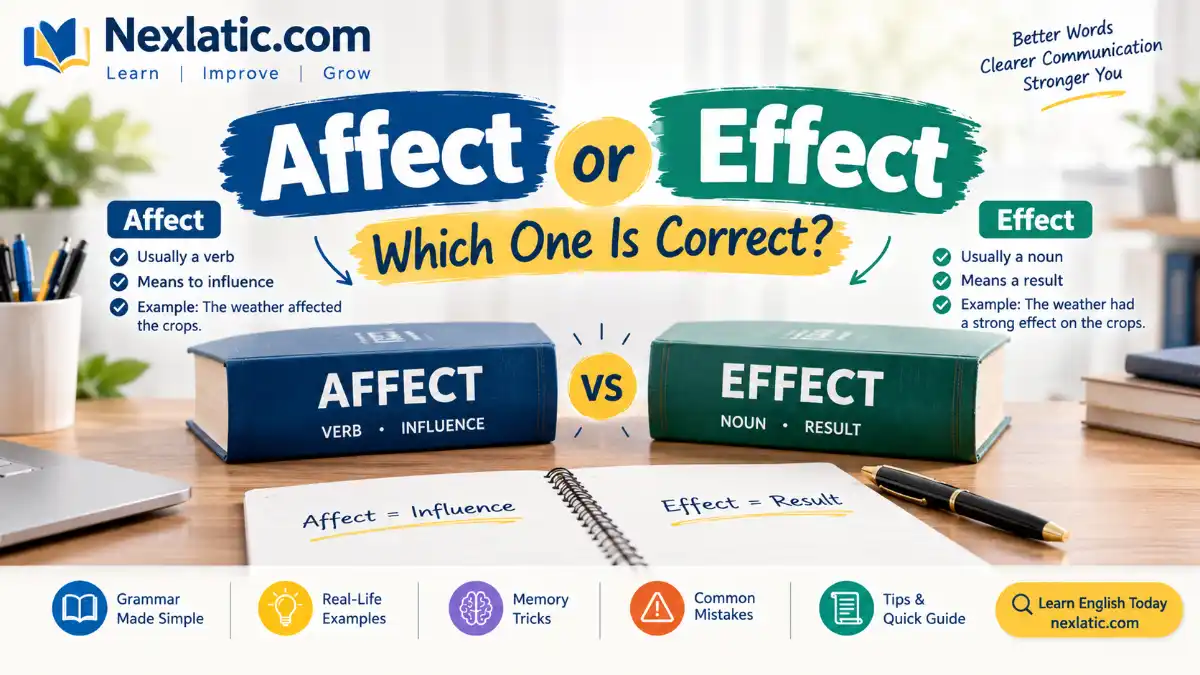
Affect is usually a verb meaning to influence. Effect is usually a noun meaning a result.
- Affect (verb): The cold weather affected the crops. (It influenced them.)
- Effect (noun): The cold had a strong effect on the crops. (It produced a result.)
Try this test. If you can replace the word with influence, use affect. If result fits instead, use effect. This rule works in most everyday sentences.
The Origin of Effect or Affect
Both words come from the same Latin root, which is why they look like twins.
Affect entered English in the 1400s from the Latin word affectus, from afficere. That verb combined ad- (toward) with facere (to do or make). Its core idea was to act upon something, to influence it.
Effect is even older in English. It arrived in the 1300s from the Latin word effectus, meaning a result. That came from efficere, which combined ex- (out) with facere (to do or make). Its core idea was something brought out of an action. The verb sense “to bring about” appeared later, in 1533.
So both words grew from facere, the Latin verb “to do.” One branch stressed acting on something (affect). The other stressed what comes out of an action (effect). They share a root but took different jobs, and that is exactly why writers mix them up.
British English vs American English Spelling
Here is the honest truth. There is no British versus American difference for this pair. Both countries spell and use them the same way.
| Word | British Spelling | American Spelling | Same? |
| Affect | affect | affect | Yes |
| Effect | effect | effect | Yes |
Unlike pairs such as favour and favor, nothing changes across the ocean. The confusion is about grammar and meaning, not region. Use the verb-noun test, and you will be right everywhere.
Which Spelling Should You Use?
Forget about region. Think about the job the word does in your sentence.
Use affect when something acts on something else:
- The new tax will affect small businesses.
- Lack of sleep affected his mood.
- The movie deeply affected the audience.
Use effect when you name the result:
- The new tax had a big effect on small businesses.
- The effect of the medicine was quick.
- Sound effects made the film feel real.
Now the two exceptions. Effect can be a verb meaning “to bring about,” but only in formal writing. “The manager will effect changes” means the manager will bring changes about. Affect can be a noun in psychology meaning emotion, as in “a flat affect.” Most writers will never need these.
Two memory tricks can help. First, remember RAVEN: Remember Affect is a Verb, Effect is a Noun. Second, the action is affect, and the end result is effect.
Common Mistakes with Effect or Affect
Mistake 1: “The weather had a strong affect on our trip.”
Fix: The weather had a strong effect on our trip. After “a strong,” you need the noun, the result.
Mistake 2: “This decision will effect our budget.”
Fix: This decision will affect our budget. The decision influences the budget, so use the verb.
Mistake 3: “What was the affect of the new law?”
Fix: What was the effect of the new law? “What was the result” fits, so use the noun.
Mistake 4: “The new policy will effect change in the company.”
Fix: This one is actually correct. Here effect is the formal verb meaning “to bring about.” In plain writing, “bring about change” sounds more natural.
Mistake 5: Trusting spellcheck to catch the error.
Fix: Both words are always spelled correctly, so the computer stays silent. Read the sentence and run the verb-noun test yourself.
Effect or Affect in Everyday Examples
In emails:
- “The delay will affect our delivery date.” (verb, influence)
- “The effect of the delay is a new delivery date.” (noun, result)
On social media:
- “Lack of sleep really affects me.” (verb, casual)
- “Side effects may include dizziness.” (noun, common phrase)
In formal writing:
- “The study measured the effects of the program on learning.” (noun)
- “The board voted to effect a full review.” (verb, formal, means to bring about)
Effect or Affect – Google Trends & Usage Data
I did not check live Google Trends data for this article, so treat the notes below as general usage guidance, not fresh numbers.
In general, effect appears more often than affect in published text, because the noun shows up in fixed phrases like “side effects,” “special effects,” and “in effect.” Affect clusters in writing about causes and change, such as news and science articles.
Searches for “effect or affect” stay high all year and rise during school terms, when students write essays. The question is popular in every English speaking country, because the confusion comes from grammar, not from any regional spelling rule.
Effect vs Affect: Side by Side Comparison
| Feature | Affect | Effect |
| Main job | Verb (to influence) | Noun (a result) |
| Replace with | Influence | Result |
| Origin | Latin affectus, from afficere (to act upon) | Latin effectus, from efficere (to bring about) |
| First use in English | 15th century | 14th century (noun), 1533 (verb) |
| Rare extra use | Noun in psychology (emotion) | Verb in formal writing (to bring about) |
| Synonyms | Influence, change, touch | Result, outcome, consequence |
| Common phrase | Affect the outcome | Side effects, in effect |
| Example | Rain affected the game. | Rain had an effect on the game. |
| UK spelling | affect | effect |
| US spelling | affect | effect |
Frequently Asked Questions
What is the basic difference between affect and effect?
Affect is usually a verb meaning to influence. Effect is usually a noun meaning a result.
Is it “affect change” or “effect change”?
Both exist. “Affect change” means to influence change. “Effect change” is formal for bringing change about.
Can effect be a verb?
Yes, in formal writing. To effect something means to bring it about, as in “to effect a repair.” In plain writing, “bring about” reads better.
Can affect be a noun?
Yes, in psychology. Affect as a noun means emotion, as in “a flat affect.” Most everyday writers never need this sense.
How can I remember the difference?
Use RAVEN: Remember Affect is a Verb, Effect is a Noun. Or think: the action is affect, the end result is effect.
Why does spellcheck not fix this mistake?
Both are real words with correct spellings. Only the verb-noun test in your head can tell which one your sentence needs.
Conclusion
Affect and effect share a Latin root, but they do different jobs. Affect is the verb of influence. It acts on things and changes them. Effect is the noun of result. It names what comes out of an action. Affect reached English in the 1400s, and effect as a noun arrived even earlier, in the 1300s. There is no British or American split. The rule is the same everywhere.
The fastest way to choose is the swap test. Put influence in the sentence. If it fits, write affect. Put result in the sentence. If it fits, write effect. Keep the RAVEN trick in your pocket, and remember the first letter clue. The action is affect, and the end result is effect.
Watch for the two rare exceptions. Effect can be a formal verb meaning to bring about, and affect can be a psychology noun meaning emotion. Test every sentence, trust the rule, and the confusion ends for good.

David Wilson is a writer and contributor at Nexlatic.com, where he writes about useful topics, everyday questions, and practical ideas. He enjoys turning information into simple, clear, and easy-to-read articles that readers can actually use. Through his work at Nexlatic, David aims to share helpful content that answers common questions, explains confusing topics, and gives readers something useful to take away from every article.