Have you ever typed “speciality” and wondered if it was wrong? Many people feel this doubt. The words look almost the same, so the choice feels hard.
People search for “specialty or speciality” for a clear reason. Both forms appear online. US sites often show one form. UK sites often show the other. Job posts, menus, and school forms add more mix.
This creates stress. No one wants a spelling error in a resume or a business email. A small error can feel big.
This guide clears the doubt. First, you get a fast answer. Next, the history shows why both forms exist. Then you learn which form fits your readers in the US, the UK, and global settings.
Real examples help you see the use in daily life. At the end, the choice will feel easy. Your writing will look clean and sure. Keep reading, and you will never guess again.
Specialty or Speciality – Quick Answer
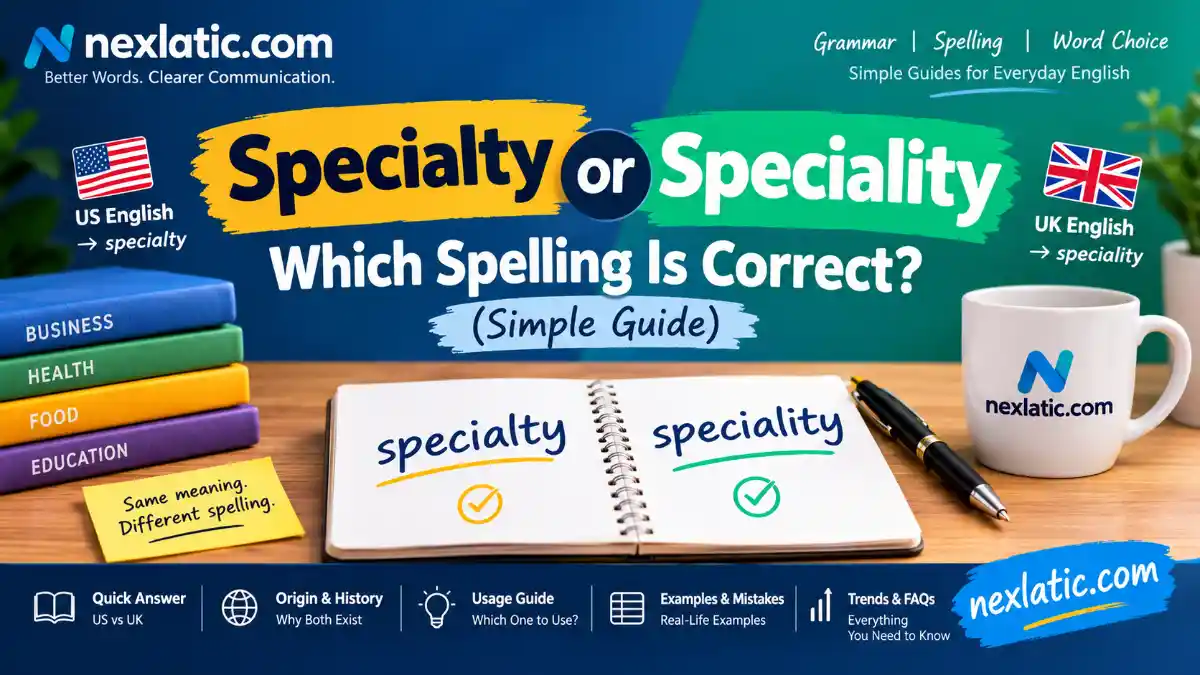
Specialty is the common form in American English. Speciality is the common form in British English. Both mean the same thing.
A specialty is a special skill, product, or field.
Examples with specialty (US):
- Their specialty is heart care.
- The chef’s specialty is pasta.
Examples with speciality (UK):
- Their speciality is heart care.
- The chef’s speciality is pasta.
The meaning does not change. Only the spelling changes by region.
The Origin of Specialty or Speciality
The root is the word “special.” It comes from Latin “specialis,” which meant for a set purpose. English took it in the 1200s.
Speciality came first in English. It was used for a special quality or field. Later, American English made it shorter. Specialty dropped some letters, which is common in US spelling.
This is why both forms live today. British English kept the longer form. American English chose the shorter form. The split follows a broad pattern, like “colour” and “color.”
British English vs American English Spelling
American English often makes words shorter. British English often keeps the longer form. This pair fits that rule.
| Use | American (US) | British (UK) | Example US | Example UK |
| Special skill | specialty | speciality | Their specialty is skin care. | Their speciality is skin care. |
| Special product | specialty | speciality | Pizza is the house specialty. | Pizza is the house speciality. |
| Medical field | specialty | speciality | A medical specialty | A medical speciality |
In short, the meaning stays the same. Pick the form that fits your reader’s region.
Which Spelling Should You Use?
Match your reader. That is the best rule.
If most readers are in the US, write specialty. It looks normal and clean there. In the UK, Ireland, Australia, and New Zealand, speciality feels local and right.
For a global crowd, pick one form and stay with it. Many global brands pick specialty because US English is common online. Either choice is fine if you stay consistent.
Quick test: Where do most readers live? Let that answer guide the spelling.
Common Mistakes with Specialty or Speciality
- Mistake: Using both forms in one text.
Fix: Pick one. Do not switch mid-page. - Mistake: Writing “specialities” when you need the US plural.
Fix: In US English, write specialties. In UK English, write specialities. - Mistake: Adding the wrong ending: “specialtiy.”
Fix: Check the order of letters. It ends with “ty” or “ity.” - Mistake: Using the word for a dish when “special” fits better.
Fix: “Today’s special” is often better than “today’s specialty” for a one-day offer.
Tip: Read the page once. Search for both spellings. Keep only one.
Specialty or Speciality in Everyday Examples
Email (work):
- US: Our specialty is fast delivery.
- UK: Our speciality is fast delivery.
News:
- US: The hospital added a new specialty in heart care.
- UK: The hospital added a new speciality in heart care.
Social media:
- US: Come try our specialty coffee!
- UK: Come try our speciality coffee!
Formal writing:
- US: The report lists three medical specialties.
- UK: The report lists three medical specialities.
Notice the pattern. The sentence stays the same. Only the key word changes.
Specialty or Speciality – Google Trends & Usage Data
In general use, specialty appears more often worldwide. This is because US English is common online. It leads in the US, Canada, and many global searches.
Speciality leads in the UK and Ireland. It also shows up more in Australia and New Zealand. There, readers expect the longer form.
Context matters too. In food and retail, both forms are common. Menus often say “house specialty” in the US and “house speciality” in the UK. In medicine, the same split holds.
Bottom line: match the country, and you will match what people expect.
Specialty vs Speciality – Side-by-Side Comparison
Here is a quick side-by-side view:
| Form | Region | Kind | Example |
| specialty | US | noun | Their specialty is design. |
| speciality | UK | noun | Their speciality is design. |
| specialties | US | plural noun | Medical specialties are growing. |
| specialities | UK | plural noun | Medical specialities are growing. |
FAQs
1. Which is correct: specialty or speciality?
Both are correct. Specialty is US. Speciality is UK. Pick by region.
2. Do they mean different things?
No. The meaning is the same. Only spelling changes.
3. What is the plural in American English?
Specialties. Example: The clinic lists many specialties.
4. What is the plural in British English?
Specialities. Example: The clinic lists many specialities.
5. Can I use specialty for a global site?
Yes. Many global sites use specialty. Just stay consistent on all pages.
6. Is speciality old or wrong?
No, it is not wrong. This is the normal UK form. It is also the older English form.
7. How do I remember which to use?
Think of “color” vs “colour.” Short form often means US. Long form often means UK.
Conclusion
In short, both words are right. Specialty fits American English. Speciality fits British English. The meaning stays the same.
This small choice shapes trust. Readers feel at home when spelling matches their region. A US reader expects specialty. A UK reader expects speciality. That match makes your text feel clean.
Pick one form for each project. Do not mix them on the same page. If your readers are global, specialty is often the safer pick, since US English is common online. Still, either form works when you stay steady.
Watch the plural too. Write specialties for US and specialities for UK. A quick search on your page can catch slips.
Keep this rule in mind for emails, menus, resumes, and reports. Small care here lifts the whole text. You will write with ease. Readers will feel the care in each line. That is the simple habit that keeps your writing sharp.

David Wilson is a writer and contributor at Nexlatic.com, where he writes about useful topics, everyday questions, and practical ideas. He enjoys turning information into simple, clear, and easy-to-read articles that readers can actually use. Through his work at Nexlatic, David aims to share helpful content that answers common questions, explains confusing topics, and gives readers something useful to take away from every article.