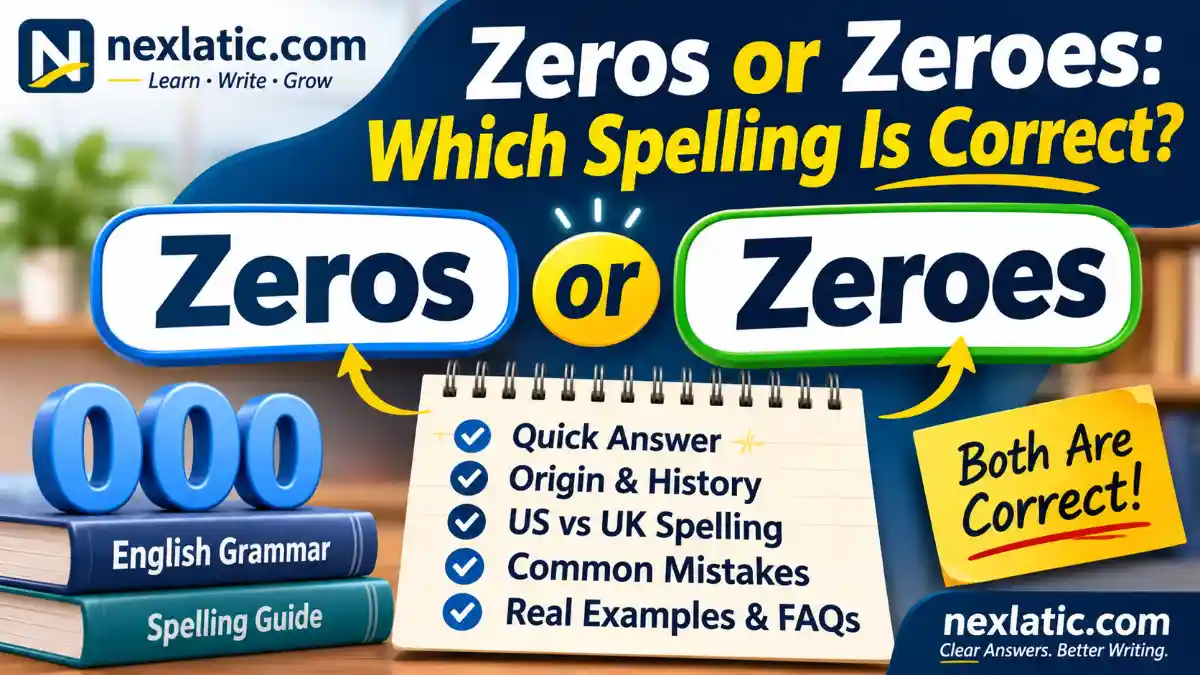
You type a number with three zeros. Then you stop and stare at the screen. Should it be “three zeros” or “three zeroes”? This guide settles the zeros or zeroes question once and for all.
You are not the only one who wonders. Students, coders, writers, and teachers search for this spelling every month. English has no single rule for words that end in -o. Potatoes take -es, yet photos take only -s.
Here is what you will get in this guide. First comes a quick answer you can use right away. After that, you will see where the word came from and how American and British writers handle it. Common mistakes, everyday examples, and a short FAQ round out the page.
By the end, you will know exactly which spelling fits your sentence. You will also learn the one case where “zeroes” clearly wins. Let us start with the short answer.
Table of Contents
- Zeros or Zeroes: Quick Answer
- The Origin of Zero
- British English vs American English Spelling
- Which Spelling Should You Use?
- Common Mistakes with Zeros or Zeroes
- Zeros or Zeroes in Everyday Examples
- Zeros vs Zeroes: Usage at a Glance
- Comparison Table: Zeros and Zeroes Side by Side
- Related Spelling Guides from Nexlatic
- FAQs
- Conclusion
Zeros or Zeroes: Quick Answer
Both spellings are correct. “Zeros” and “zeroes” are plural forms of “zero.” Major dictionaries list both spellings as standard.
Here is a simple rule you can follow:
- Plural noun: use “zeros.” (“Zeroes” is also accepted.)
- Verb: use “zeroes.” (She zeroes in on her goal.)
Short examples:
- The number 1,000 has three zeros.
- Add two zeroes to the end of the price.
- She zeroes in on her goal.
- The file was full of zeros.
If you want one safe default, pick “zeros” for the noun. Use it the same way every time.
The Origin of Zero
From Ancient Counting to English
The story starts in ancient India. Scholars there used the Sanskrit word “shunya,” which meant “empty.” Arabic writers adapted it as “sifr.” Medieval Latin turned it into “zephirum.” Italian shortened it to “zero.” English borrowed the word from Italian around the 1600s.
So the word traveled across four languages before it reached English. That long trip explains why its spelling looks a little unusual today.
Why the Plural Splits in Two
English never settled on one plural rule for words that end in -o. Older words often take -es. Potatoes, tomatoes, heroes, and echoes follow this pattern.
Borrowed and shortened words often take only -s. Pianos, photos, radios, and solos follow that habit instead.
“Zero” sits in the middle. It came from Italian, which points to the short -s ending. The word is also short and common, which pushes it the same way.
Over time, the plain -s form pulled ahead. Still, the -es form never disappeared, because English keeps old habits alive for a long time. The same kind of letter trouble shows up in other words too. Our guide on Firey or Fiery walks through another tricky spelling from the same family of problems.
British English vs American English Spelling
Here is the good news. This is not a color/colour style split. Writers in the United States and the United Kingdom accept both forms.
| Use | American English | British English | Safest Pick |
| Plural noun | zeros (common), zeroes (accepted) | zeros (common), zeroes (accepted) | zeros |
| Verb form | zeroes in | zeroes in | zeroes |
| Past tense | zeroed in | zeroed in | zeroed |
| Plural possessive | zeros’ | zeros’ | zeros’ |
| Everyday example | “three zeros” | “three zeros” | either works |
Some key points:
- American dictionaries usually list “zeros” first.
- British dictionaries accept both forms as equals.
- Neither side calls the other form wrong.
When no rule divides the two regions, your own consistency matters most.
Which Spelling Should You Use?
Match the spelling to your reader and your goal. American readers expect “zeros,” which looks clean and matches most US style guides. British and Commonwealth readers accept both forms, yet “zeros” remains the safer pick there too. A global audience reads the short form most easily, so “zeros” wins again.
Academic or business writers should check their style guide first. When the guide stays silent, default to “zeros.” Tech and coding content favors “zeros” as well, since binary code, arrays, and data files all use the short form. The verb is the one exception: always write “zeroes in on.”
Whatever you choose, keep it the same across your whole text. Mixed spellings distract readers and weaken trust.
Common Mistakes with Zeros or Zeroes
Adding an Apostrophe to the Plural
- Wrong: three zero’s
- Right: three zeros
An apostrophe shows ownership. It never makes a plural. Use “zeros'” only when the zeros own something.
Mixing Both Spellings
Some writers use “zeros” in one line and “zeroes” in the next. Readers may read the switch as a typo. Pick one form and stay with it through the whole piece. Our guide on Truly or Truely shows how another word pair causes the same mixing problem.
Misspelling the Word
- Wrong: zeroe, zerose, zeroos
- Right: zeros or zeroes
These mangled forms appear in rushed typing. Slow down and check the ending before you hit send.
Using “Zeros” as the Verb Form
Some writers type “zeros in” for the verb. You may see it online, but “zeroes in” is the standard form. Keep the -es ending for the action. She zeroes in on the answer. He zeroed in on the bug. It zeroes in on the target.
Forgetting the Hyphen in Compounds
Compound words like “zero-sum” and “zero-based” need a hyphen. Write “a zero-sum game,” not “a zero sum game.”
Zeros or Zeroes in Everyday Examples
In emails, you might write:
- “Please check the invoice. It has two extra zeros.”
- “The report shows zeroes in every column, so the data failed to load.”
News writing favors the verb:
- “The team zeroes in on a new plan after last week’s loss.”
- “Police zeroed in on the suspect within hours.”
On social media, both forms pop up:
- “My bank balance has so many zeros, though they sit on the wrong side of the decimal.”
- “I just counted the zeroes on that price tag. Nope.”
Formal writing stays with the short form:
- “The function returns an array of zeros.”
- “You will often see six zeros in a national budget total.”
Notice how the tone shifts while the spelling stays easy to read.
Zeros vs Zeroes: Usage at a Glance
Published books and major dictionaries list “zeros” first. The verb “zeroes in” keeps the -es ending everywhere. American and British writers agree on both points.
| Context | Common Choice | Example |
| School and math | zeros | Count the zeros in 1,000. |
| Tech and data | zeros | The array holds ten zeros. |
| News and sports (verb) | zeroes | She zeroes in on the lead. |
When you need a default for any audience, “zeros” is the one to trust.
Comparison Table: Zeros and Zeroes Side by Side
| Form | Correct? | Best Use | Example |
| zeros | Yes | Plural noun (most common) | The code has ten zeros. |
| zeroes | Yes | Plural noun (less common) or verb | She zeroes in on the target. |
| zeroed | Yes | Past tense verb | He zeroed in on the error. |
| zeroing | Yes | Verb, -ing form | They are zeroing in on a fix. |
| zero’s | Only as possessive | Singular possessive, never plural | The zero’s shape is round. |
| zeroe | No | Never use | None. This form does not exist. |
Related Spelling Guides from Nexlatic
Spelling puzzles like this one show up all over English. These Nexlatic guides solve the same kind of problem:
- Truly or Truely: Which Spelling Is Correct?
- Firey or Fiery? Correct Spelling Explained Simply
- Principal or Principle: Which Spelling Is Correct?
- Compliment or Complement: Which One Is Correct?
- Woah or Whoa: Which Spelling Is Correct?
Each guide gives a quick answer first, then examples you can copy with confidence.
FAQs
1. Is it “zeros” or “zeroes”?
Both are correct. “Zeros” is more common, so it is the safer pick for the plural noun.
2. Is “zeroes” wrong?
No. Major dictionaries accept it. The form is simply less common as a plural noun.
3. Which spelling is American and which is British?
Neither belongs to one side. Both countries accept both forms, while “zeros” leads in each.
4. Do I write “zeros in” or “zeroes in”?
Use “zeroes in” for the verb. For the past tense, write “zeroed in.”
5. Why do some -o words take -es and others take -s?
English has no single rule. Older words often take -es, while borrowed and shortened words often take -s.
6. Can I mix both spellings in one article?
You can, but you should not. Mixed spellings look like errors, so pick one and keep it.
7. Is “zero’s” ever correct?
Yes, but only as a possessive for one zero, as in “the zero’s position.” Never use it to make a plural.
Conclusion
So which is right: zeros or zeroes? Both are. Dictionaries accept both plurals, and no rule bans either one.
Still, one choice is smarter for most writers. Use “zeros” for the plural noun. The form is shorter, more common, and easier to read.
Here are the key takeaways:
- Both spellings are correct plurals.
- “Zeros” is the most common and the safest pick.
- “Zeroes” fits the verb form best.
- Never add an apostrophe to make a plural.
- Pick one spelling and keep it through your whole text.
The word traveled a long way from ancient India to modern English, so its split spelling is no surprise.
Next time you type three zeros, do it with full confidence. Write it, trust it, and move on.

David Wilson is a writer and contributor at Nexlatic.com, where he writes about useful topics, everyday questions, and practical ideas. He enjoys turning information into simple, clear, and easy-to-read articles that readers can actually use. Through his work at Nexlatic, David aims to share helpful content that answers common questions, explains confusing topics, and gives readers something useful to take away from every article.









1 thought on “Zeros or Zeroes: Which Spelling Is Correct?<p class="post-updated-date">🕓 <span class="updated-label">Last updated on</span> <time datetime="2026-11-02T16:28:30+00:00">November 2, 2026</time></p><script type="application/ld+json"> { "@context": "https://schema.org", "@type": "BlogPosting", "mainEntityOfPage": { "@type": "WebPage", "@id": "https://nexlatic.com/zeros-or-zeroes/" }, "datePublished": "2026-11-02T16:28:27+00:00", "dateModified": "2026-11-02T16:28:30+00:00" } </script>”